










‘No Zone’ redux

July 28, 2010

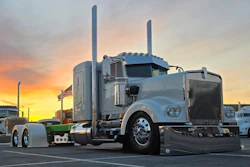
Speaking of the “No Zone” trailers I mentioned in my post from yesterday, about Con-way Truckload driver Toby Bogard’s new Semi Aware book, I encountered this one (pictured) at the Green Bay, Wis., Driver Training Center of Schneider National when I was there in June for the fleet’s 75th anniversary celebration. Dan Pearle, Schneider Director of Loss Prevention, told me to the best of his knowledge the program originated from an American Trucking Associations four-wheeler education campaign launched in the early 1990s. “It’s been all over the country,” Pearle said of the trailer. “As they age, they get pushed around to different places.” But, he added, America’s Road Team, a public outreach group of drivers, is “still talking about the No Zone.”

This post currently has no responses.

Print

Con-way Truckload driver pens ‘Semi Aware’ book for teen drivers

July 27, 2010

Toby BogardBut it’s not just for teens, Toby Bogard says. The Crossville, Tenn., resident and seven-year Con-way Truckload company driver was approached in a truckstop not so long ago by a woman whose question left him at once baffled and moving toward something of an epiphany. She asked him why, if tractor-trailer rigs have 18 wheels, they weren’t able to stop more quickly than standard automobiles.

“She wasn’t joking,” says Bogard, the author of a slim “Driver’s trip plan to success” in the book On the Big Road, published last year (check it out on Bogard’s site, where he also keeps a blog: http://www.truck-writer.com).

He explained to her the basic physics involved, and, “after that, I realized the full extent of the information that people who drive cars don’t know that I take for granted, because I drive a truck and I know how to drive around them. And that information needs to be passed on.”

He set about writing a second book, now out, called Semi Aware, which delivers helpful information about safe driving around big trucks. It’s primarily meant for “teens about to get their driver’s licenses before they get into the bad habits,” Bogard says, two of which you’ll be more than familiar with.

The cutoff: “One of the biggest things I see,” Bogard says, “is when people driving a car will zip around a big truck to suddenly jump in front of us because they’re going to miss their exit. If you jump in front us [it’s an obvious problem because] we can’t stop as quickly as you can.”

Tailgating: “Some people call it drafting [or hypermiling]– mathematically, you need to be within 13 feet of the rear bumper of the big truck to save any fuel whatsoever. The savings then is so minuscule that you might as well back off” for safety, as truck drivers can’t see a car that close to the back of the trailer, Bogard notes.

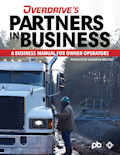
Written in a conversational style, with space left in each chapter for the studious reader to take notes, it could well make a great gift for that 15-year-old in your life. The book is available for purchase at Amazon.com. Click on the cover thumbnail image above.

But, says Bogard, “this book can be read by anybody, and the techniques in it can be applied by anybody. There are a lot of people who drive big trucks who, well, have bad habits, too.”

A firm believer in the Smith System of truck-driver education and its benefit for drivers of all types, Bogard sees Semi Aware as of a piece with public outreach efforts of carriers and trade associations (remember those “No Zone” trailers?) and others in the driver community. Ultimately, he hopes the book will fill a void in basic driver training – the lack of any formal training on how to drive safely around big trucks. “People about to be getting their driver’s licenses need to be trained — at least spend a day on it when you’re in driver education class, make it a portion of the written test. Make sure it’s covered.”

On Bogard’s YouTube channel, he’s posted several video companion pieces to Semi Aware, the latest a sort of pretrip on his bobtail.

This post currently has one response.

Print

‘Nice mouse, driver’

July 26, 2010

Whence the Class 8 mouse?The folks at Avant Garde Gifts, LLC, offer the MotorMouse, a computer mouse of wireless design and in varying colors — and that looks like a sports car, as you can see (that the Porsche 911 you recognize). As company reps have it, it might well be a “great gift” for car lovers at Christmastime or for a birthday, is “perfect for the office or at-home use, and it’s a guaranteed conversation starter.” Indeed: imagine the talk you could get into next time you whip it out with your laptop out at the truckstop counter, eh? Well, that might not exactly be a pleasant conversation, depending on who’s around.

The MotorMouse works on both Mac and PC systems, and features a trunk that actually opens — it’s where the batteries are stored. It’s available in red, silver and black.

What we want to know is whence the Class 8 mouse? It’d come with D batteries popped into the trailer, the scrolling roller like a gap reducer spanning the space between van and tractor. That would truly be avant-garde.

This post currently has no responses.

Print

From homeschooled in the cab to Harvard Law

July 23, 2010

Kerry Anderson may someday be the President of the United States. She’s got the educational pedigree, at least, having graduated from Harvard and now contemplating law school — what’s interesting about all this is that according to the feature interview NPR All Things Considered cohost Michele Norris conducted with Kerry Anderson Wednesday, Anderson is the daughter of a long-hauling mother who schooled her daughter in large part from the sleeper cab of her truck.

“A lot of our schooling actually was integrated into what she was doing,” Anderson told Norris. ”When we knew where we were going – Texas to California, for instance – we had to map out the mileage. We had to map out when we had to fuel, how fast we were going to be going, where we needed to stop, rest areas, all of that kind of thing, what our fuel mileage was going to be.”

Supplemented by a mail-in testing and schoolwork program, Anderson’s primary education might well be considered to have been in the culture of the road, where one learns how to exist in the wider world of people, writ large. She told Norris that, after two years in community college and her recruitment to Harvard, where she finished school, she missed “the total culture. It’s a different culture. You meet different kinds of people, and you get to see different kinds of you hear different stories and things like that, and I miss that. It’s a different thing you don’t get sitting in a classroom.”

Find the full story, and audio, here.

This post currently has no responses.

Print

Suvey says DOT’s happy, how ’bout you?

July 22, 2010

We couldn’t help but chuckle here at Overdrive HQ when we saw a particular press release blast from the U.S. Department of Transportation’s halls a couple weeks back now. Its title, “Latest Survey Shows DOT Employee Satisfaction on the Rise,” read to our trucking ears like a piece of news full of all manner of comic, satirical potential, given the daily discontent we hear from the trucking public about the department’s continual mucking up/messing with the hours rules, the equipment rules, the medical rules, the enforcement rules… Name any area of DOT jurisdiction and you can probably note a significant change to have come about in the last few years. Perhaps DOT’s so satisfied because they feel empowered doing their jobs to the utmost potential – they’re making a difference, things are changing. While the reasons for all the change are no doubt laudable in many cases, they’re also debatable, and some changes, well, are just not so easy to put into motion. 

At least somebody’s happy, eh? How about you? Sound off in the comments here or on Overdrive’s Facebook page… 

This post currently has no responses.

Print

A Jazzy Jordan racecar design; more from the run

July 21, 2010

Since Jasmine “Jazzy” Jordan completed her run across the United States to benefit the St. Christopher Truckers Development & Relief Fund, haulers around the nation have used the internet to send out mini-tributes to her historic effort, from posted pictures (such as the one here from Robert Curran, of Jazzy signing his flatbed) and anecdotes on blogs and more; others have custom-designed tribute slogans and placed them in various spots on their trucks and trailers.

But how about a Jazzy Jordan/St. Christopher fund-themed racecar? You can vote for the Jazzy-car design a friend of Keys Truckers Jan and James McCarter put together and entered in Toyota’s “Sponsafy Your Ride Contest.” If you like it, that is. There are more than 4,000 entries thus far to choose from, the contest a sort of big-tent “file under fun” effort by Toyota to increase connection for fans with their NASCAR brand — the car design that gets the most votes will be showcased at the Phoenix race later this year, and designers will get comp tickets and accommodations for the trip, a nice way to potentially spread the word about the the 17-year-old Minnesota native’s achievement.

McCarter reports you can vote for the “Jazzy” car design (click “view the gallery,” then search “Jazzy”) once a day through mid-August.

It looks like she’ll be at Truckers News’ Fit for the Road booth at the Great American Trucking Show Aug. 26-28, too, perhaps participating in a FFTR 5K run the 27th — if all goes well, so will I.

This post currently has no responses.

Print

U.S. Army’s self-driving truck a long way from the action

July 19, 2010

Check out the latest edition of the DTI, or Defense Technology International, journal, and you’ll get an electronic whiff of the latest experiment in a self-driving truck — this one from Lockheed Martin and steered by the company’s Convoy Active Safety Technology, or CAST, being employed on a few prototype U.S. Army Tank Automotive Research, Development and Engineering Center trucks on Ft. Hood, Texas. Like the VORAD systems on some commercial rigs on the roads today, the trucks use radar and various sensors to control themselves.

And hey, it turns out that when we’re not actually responsible for operating a vehicle moving at normal operating speeds, we can scan for roadside bombs with a 25 percent better rate of accuracy or detection — a big improvement, I’d say, but worth the $5.3 million of U.S. taxpayer monies have helped fund the project? There’s probably no better substitute/supplement than a couple good extra pairs of eyes out there — the potential to keep lives out of harm’s way, reducing risks, is what’s most exciting about it all, in the end.

In any case, automated supply convoys could be in Afghanistan’s future, to say nothing of where the tech might go in on-road situations in country. Hit the link above for more, but don’t expect to see any driver-less rig passing you on the right anytime soon. As a Wired story about the CAST technology noted, Lockheed plans to test the vehicle in live combat zones but it’s “not built for going off-road.” Might be a problem in more than a few places, no doubt.

This post currently has no responses.

Print

News flash: Owner-operator likes electronic logs

July 16, 2010

Dart Transit leased owner-operator Perry FamularoJeffersonville, Ind.-based owner-operator Perry Famularo says he ”was one of those guys who said, ‘If you make me go to electronic logs, I’m out of here.’” Leased to Dart Transit, though, he was presented with the opportunity a couple years ago to try out one of the PeopleNet eLogs units the mostly owner-operator carrier was beginning to test and offer its contractors. As Famularo tells it, “Dart asked me would I want to experiment with one. I said, ‘Well sure, I’m willing to help out.’” But going into it he also wanted to be sure of one thing, so he asked company reps, “If I don’t like it, can I give it back?”


The answer was yes, but “after about a week and a half,” Famularo says, “I told them I’d never go back to paper.”

This, coming from an owner-operator, as you may have noticed reading my May cover story in Overdrive on electronic on-board recorders for hours-of-service compliance, is not exactly common. Many view electronic logs as impositions on operational and business freedom, invasions of the privacy of the cab or worse. 


The reasons Famularo and others among the U.S. trucking public think different are multifold, not least among them the ease electronic logs – also known as “electronic onboard recorders,” or EOBRS — lends the process of maximizing hours while running legal. No longer, says Famularo, must he flag a quarter-hour every time he stops for fuel or a quick spot of coffee. “I can pump 100 gallons in four minutes or less. And when you do your post-trip inspection at the end of the day, too, it’s not a full 15-minute block anymore – now I can do it in about 7-8 minutes.”

In the end, Famularo says, it all adds up. “I find myself with almost 3 hours a week more that I can legally drive than I could under a paper system.” He pays a rental fee for use of the logging device that amounts to less than a dollar a day.

Dart Transit currently has “about 500 units” of the PeopleNet eLogs system being used by company independent contractors, representing “about 20 percent of our fleet,” says Gary Volkman, safety vice president. Famularo’s experience, furthermore, Volkman adds, is in no way an outlier among owner-operators employing electronic logs. “We’ve found a pretty high success rate with contractors using an EOBR. There’s a high degree of acceptability and it’s often sort of like, ‘Don’t take it away from me.’”


Hours documentation’s defensibility in court and in an FMCSA audit is a growing concern, too, of large freight carriers across the U.S., Volkman says, and they like EOBRs for that reason. “You don’t have all of the regulatory support documentation issues with EOBRs — whether it’s litigation or whether you’re trying to defend yourself with FMCSA.”

The concern should translate to single-unit fleets as well, as Famularo says. He doesn’t deny that, under the paper system over his long career, he’s seen a fair amount of hours fudging. ”But in today’s environment, if you’re out there and you mess up and you’re not where you’re supposed to be,” he asks, ”are those extra 120 miles worth going to prison over?”

This post currently has one response.

Print

Former trucker walloped by ‘double rainbow’

July 15, 2010

Double RainbowIt was probably only a matter of time before a driver produced one of those viral videos that tickles the funny bones of million of users worldwide — Paul Vasquez, described as a “former trucker” (according the Vasquez interview in the Merced Sun Star, he drove until about 2004, when his weight forced him off the road) who lives in the Mariposa, Calif., took the double rainbow video you’ve probably seen making its way around the net after he posted it to his Hungrybear9562 account. It’s from an encounter Vasquez had with a rainbow outside his home way back in January that, if you’ve seen the vid, had a pretty wild effect on him. Not least, it prompted questions of significance — “What does it mean?” he repeats several times throughout the three-minute clip.

For my money, it means little beyond diversion for the lot of us out here — some pretty good laughs. But what might well be funnier is the remixed musical version of the vid below, in which Vasquez’s voice is auto-tuned and set to music. Enjoy:


This post currently has no responses.

Print
  • Randall-Reilly™
  • ©2010 Overdrive Magazine