











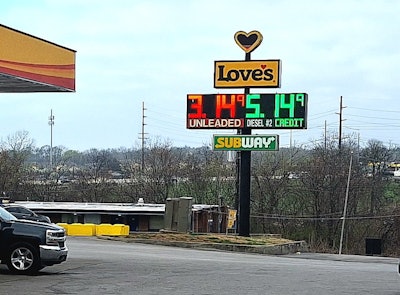
The escalation of the war in Iran continues to impact diesel prices across the U.S.
Diesel prices soared by nearly a dollar a gallon during the most recent week ending March 9, according to the Energy Information Administration’s weekly report. EIA’s national average for a gallon of on-highway diesel is up to $4.86 -- 96.2 cents higher than the prior week’s average when the Iran conflict had just begun.
The $4.86/gallon national average is the highest since the week ending Dec. 5, 2022, when the national average was $4.97. Prior to that week in 2022, prices had been above $5/gallon for much of the year since the war between Russia and Ukraine began in February.
During the most recent week, prices were up in all regions across the U.S. -- the most significant jump being observed in California, were prices increased by $1.11 per gallon.
With that increase, California remains home to the nation’s most expensive diesel by far, at $6.10/gallon -- more than a dollar higher than the next highest region.
The cheapest fuel was observed in the Rocky Mountain region at $4.40/gallon.
Prices in other regions, according to EIA:
- New England -- $4.97
- Central Atlantic -- $4.94
- Lower Atlantic -- $4.88
- Midwest -- $4.80
- Gulf Coast -- $4.63
- West Coast less California -- $5.09
ProMiles’ diesel averages during the same week jump by 49 cents to $4.24/gallon nationwide. According to the ProMiles Fuel Surcharge Index, the most expensive diesel can be found in California at $5.48/gallon, the cheapest in the Rocky Mountain region at $3.96/gallon.
How much higher could diesel go?
At this point, it’s difficult for analysts to predict. Tom Kloza, chief oil analyst at Gulf Oil, said Monday that crude has been trading between the high $90s per barrel and nearly $120/barrel on Monday.
Good news on Tuesday morning, though, was that crude oil prices were falling after President Donald Trump signaled the conflict in Iran could de-escalate soon. WTI crude was trading at around $85/barrel Tuesday morning, while Brent crude was just below $90/barrel.
Kloza noted that diesel prices are among the most volatile when oil prices surge like they have in the last week. “I’d estimate that we’ll see average truck stop prices for diesel surpass $5/gallon this week,” he said Monday.
However, the downswing Monday afternoon into Tuesday, Kloza said pressure had eased on pump prices, and $5-plus/gallon had not materialized at this point.
“Pump prices for diesel respond quickly to hikes in the global markets,” Kloza said. “At the end of February, diesel fetched a price around $3.85/gal., but by this morning the national average was $4.78/gal. Had there not been an afternoon dip [Monday], we would be looking at a $5/gal. or higher average.”
Kloza noted that while the run-up in oil and fuel prices has similarities to the first few months of the Russia-Ukraine war, “in terms of barrels impacted, this war is much more serious,” he said of the Iran conflict.
The Russia-Ukraine war disrupted up to one million barrels per day early in that conflict, but the shutdown of the Strait of Hormuz has disrupted more than 15 million barrels of crude per day, he said, along with five-to-seven million barrels per day of refined products.
Kloza observed a $4.78/gallon national average for diesel Tuesday morning, but he doesn’t expect that to be the 2026 high point. “[Diesel] is a product that can move without the consequences attached to gasoline, which is a bit of a third rail. In 2022, without nearly as much production impeded as we see now, diesel prices eventually tapped out at $5.816/gal.”
The Energy Information Administration, in its monthly Short-Term Energy Outlook released Mach 10, noted that Brent crude settled at $94 per barrel on March 9, up about 50% from the beginning of the year and the highest since September 2023. The agency forecast that the Brent crude oil price will remain above $95/barrel over the next two months, before falling below $80/barrel in the third quarter of 2026 and around $70/barrel by the end of the year.
EIA also revised its forecast for diesel’s average retail price for 2026. February’s report estimated a $3.43/gallon national average for the year, but the updated March forecast projects a $4.12/gallon national average for the year.
Dry van, reefer rates headed in wrong direction as fuel soared
Spot rates, meanwhile, backslid for dry van and reefer haulers during the week that saw increased costs pressures due to fuel.
As shown, Truckstop.com and FTR Transportation Intelligence tracked declines in reefer and dry van spot rates, but the increase in flatbed rates was enough to make up for the van declines when looking at the total spot rates picture.
The total market broker-posted rate in the Truckstop.com system increased 4.3 cents, again reaching the highest level since the final week of 2022. Total rates were close to 15% higher than in the same 2025 week -- once again the strongest prior-year comparison since March 2022.
DAT’s numbers for the last week also showed declines in dry van and reefer rates coupled with an increase in flatbed rates.
Of flatbed’s continued increase, DAT analyst Dean Croke said, “at $2.33 per mile, last week’s national average spot linehaul rate for flatbed freight was 29 cents higher year over year and 16 cents higher than Week 10 in 2018, when flatbed equipment was in high demand. Flatbed load posts were nearly 47% higher year over year.”