











What you need to know:
- Tesla Semi production will soon begin at the new Nevada Gigafactory
- First Megacharger station opens in Los Angeles, delivering 750 kW charging
- Nationwide Megacharger rollout expands along key freight corridors
- Tesla Semi specs: 325–500 mile range, three-motor 800 kW powertrain, Megawatt Charging support
Nearly nine years after its 2017 unveiling, the Tesla Semi is finally about to begin series production at the OEM's new and dedicated Semi Gigafactory in Nevada.
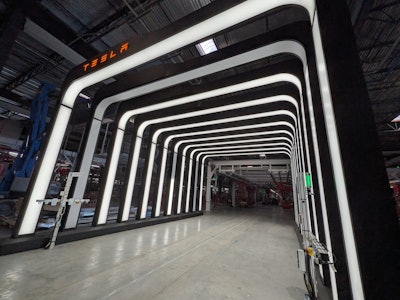
Need proof? Journalist and filmmaker Ashlee Vance (and the author of a 2015 Elon Musk biography) recently posted several photos of the completed Semi factory's assembly line on X.
These may be the best—and possibly the only—images to date showing activity inside the approximately 1.7 million-square-foot facility that broke ground in 2024.
The timing of these photos is no coincidence. In recent weeks, Tesla has released key details not only about the Semi itself, but also—just as importantly—about the charging infrastructure essential to its success.
 The Tesla Semi production floor assembly line.Ashlee Vance, via X
Tesla Semi infrastructure updates
The company launched its inaugural public Megacharger station for the Semi in Los Angeles last week, marking a major step in supporting its electric freight ecosystem. The station delivers up to 750 kW of charging power and is currently accessible to Semi operators.
Tesla also recently released nationwide maps outlining both current and planned Megacharger stations, extending beyond California to cover key freight corridors across the U.S.
[Related: Tesla's new V4 cabinet Supercharger delivers 1.2MW fast charging for the Semi]
A closer look at the rollout shows Texas leading the expansion with 19 planned locations, followed by California with 17 sites under development. This indicates a strategic distribution of chargers across major logistics hubs and high-traffic freight regions.
Two interstate corridors appear central to the initial network buildout. Interstate 5 runs along the West Coast, linking major ports and distribution centers from Southern California to the Pacific Northwest. Interstate 10 serves as a critical east–west artery, connecting the West Coast to Texas and supporting cross-regional freight movement.
Early Tesla Semi deployments have already been operating along these corridors. Fleets such as PepsiCo have put the electric Semis into service on similar routes, demonstrating the practical role of these Megacharger stations in commercial operations.
Outside of Texas and California, several other states are slated to join the next phase of expansion. Florida, Georgia, Illinois, and Washington each have four Megacharger sites planned, while New York and Nevada are scheduled for two locations each.
Additional states—including Arizona, Colorado, Utah, Oregon, Indiana, Pennsylvania, and Maryland—are slated for a single site in the near-term expansion, rounding out Tesla's growing national charging footprint.
Tesla Semi: Final specs
Last month, Tesla released the Tesla Semi final specifications. It will be offered in Standard and Long Range variants, with ranges of approximately 325 and 500 miles, respectively. Both boast a three-motor electric powertrain producing up to 800 kW and deliver energy efficiency around 1.7 kWh per mile.
The trucks support high‑power charging via Tesla's Megawatt Charging System, reaching roughly 60 percent charge in 30 minutes, and include an electric power take‑off for trailer systems. While exact battery sizes and pricing remain undisclosed, the Semi is designed for Class 8 freight operations and early deployments are already underway on major logistics corridors.
[Related: Megawatt charging explained: What it is and why it matters]
Last November, Tesla unveiled the updated Tesla Semi design, featuring several aerodynamic tweaks, interior upgrades, and tech refinements that are essential given the original design's age. Tesla aims to begin Semi series production this summer with the goal of producing around 50,000 units annually.