










In this video walk-and-talk around the new Cummins X15 diesel and get a close look at additional components in the aftertreatment system with Overdrive sister publication CCJ's editor Jason Cannon and Cummins' Kyle Richardson:
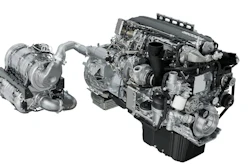
- An extra canister, with smaller diameters than prior generations, contains the diesel particulate filter (DPF) mechanism and dosers for selective catalytic reduction (SCR) to meet new NOx-reduction targets.
- An emissions-dedicated 48-volt alternator delivers power to electric heaters in the exhaust plumbing.
- Those new heaters are located ahead of the diesel oxidation catalyst (DOC) and SCR, allowing broader utilization of the SCR.
- A new breather added to the engine to capture blow-by -- with no new filter or maintenance requirements -- pulls out the oil from blow-by and putting gas back in the intake of the turbo.
[Related: Cummins showcases its 2027 X15 diesel engine]
On the engine itself, Cummins cut about 150 pounds from the previous '90s-era design, but that's mostly offset by new additions to the aftertreatment system to meet the Environmental Protection Agency's 2027 NOx-reduction requirements. The new design, Richardson said, provides "better cooling, better efficiency."
 Cummins Product Manager Kyle Richardson walks through the changes coming to the X15 with the 2027 model year.
"What we've tried to do is maintain the current architecture as much as possible... while bringing in goodies like fuel efficiency and weight reduction," Richardson said.
The new X15, otherwise, isn't that dissimilar from the current-gen X15 with the Variable Geometry Turbocharger (VGT) mostly untouched, similar fuel injectors and high-pressure common rail fuel system.
"The bolt-ons and the way that we're doing our combustion recipe, the way that we are operating the engine are very, very similar to today," he added. "We like what we've developed as far as reliability, and we're trying to carry that forward on some of the base components."
 With the new engine, Cummins is seeing up to 3% improvement in fuel efficiency over the current-gen X15, though idling with the new X15 will burn more fuel than the current model.
Performance-wise, the 2027 X15 ranges in horsepower from 420-605 hp, and up to 2,050 lb.-ft. of torque.
Kyle Richardson: So with the new engine, we are seeing up to 3% fuel efficiency improvement. One thing that I would like to mention is fleets that see a lot of idle time may not see as great a numbers, as now that we've got to get more emissions out of the idle, we are going to burn a little bit more fuel at idle.
Jason Cannon: Hey everybody. CCJ Editor Jason Cannon here and star of this video is this red beauty behind me. It's the Cummins X15, the second engine released on Cummins' updated HELM platform. We can't talk about the engine first, because the first thing we need to talk about is the aftertreatment system, because all of this engine's changes... Well, maybe not all the changes, but a significant number of the changes that take place on this engine sort of start with what's going on in the aftertreatment system. To keep up with all the news, 2027 regulations, everything about trucks and everything about engines, check out ccjdigital.com.
Kyle Richardson: So to start the story, let me set the stage a bit. Why is this new engine so important and why are we talking about new engines so much here at ACT Expo? It's because 2027 emissions is right around the corner for us. 2027 has a NOx regulation that's coming in and reducing cycle NOx 83%, as well as reducing the idle NOx limit by two thirds, so from 30g per hour down to 10. This has required us to change the way the engine's operating and obviously get tailpipe NOx down.
To tell the story, I'm going to start in the rear there where NOx comes out and how we treat it. And then I'm going to work toward the engine and what we've done on the engine side. Since 2017, we've had what we've called the single module aftertreatment. It's actually visible here. We haven't changed too much when it comes to the after treatment.
So, in today's truck you've got a DOC, DPF and mixing body where DEF is injected and then an SCR catalyst to improve upon the amount of NOx reduction that we're doing. We've had to add some catalyst that that made the single module too long. So what we've done is we've just moved that SCR catalyst underneath, and it looks a little different.
We've packaged it as two side by side, smaller diameter catalysts to lower back pressure. Think breathing through two straws instead of one, right? So that that's simply moved here. No sensor changes. No other way that the aftertreatment operates to that point. The second reason we broke it into two was then to provide some heat. So, these elbows here house essentially what is a grid heater. Power in, power out. Not a smart device. It's just a resistive heater. Think toaster, hairdryer, right? We put current across it and it creates heat. We have one before the SCR and one before the DOC. And really what this does for us is just allows us to utilize the SCR in a broader range of the duty cycle. So think when you key on in the morning, you're going out to your car, you get smells like hydrocarbon because your catalyst isn't warm, right? Same thing happens here when we turn on the engine. In today's engine, thermal management is done on the engine. It's got to run inefficiently to try to heat the catalyst in order for the catalyst to start working. Now, the engine can most effectively heat it by just turning an alternator, which powers these two heaters and puts heat directly into the aftertreatment, allowing us to start NOx conversion in that window where we normally couldn't.
And this is really what's allowed us to keep most of the operating the same on the after treatment. When you talk sensor hardware, fault codes, what the service techs are used to. Same DOC, DPF, all very familiar, same maintenance intervals, DEF usage, we might creep up a little bit, but we're generally in the same ballpark as far as our percent DEF usage to fuel usage.
And so I wanted to kind of demystify it looks a little bit different. Definitely takes up a little bit more space. But in general what we've tried to do is maintain the current architecture as much as possible.
And to help offset some of the weight that we've added here, I'm going to go over to the engine and tell you a little bit about what we did with the engine to bring in some goodies like fuel efficiency and weight reduction.
Standing next to the X15 engine, new for 2027. So we do have a new base engine design. So what does that mean? The current product that folks are buying today was originally designed in the '90s. Block and head design cast in the '90s using the latest and greatest manufacturing advancements at the time. This engine has now been designed in the last decade and helped us kind of move forward as far as what we're able to do with efficiency and base engine design.
What you'll notice is the sculpted block, and using computer analytical design that allows us to do full 3D analysis of all of the coolant passages, all of the oil passages, and rely on advanced casting techniques to actually cast in exactly the passage we need, we've been able to reduce the parasitics of moving those fluids through the block. At the same time, we've created a block that is stiffer by identifying exactly where we need to put material, and this has allowed us to take 150 pounds, roughly, of gray iron out of the block compared to its predecessor, while getting better cooling, better efficiency and that weight reduction.
So what did we do with the weight reduction? I've already talked about the aftertreatment and where we've added some SCR and some heaters. Obviously that takes some additional weight compared to today's. We've also added an alternator then to power that those heaters. And we like to say dedicated alternator. I know there's lots of folks that see these electrons for all kinds of auxiliaries and would like to use them, but it is dedicated to the after treatment heat. It's inside the emissions boundary as an emissionized component, subject to the emissions useful life and emissions warranty that comes with vehicles. And so we're being very protective over it at this time. So that is on its own belt plane. It sits here on the engine. It is water cooled. Some of our other products you'll see have an air cooled version. The X15 has a water cooled version.
The other thing that service techs will notice immediately is the gear train has moved to the rear. So we have a rear gear train. Now this has allowed us to cast in the gear housing with the block. We've eliminated that seal there. It's all one piece and that helps stiffen the block as well. Block stiffness is what gives us that rigidity for liner retention and ensuring that the engine's durability for long term is there.
Outside of that, what we've done is tried to take the best of the best from the current product and move it forward, so you'll see all type of familiar technology on the VGT turbo has had some minor change for efficiency, but otherwise untouched.
The injectors and the high pressure common rail fuel system is very similar to what we have today. Some of the position of some of the components, like the air compressors, followed the gear train to the rear of the engine, but otherwise the bolt-ons and the way that we're doing our combustion recipe, the way that we are operating the engine are very, very similar to today. We like what we've developed as far as reliability, and we're trying to carry that forward on some of the base components.
One other emissionized component that we've added on engine is the breather. So this is something that you'll see common in the industry. We now need to capture that blow-by. It's not a new filter. There's no new maintenance that comes with it. It's an actor of centrifuge, electrically driven, and that allows us to to pull out the oil from blow-by and put the gas back into the intake of the turbo and ensure that we're treating all potential emissions leaks. As I mentioned, we still have our variable geometry turbo.
We still have cooled EGR similar to how we have today. The shape of the EGR cooler is a little bit different between the Performance Series and the Efficiency Series. So depending on what image you've seen, I know that's been called out to me recently. And then the other thing that I'd like to mention on the maintenance side is the move to the canister style filters. So now instead of throwing away an entire oil filter with the steel can every single time you change the oil, you're able to remove the media, put new media in, screw that filter back on, and we're really excited to be able to be a little bit more sustainable and not having to throw away steel every time we do an oil change.
Jason Cannon: Kyle, I know a lot of times when we talk about taking down emissions, fuel economy goes with it. But that's not the case with this engine, right? So what's what's the comp for the prior generation X15 versus the coming generation X15?
Kyle Richardson: Sure. It's a great question. So with the new engine we are seeing up to 3% fuel efficiency improvement on the previous gen. That's done through the base engine and higher compression ratio. One thing that I would like to mention is fleets that see a lot of idle time may not see as great a numbers, as now that we've got to get more emissions out of that idle, we are going to burn a little bit more fuel at idle.
Jason Cannon: You mentioned the word performance, and we can't talk about performance without a couple of key indicators. That's horsepower and torque. So what are my ratings looking like?
Kyle Richardson: Yeah, so we've attempted to maintain all the ratings. We did lose one on the low end. So we've moved from 400 to 420 on the low end. However we have the full range all the way up to 605, 2,050 ft.-lb. for the heavy-haul guys.
Jason Cannon: Kyle, you mentioned maintenance intervals a second ago. So let's talk about that here. We've still got engine oil. We still have filters. There's lots of things that still have to happen here. So what are those intervals look like from this coming generation to the generations prior?
Kyle Richardson: Yeah, so depending on where you're coming from 2017, 2021, we've been making advancements all along the way. And generally our longest ODI is go up to 75,000 miles. And in fact, Valvoline just announced a potential 100,000 mile oil change interval on their most premium oil they're just now releasing, it is going to be approved on the X15. So there's always work on going to continue to stretch those, and especially on DPF maintenance, as well. What we've done in the last 10 years and that well beyond 500,000 miles, as much as 800,000 miles on DPF ash interval changes.
Those are the things that folks now are expecting from the latest generation and what what they'll get with the with the new one as well.
Jason, I just want to thank you and CCJ for coming to the booth and spending time with us today here at ACT, and we've been really happy with the show and appreciate you all for coming by.