










Trucking news and briefs for Friday, Nov. 13, 2026:
- Fleets commit to hiring 13K veterans.
- Bill to guarantee bathroom access for truckers gets late push.
- U.S. highways getting statistically safer.
FMCSA touts ‘Freedom Haulers’ progress
Earlier this year, the Federal Motor Carrier Safety Administration launched a program it called “Freedom Haulers” to expedite the CDL credentialing process for military veterans with experience driving heavy trucks during their service.
The goal of the effort is twofold: Helping veterans transition to a civilian career and bringing quality drivers into the industry.
As part of the program, FMCSA expanded its Even Exchange program from one year to two years, which allows veterans to bypass both written and driving exams to fast-track the CDL licensing process. It also allows the GI Bill to cover 100% of CDL tuition at State Approving Agency-approved schools.
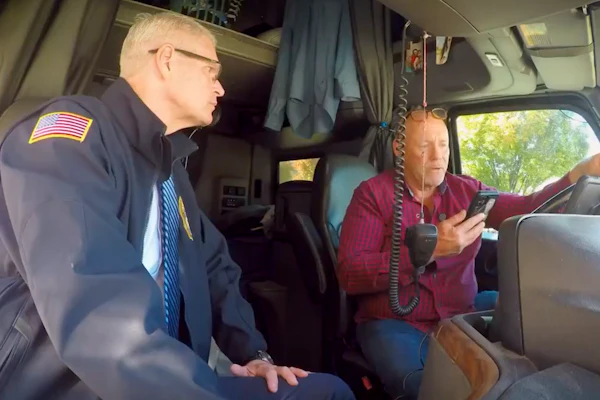
 During a Veterans Day program Wednesday, Nov. 11, on the National Mall, Transportation Secretary Sean Duffy and FMCSA Administrator Derek Barrs highlighted the success of the program.U.S. DOT
Since it was announced in June:
- FMCSA is investing $3.5 million in training providers in 21 states to expand services training programs for veterans.
- 12 trucking companies are committing to hiring more than 13,000 veterans with help from the Department of Labor.
- Nearly 400 veterans have already used their GI bill to obtain benefits thanks to the Department of Veterans Affairs.
“There is no better way for FMCSA and the Department to express their gratitude to our nation’s veterans than through Freedom Haulers,” said Barrs. “We’re proud to continue supporting the brave men and women who have fought to defend our freedoms as they begin the new mission of keeping our supply chains secure and resilient.”
[Related: DOT's 'Freedom Haulers' program fast-tracking CDLs for veterans]
Truckers’ bathroom-access bill intro’d in Senate
Even as the current Congressional session winds down, truck drivers are still garnering attention in Washington, D.C., as bipartisan legislation to improve drivers’ access to bathrooms at shippers and receivers was introduced this week in the Senate.
Companion legislation came to the U.S. House early this Congressional session back in early 2025. It was referred to the House Subcommittee on Highways and Transit, but no other action has been taken.
This week, U.S. Sens. Lisa Blunt Rochester (D-Delaware) and Deb Fischer (R-Nebraska) introduced the Senate version of the "Trucker Bathroom Access Act."
If passed, the bill would not require shippers and receivers to construct new bathroom facilities, but it would require that truckers have the same access if a business has a bathroom available to their customers or employees.
“America’s truck drivers are vital to keep our country moving forward,” said Sen. Blunt Rochester. “Increasingly, more women are filling these critical jobs, and they should feel confident their basic needs will be met. I’m proud to partner with Senator Fischer to break down barriers for men and women in the trucking community and continue efforts to sustain and support our economy.”
The legislation has broad support from trucking groups, including from the Owner-Operator Independent Drivers Association, American Trucking Associations, Women in Trucking and others.
“Over 70% of America’s freight is exclusively carried by trucks, yet every single day men and women truck drivers are forced to ‘hold it’ because they aren’t allowed access to the restroom when picking up or delivering freight,” said OOIDA President Todd Spencer. “OOIDA and truckers across America thank Senator Blunt Rochester and Senator Fischer for showing tremendous leadership on this issue and we look forward to working with them and our coalition partners to get this commonsense, bipartisan legislation signed into law.”
If action is not taken on the legislation before the 120th U.S. Congress convenes on Jan. 3, 2027, it will need to be reintroduced in the new legislative session.
[Related: In-cab showers for the masses? Be Camper Sleeper's drive to deliver]
Traffic fatalities continued to trend down in Q2
As partly reported yesterday with news of DOT's investment in roadside blood transfusions for crash victims, traffic fatalities in the United States during the first half of the year continued to fall, according to estimates from the National Highway Traffic Safety Administration.
Earlier this year, NHTSA reported that total traffic fatalities on U.S. roadways fell 4.3% in 2024 and estimated that 2025 saw an additional 6.7% decline from the year prior.
In its estimate for the first half of 2026, NHTSA reported another 2.5% drop compared to the same period a year ago to what would be the second-lowest half-year fatality rate in U.S. history if the estimates hold, the agency said. Crash fatalities fell to an estimated 16,750 from January through June 2026, down from 17,175 during the first half of 2025.
“We’ve made progress on road safety, but the Trump Administration isn’t letting up,” said NHTSA Administrator Jonathan Morrison. “Even with near-record low fatality rates, we will continue to work with a sense of urgency to make sure more Americans get home safely. Through our Pathways to Safer Streets initiative, we are tackling the leading causes of traffic deaths -- from reckless driving to impaired driving -- while funding critical lifesaving measures like prehospital blood programs.”
The estimated decline in fatalities occurred even as vehicle miles traveled increased by 0.8% during the first half of 2026. As a result, the fatality rate fell to a near-record low of 1.02 fatalities per 100 million miles traveled, down from the estimated rate of 1.05 from the same period in 2025.
Fatalities in Q2 2026 decreased by 0.2%. NHTSA’s statistics show traffic fatalities have declined for 17 straight quarters through Q2 2026, dating back to Q2 2022.
In total, 35 states and Puerto Rico are projected to have had fatality decreases during the first half of 2026. Regionally, eight of 10 regions saw fatality decreases in the first half of 2026 compared to the first half of 2025.
NHTSA’s report of first-half statistics does not differentiate by vehicle type, so it’s unclear how truck-involved crashes are trending. The most recent truck-related statistics were released earlier this summer, highlighting numbers from 2024, which showed a 2.5% decline in fatalities in crashes involving large trucks compared to 2023.
[Related: New truck crash stats show safety improved, even with more non-domiciled CDL drivers]