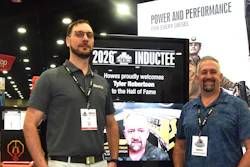













 Owner-operator Joel Boelman of the Trucking Solutions Group emphasized overlooked-maintenance items as part of a panel discussion at the 2026 Mid-America Trucking Show. Flanking Boelman, other TSG member owner-operators, from right: Hec Hiltabrand, Mark Heggestad, Henry Albert, and Shane Rizzuto. Overdrive's Todd Dills, to Boelman's left, helped moderate.Michelle Hiltabrand
Any successful owner-operator keeps truck and trailer maintenance top of mind during the course of operations. Yet even for the most disciplined, areas get overlooked.
At the Mid-America Trucking Show late last month, a group of seasoned owner-operators who make up part of the membership of the Trucking Solutions Group (TSG) hosted a panel discussion featuring overlooked maintenance items, and fielding questions from show attendees.
The discussion played out mostly with involvement of the audience, yet Overdrive’s own Todd Dills helped moderate.
One oft-overlooked item: for post-2010 emissions trucks, the diesel exhaust fluid (DEF) filter, noted TSG member Hec Hiltabrand. The filter comes with a recommended change interval from the manufacturer -- in Hiltabrand’s case with a 2022 Volvo, that’s 150,000 miles or once a year.
“It’s a simple filter at the bottom of your DEF tank,” Hiltabrand said. “It’s in line after the pump, so it’s easy to change, and they’re cheap, but a lot of people overlook them.”
Let it go too long and your truck throws a fault code pointing to a DEF problem.
“You’re going into the dealer trying to figure out what it is, and they just change the filter out,” Hiltabrand said. Change it yourself and “it saves you a bunch of money,” considering shop labor rates at $150-$175 an hour, “plus whatever they’re going to charge you to diagnose the truck.”
TSG members highlighted the importance of keeping track of when you do any type of maintenance to your trucks and trailers. Mark Heggestad noted that he and his wife are in the process of growing their fleet. Their ELD provider’s tracking capabilities have been invaluable for keeping track of trailer miles in particular.
Tracking devices installed on all equipment means "we’re now starting to keep better records on when did we lube it, when did we change tires, what brand of tires are we running, all sorts of different things like that,” Heggestad said. “Slack adjusters, brake systems. Same way on the truck, same way on your oil changes.”
Other operators might use a different system -- an Excel spreadsheet, ELD software tools, even something as simple as a whiteboard in the shop -- to track anything and everything business-related, maintenance or otherwise.
When longtime owner-operator and TSG member Henry Albert was running a fleet, he said, keeping track of trailer maintenance “was my hardest thing."
The cure? Simply recording the work exactly when it was done. "Write it down then," not later, he said. Before he got diligent about it, he added, "later just seemed to not happen.”
[Related: Owner-operators adapt conservative approach to ever-expanding diesel oil-change intervals]
Tire pressure, hub oil: Close monitoring yields dividends
Owner-operator Albert advocated for installing a tire pressure monitoring system (TPMS) on both trucks and trailers. Compared to the cost of tires and fuel, they're "cheap,” he said. “I have one that checks my truck and trailer, and one of the things I automatically do when I’m getting up and I’m getting dressed in the morning” is check the system.
Its display sits “up on the dash," he added. "I at least know before I even begin my pre-trip that they’re all holding air and everything’s good.”
For Albert, a TPMS “is just like having mirrors on the truck” in terms of importance. On his way to MATS, driving out of Baltimore, Albert’s TPMS alarm went off. He keeps a plug kit in the truck, so he was able to fix the leak before the problem left him with a service call.
He could get to a tire repair shop on his own time, saving those costs.
“Tire monitors, to me, as far as helping you with your maintenance and your day, that’s just such a great investment,” Albert added.
Hiltabrand had just bought a TPMS for about the cost of a single tire, he said. So: one tire saved by the system and it more than pays for itself when considering other blowout damage to mudflaps, hangers and other parts.
The roadside repair can be a killer.
Running without a TPMS, TSG member Joel Boelman noted he'd recently spent “$1,300 just to have the tire replaced” by roadside repair. “And on top of that, the half fender, the FlowBelow system and everything else, and the time of doing that. So, a tire pressure monitor system would have been a third of the cost of what I ended up paying.”
Boelman stressed, too, the importance of checking and changing the hub oil in oil-bath hubs. It's practice he’s been “very bad about” in history, yet stressed the importance of that visual inspection that there is indeed oil in the hub, and that the hole in the center is open to ensure the pressure is able to release.
That pressure is “gonna go somewhere. If it’s not going out that little hole, it’s pushing out the wheel seal,” he said. “That’s one area that I am guilty of not checking often enough.”
Hiltabrand stressed that monitoring hub oil and changing when appropriate yields dividends that can extend beyond the obvious. “If you’re changing it, you’re keeping it clean,” he said, but making sure hub oil is there and clean could also help with fuel economy.
“If you’re running low on that," he added, "that stuff’s getting extra hot where it shouldn’t be, and it’s gonna cost you money and time.”
[Related: Preventing dramatic wheel-off incidents like this one could get a lot easier]
Other oft-overlooked maintenance
 The discussion at MATS touched on nearly all of the items shown here, derived from each panelists' real-world recognition of mistakes made, corrective action identified and executed. Catch the full discussion in the video from MATS at bottom.
Current TSG chair Shane Rizzuto noted how easy it is to overlook the cabin air filter. “It’s pulling the air from the outside, so all those allergens get caught in the cabin air filter,” he said. “It needs to be changed. It gets dirty. Your airflow from the venting system gets diminished, and it starts freezing up.”
Some truck models’ cabin filters are easier to get to than others, he said, but it’s definitely an item to keep in mind.
Rizzuto pulls enclosed car-haul trailers -- where multiple trailer doors means keeping locks lubricated to prevent rust and corrosion, prolonging life. He uses a product called Fluid Film to repel water, preventing downtime with a lock seizing and having cargo stuck in the trailer.
“It’s a simple thing," he said, "but it’s going to save you time and money.”
Boelman added that “a lot of people forget to lubricate your kingpin and your jaw mechanism with the fifth wheel.”
Owner-operator Albert noted he's used motorcycle chain wax to lubricate those parts, as well as to grease his fifth wheel -- before he went to a greaseless variant.
Boelman now runs a Teflon plate on top of his fifth wheel and “every probably two weeks, or at least once a month, I take Dawn dish soap and put it on there like everybody does a grease gun,” he said. “It just helps clean it up. And Dawn dish soap is a good lubricant, also, and it keeps it nice and clean.”
A whole host of other topics were touched on in the session -- catch it in full in the MATS video below: