











Adam Mackey's first year trucking with authority was a trial by fire.
He'd cashed out quite a bit of his 401(k) from prior company work to buy the truck -- he "didn't want that truck payment" hanging over his head, as he put it.
He and his wife were living RV-style in a school bus, and three months in, he "had all kinds of problems" with the used-purchased 2007 Freightliner Columbia, powered by a Cat C13 that cracked a head, Mackey said. "We had to sell the school bus, and I had a Mustang that I sold. We sold all this stuff just to cover the expenses."
It was a tough time, the newly-minted owner-operator attempting to follow the example of a mentor and running freight utilizing load boards for the connections. It got so bad at one point he "was down to like $200 with the business," he said.
If something didn't change, he thought to himself, "I don't know if I'm going make it."
But change it did -- with no small amount of effort on owner-operator Mackey's part.
Adam Mackey transformed his approach with complete diligence with respect to cost control and tracking, and that mentor and friend, fellow independent Dynasty Transportation owner-operator Felix Igbeka, in fact sees Mackey today as his own shining example of just how to run a one-truck business.
 Owner-operator Adam Mackey
Yet Mackey, after that first rough year, re-focused his operation closer to home, taking his backhaul with him often enough on short loads that paid exceptionally well, booked through brokers with whom he put in time and effort to build relationships, who'd come to rely on his service.
"He might go to Kansas City and do that early and return back the same day," Igbeka said. "Deadhead back. I was like, 'Are you really making money doing that?'"
"I don’t need to make all these thousands a day" in revenue, Igbeka said Mackey told him. "I keep my debt down, pay my bills."
By then he had meticulously-kept records to prove that, yes, he was making plenty money above and beyond expenses, today with loads that average above $4/mile outbound from the Oklahoma City area typically, $2-$3/mile back if loaded, Mackey said.
"I don’t know anyone like him when it comes to that," Igbeka said. "He’s on-point with the record-keeping. He’s definitely Trucker of the Year in my opinion -- one of the last of a dying breed, for sure. He definitely deserves it."
Owner-operator Adam Mackey, now with more than seven years of authority as Mosermackey Trucking behind him, is Overdrive's Trucker of the Month for February, putting him in the running for the 2026 Trucker of the Year award.
 Overdrive's 2026 Trucker of the Year competition recognizes business acumen and unique or time-honored recipes for success among owner-operators. Nominations are open for exceptional owners, whether leased or independent (up to three trucks). Enter your own or another owner-operator business you admire via the links.
Documenting the journey to owner-operated success
 Mackey's '07 Freightliner Columbia, hooked to a hopper. Note the "square stacks" the owner-operator engineered himself after realizing how much (roughtly $3K) a shiny kit was going to cost him. More detail in this brief Youtube explanation of just what all he used for them.
Mackey's shared his journey with owner-operator peers increasingly through the recent years via his "Aftersolo" Youtube channel, where he's documented not only numerous modifications to the Columbia -- including those unique stacks -- but a different sort of buildout recently completed.
He and his wife, Rebecca, switched office spaces in their Mustang, Oklahoma, home, essentially, as he explains in the video. He details mods to the cabinets with dry-erase boards for maintenance-interval and other reminders accessed simply by opening the cabinet doors.
Rebecca didn't want to have to look at minder boards day-in, day-out in what was a shared space in their house. "So I said, 'well, I'll make a case for it so I can cover them up,'" Mackey said. "It's one of the things that takes a little time to put it all together. But once it's put together, it's really easy to keep up on everything with it."
He's got short- and longer-term intervals for various maintenance items for both the Columbia and a 2005 Utility flatbed on one side of it, covering nearly the entire backside of one of the cabinet doors, as shown in part below:  From top to bottom, items are ordered by length of the interval and with last-service/needed-service odometer-miles notations. Mackey subscribes to a numbers approach Overdrive contributor Gary Buchs dubs touching the numbers of your business for real engagement on costs, revenues and profits. With respect to the schedule minder here, he noted, "it's definitely handy. I don't like keeping things on my phone" and relying so much on a notification, on the phone itself. "I like seeing things," having that physical representation of it.
"When I first started" as an owner-operator with authority, he said, "I was used to just getting a guaranteed paycheck every week, and you didn't really have to worry about that kind of stuff."
After the early rough period, he doubled down on "keeping track of everything and making sure I know where my money's going and making sure I'm doing enough work every week" to well more than offset the cost, he said. "It's a lot. It made me way more organized and more meticulous with everything."
[Related: Staying young, learning more: Alan Kitzhaber is Trucker of the Year]
The Columbia's Caterpillar motor he calls something of an "oddball" at 430 horsepower, paired with a 10-speed manual and 3.42 rears. "I'm not doing anything over 80,000 with it," he said, "but it does the job."
He purchased the unit in 2018, not longer after it had been repowered by the prior owner, headquartered in Kansas City, Missouri. He's since put roughly 500K miles on the odometer, sitting today at 1.35M total.
He's not after big miles, though, as suggested by owner-operator Igbeka -- Mackey guesses he's averaged "70,000 miles a year" in recent years, though it varies. "If I can keep the miles off of it, I get more life out of it."
He's focused on that long run with maintenance, that's sure, and has enough mechanical ability to do most repairs (but for engine work) on his own, documenting them and feeding it all into his Youtube channel with a video. Doing maintenance research early on, Mackey initially found it tough to locate information on particular jobs for his model and spec, and today often enough "I refer back to my own videos when I’m working on something" as a refresher.
He's learned a great deal with engagement from the community of more than 40K subscribers he's built on Youtube. "I've learned a lot from the comments there," he said. "Better ways to do things."
 Adam Mackey and his wife, Rebecca, shown here with the truck at home. She's supportive and involved in the business, Adam said, particularly for consult on "any major decisions. ... She really helps me out a lot," including meals prepped and packed for trips where he knows he'll be out for two-three days. "She’ll pick me up when I need to be picked up" from the service station where he parks the truck and trailer with agreement of the property owners (and monthly rent). Rebecca even "helps out with something on the truck" time to time, "gets some grease on her hands."
In 2022 a fellow Mustang, Oklahoma, resident, Darrel Martin, happened upon Mackey's Columbia and flatbed parked out at the service station he utilizes for parking when he's home. "I left a card on his windshield, and he called me," Martin said.
He's the owner of Silver Moon Energy Services, a brokerage he founded roughly six years ago. Mackey today "works for me nonstop," Martin said, running a little bit of everything in an operation Martin describes as a "direct customer kind of broker. Adam's great at that," serving those customers like his own. "He's educated, does things right and doesn't cut corners."
Martin gives him customers' phone numbers, names, and contacts for better, more direct communication and Mackey just "does a really great job for me. He's got good equipment, a good truck, good trailer."
Likewise: "Plenty good damn common sense," Martin said, sometimes in short supply in this day and age.
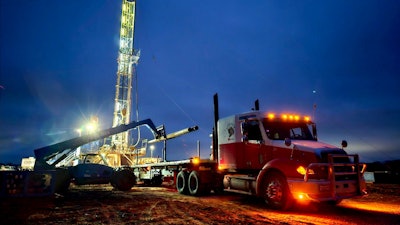
The photo at the very top of this story shows delivery of a commodity that accounts for roughly 75% of the work Mosermackey Trucking does these days, in Mackey's estimation.
"Mainly what I haul is that oilfield pipe," he said, for Martin, generally staying within a 500-mile radius of home. Very occasionally he might catch a run out to Denver or up to the North Dakota oil fields.
He's a go-to service provider for Martin, in more ways than one. "At times he’s been able to help customers out assisting with loading," Martin said, not that he's demanding or even prefers that by any means. "He's very mechanically inclined, and I’ve had him help people fix their forklifts. He really goes above and beyond. If he ever has issues or a problem, he calls me."
 The Columbia was "bone stock when I got it," Mackey noted. He "put on the bumper, headache rack, stacks, and the camera system." The Falcon Eye Electronics cam array contains eight different cams and a 10-inch in-cab screen. Three face forward, one on each mirror faces back along the sides and two "way up high face back. There's one on the back of the trailer," helpful in tight spots. "It's one of the best investments I’ve made."
Modest start to mastery
Adam Mackey didn't set out to truck with his own authority when he got his CDL almost 20 years ago now.
"I never really rode in or drove" big Class 8 trucks growing up on a small farm, he said, rather "two-ton trucks -- older trucks with four-speeds in them."
He'd see big units out at the farm every now and then, though, and in 2006 he started to get interested in trucking as an equipment operator. The company he worked for essentially would "let you run anything," he said, occasionally involving a water truck or a dump truck. "They'd just tell you get in the truck and figure out stuff."
An OTR operator occasionally delivered equipment to the operation on a lowboy. "He seemed like he was doing pretty well" for himself, Mackey said. The big economic crash in 2009 rolled around, and the company started laying off all manner of people without a lot of hours to go around. Mackey enrolled in the CDL program at Central Tech in Drumright, Oklahoma -- tuition, room and board all paid for by unemployment.
The monthlong program finished, ultimately, he got hired on and drove OTR for seven or eight months. "I was sitting at the docks more than anything," he said, and "wasn’t making a lot of money, gone from home all the time," with just a day a week off.
It wasn't for him. His next gig wasn't much to his liking, either, with a carrier local to him in Oklahoma City delivering freight with little pup trailers and 48-footers with liftgates. "A lot of the work there" was actually "at the dock" itself, with strenuous loading and unloading.
He saw many fellow driver come and go in his brief time there. "Most would be there about a year and move on," Mackey said.
A lot of them migrated to Old Dominion Freight Line -- famous in the area for no dock work to speak of. There, Mackey found a reliable spot for much of the decade prior to COVID in 2020. "It was a good company to work for," he said.
It was there he met Felix Igbeka, who actually came to work for Old Dominion originally on Mackey's example, as Igbeka told it. Igbeka recalled he was working for what was then Con-way Freight and, "out and about I saw his Old Dominion truck. I just went to ask him a question about Old Dominion," and "like literally the next day I went to talk to the terminal manager and told them I talked to Adam."
The pair were fellow drivers out of that terminal for the next two and a half years before Igbeka bought a truck and went out on his own.
Adam Mackey drove for the company for years longer, yet always held in the back of his mind just what else might be possible. He had an example in owner-operator Igbeka, who by 2018 was benefiting from an uptick in spot market rates that relatively solid year post-ELD mandate.
Mackey made his own move, but what he found utilizing load boards, more or less as Igbeka was doing at the time, penciled out less than desirable, that's sure, as that rough first-year experience attests.
Igbeka was a huge help with flatbed securement and other aspects of the platform niche. "All I’d done was vans and pups" at Old Dominion, Mackey said, with no flatbed experience to speak of.
He still utilizes load boards accounts -- mostly Truckstop.com, and DAT he calls "pretty good for power only" -- yet recognizes how hard it can be to "find good-paying loads on there. Soon as the load pops up you have to really move," too. Yet "I make do with it. It still accounts for quite a bit of my income."
[Related: Master negotiation's fine art to stop settling for low rates]
He's to the point now, though, that at a quick glance at the broker on the boards he knows "who the good ones are," he said. A few he's worked with in the past, too, "will call me out of the blue."
It's where you want to be if you're relying on spot freight to some sizable measure, as those in the load-board business have long known and shared in many cases: The best-paying freight never sees the load board.
Rather, brokers cover it via their trusted carriers.
Mackey tries to take a similar approach with them when he must, and if he does venture into the Wild West of the board with an unfamiliar broker, he always checks their credit with his factoring company -- the former TBS Factoring, now part of Love's factoring arm.
Lately, 42-year-old Adam Mackey's translated his meticulous, regular approach to longer-term health and building a retirement nest egg, setting aside a regular amount weekly in an IRA and utilizing a home gym for routine workouts "every other day," he said.
He and Rebecca invested in the equipment for the gym roughly six months ago. He calls it a "good investment."
Owner-operator Igbeka credits Mackey's example with the big shift in his own business, away from 100% spot freight to where he is today, hauling in a 1998 Freightliner FLD "a mixture of power only and flatbed," he said. "I do try to be at home a good bit more," with a "couple of contracts with Amazon, out-and-back roundtrip, two-day-type situations."
He might be out on the road two nights a week.
"He didn’t think it could be done, but I guess I proved him wrong on that," Mackey said, re-emphasizing one of the key things he's learned throughout his burgeoning career in business.
"The big part is maintaining relationships with people," he said. "He might be home more than I am now," he added of Igbeka.
Business has been good for the past year -- "this last year was one of my best," he said, though not to the level of post-COVID 2021, he noted. Business "seems to have leveled out," in any case, as he strives to maintain, to keep bringing in profits.
[Related: 'Determination and perseverance' keep Top Notch Transport in the black]