










You call the broker, hoping to book the load. The phone is ringing. You're practicing in your head how you'll answer what you're hoping to hear: What good timing! I really need you to haul this load ASAP!
All too often, though, the call takes a different turn, and there are a few more things you have to do to convince the broker you are who you say you are, or maybe worse: The rate we posted was not exactly right.
Dreams of the perfect load, the money you expected to make, hours of service and fuel stop planning: All are in limbo. Now what? The broker’s got you destabilized, and it feels like you have to act fast to accept the offer, and hope it works out -- or just sit and lose more time.
Time is money, of course, as your fixed costs never stop accruing.
[Related: Keen fixed, variable cost understanding key to long-term owner-operator success]
But there is a third way, and it's called negotiation. It's an uncomfortable task made even more so by the speed with which information flows from party to party in our world. The business, the very lifestyle of trucking is grueling enough without having to think about haggling over the next load.
You can extend that same logic to purchases big (a new truck, trailer) and small (the price of a full PM inspection added to an oil change, say).
Too many owner-operators succumb to the pressure to accept the first offer because they feel they just can’t turn it down, there's always going to be somebody around the next corner willing to take it. Yet you do have a choice, and turning down the offer in the right circumstances might well be your best negotiation tactic, an opportunity to open up a conversation directed toward good-faith understanding of both parties' needs.
Truckers need loads -- we need that revenue. Shippers need their loads moved. Are we so conditioned from seeing the advertised prices for everything in our lives that, when looking at a load board, our thoughts automatically interpret what we see as gospel? Or do we feel like if that rate is going to move, it’s not in the direction we want it to -- that is, up.
Be conscious of that way of thinking. Stay on high alert for what’s happening as you stare at all those rates.
In this piece of the Partners in Business playbook, find tactics to help you in what should be your goal in advance of any load negotiation. That is, move your eyes from the posted price and examine the load’s details.
Strive to know the answer to this question: If the offer rate wasn’t posted right there with the details, what rate would you assign to the load?
[Related: Take the wheel of Overdrive's Load Profit Analyzer]
The hard work that comes first: Focus on cost
It’s easy to see or hear the revenue being offered, but it can be a little like herding cats to know what it will cost you, depending on the load information provided. Armed with details, it’s better to know what it will cost to move any load before what it might pay you.
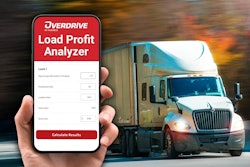
Overdrive’s Load Profit Analyzer is a fairly simple tool that could help owners in their efforts to corral costs and estimate potential profit with the right details. After the tool launched in 2024, it didn't take long before the time/speed frustration reared its head in comments under the story announcing it.
To wit: “If you know all your costs you don't need an analyzer. Most of the time when taking a load, you don't have time to analyze it or it's gone.” It's the reality for many if not most truckers negotiating for spot-market loads; time restrictions become a roadblock interfering with business execution.
Time lost = loads lost = miles and money out the window.
Negative emotions experienced are often more powerful than those that come with a gain of equal value, even if time lost was successfully put to use negotiating a more profitable contract or purchase.
End result for many: Conviction that the only choice is to accept or decline, not to negotiate.
[Related: How truckers can flip the script on the negativity trap]
Claim the home field advantage
The Mind and Heart of the Negotiator, by Leigh Thompson, describes negotiation as an "inner personal decision-making process.” For the single-truck business -- any small business, really -- everything eventually becomes personal. Personal biases, coupled with our emotions, are powerful forces. It’s important to make sure they don’t get in the way of making a deal that works.
- Set your minimum for rates, and don’t bother trying to search for or call on anything less than your own predefined acceptable pricing. Write this down in bold, or risk backing down from what is acceptable. Taking even a few seconds to write something down will help you slow down decision-making, maybe just enough to improve the odds that a winning move doesn’t become a future regret.
- Use a strategy of pre-negotiation. If you feel you only have that one chance to accept a deal, there’s no better time than before the call is placed to use pre-negotiation. Research average pricing for capacity, equipment or parts available, whatever you're negotiating. Compare the opportunities. Think about what you need days, weeks, even months in advance. Consider building more time in between an immediate need and starting your negotiation. This can help avoid participating in what might otherwise feel like an auction.
- Understand auction theory, and don’t let your zeal to win freight sell your business short. Cue Stanford economist Robert Wilson, detailing what’s known as the "winner’s curse" in this 2020 story from StanfordReport: “If different bidders have different information about what that price will be, then the person that overestimates the value the most will tend to win.” Pardoxically, in auctions winning bidders really lose, then, shelling out more for a product than it’s worth. In the freight-rates context, it's in reverse: winners are actually losers in the other direction, of course -- getting the freight but at rates that stink.
What you're selling: Is it your truck’s miles, or your time?
With time frustration high, it's legitimate to question why we’re all still negotiating rates per mile and not always with respect to time. Lost time is clearly recognized as costly, yet nailing down total cost can be like a riddle for some loads, since time is even less predictable than the miles driven.
Start by deciding what your time is worth, a calculation only you can make. (Ideas for how to get there are detailed in the Business Management section of the Partners in Business playbook, likewise with respect to evaluating detention compensation in a carrier's pay package in the Starting Line section.)
One thing’s abundantly clear: There’s no standard, agreed-upon route taken by owner-operators toward answering the question of what time is worth. Every owner has their own definition of target business profit and/or personal pay for themselves.
You might use a calculation of your fixed cost per day worked as part of it, among reasons Overdrive put that field among possible cost inputs in the Load Profit Analyzer. Consider what company drivers are earning, including benefits -- not drivers with a 1099 contract. (On average in 2023, according to the American Transportation Research Institute, driver pay and benefits together cost more sizable fleets about 96 cents a mile on average, and that figure's only risen in years since.)
[Related: Calculate any load’s cost in relation to time, not just miles]
Be on the lookout for new strategies, and ways to put non-driving time to good use, too. Overdrive provides a wealth of reliable source material, particularly examples of how peer owner-operators have discovered a path to success that hinged on well more than just driving. Seek new and continuing education. Attend meetings and trade shows like the Mid-America Trucking Show, the Broker-Carrier Summit event, or that company affair where you might meet business partners face-to-face to talk and share concerns.
How would you answer this question: When is the last time you made a sales call to a customer?
Make it a goal to be able to answer “yesterday” or "this morning" next time.
For a one-truck business, the owner-operator knows more any other person involved what it will take to successfully provide the customer services requested and defined in rate contracts. Remember all the hubbub over so-called "remote work" among office types so many years ago now? The one-truck business owner is the ultimate remote worker in some senses -- mobile, taking the office everywhere we go.
Yet, really, the opposite is true. Owner-operators are at the very center, on-site, of the work being done for every mile and hour in between negotiation, pickup and delivery of a load. Everyone else involved? They’re the remote workers.
You see and know more about what is happening as the work gets done than any other party -- communicate observations and updates effectively, and you’ll be the player everyone wants on their team. Better negotiations with them could well be the result.
Read next: Overdrive's Load Profit Analyzer: How to use to assess rates, costs