










The Federal Motor Carrier Safety Administration has responded to questions from the Commercial Vehicle Safety Alliance related to English language proficiency enforcement in “commercial zones” along the U.S.-Mexico border.
FMCSA guidance related to how law enforcement should enforce English language proficiency in those border zones directs inspectors to cite the violation but not place the driver out-of-service. CVSA requested further clarity on just who that guidance applies to, how it should be applied, and more. The full FAQ on clarification of the guidance can be seen here.
Notably, FMCSA clarified that the border zone exception applies not just to a Mexico-domiciled driver operating in a border zone but any commercial driver inspected there, regardless of the “driver or motor carrier’s country of domicile or whether the driver holds a U.S. CDL, Mexican Licencia Federal de Conductor, or Canadian CDL.”
Even a driver with a valid U.S. CDL, operating for a U.S.-domiciled company, who fails the ELP evaluation should not be placed out-of-service in a border commercial zone, FMCSA said.
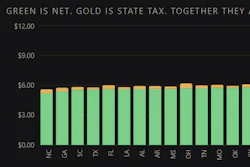
Southern-border states account for a sizable majority of all ELP violations written nationwide. Overdrive sister data company RigDig's accounting of 2025 violations of the ELP rule shows Texas, New Mexico, Arizona and California issued nearly 7 in every 10 such violations, or 68.4% of a total 48,213 ELP violations in 2025, with most of December-issued violation numbers in. (Numbers have been updated as of Feb. 11, 2026, after initial publication, as more violation data flowed into RigDig's accounting from state inspectors and the federal system).
[Related: Trucking English language enforcement: The toughest and most lax states]
Texas alone issued a whopping 57.2% of the total national ELP violations. Around the rest of the nation, as with other violations of federal regulations, enforcement has proved to be highly variable, as the map below shows.
Since the ELP violation was added back to CVSA's out-of-service criteria in late June 2025, the 10,000-OOS-violation milestone was reached in December, representing nearly a fourth of total ELP violations issued.
[Related: Will insurers drop carriers with non-English-speaking, non-citizen drivers?]
FMCSA in its new FAQ on the commercial zones clarified just where the zones are by pointing to the definition of “border commercial zones” in 49 Code of Federal Regulations Part 372, Subpart B.
“In general, the size of the commercial zones for border municipalities are based on the size of the population of the municipality (see 49 CFR Part 372.241),” FMCSA said in its FAQ. “The size ranges from 3 to 20 miles. In addition, the Cameron, Hidalgo, Starr, and Willacy Counties, TX; the City of El Paso, TX; and the New Mexico commercial zones (see 49 CFR Parts 372.237, 372.247, and 372.245) are also considered ‘border commercial zones along the U.S.-Mexico border.’”
FMCSA also clarified hard coding in the systems that inspectors use to record violations that prevents non-border violations from being logged as non-out-of-service. Nationally, Overdrive and RigDig's accounting shows that in 2025, nearly 60% of all ELP violations were recorded as occurring in a Southern border commercial zone.
For those border states, the violation shares were as follows:
- Arizona: 75% logged in border zones
- In California, federal inspectors, mostly operating in border zones, were the only roadside officers enforcing the ELP requirement in 2025, a fact that's cost the state's truck-enforcement division millions in federal funding. There, a similar 74% of ELP violations occurred in border zones.
- New Mexico: 57.7%
- Texas: 88.4%
FMCSA's full FAQ on ELP enforcement, including some clarification related to inspectors' two-part driver ELP assessment, interested readers will find at this link.
[Related: Funding bill signed into law enshrines ELP as an OOS violation]