











The Federal Motor Carrier Safety Administration kicked off the Mid America Trucking Show with a panel discussion on the industry's hottest issue -- cargo theft and fraud.
 Led by Tom Liberatore (far left), FMCSA's Office of Compliance director, the panel included Ankur Saini, FMCSA's IT director (center on chairs); Shannon Chelf, a training specialist at FMCSA (left on chairs); and Lewie Pugh, the Owner-Operator Independent Driver's Association's Executive Vice President (right).Matt Cole
The panel talked all things fraud, with a special focus on small biz trucking.
FMCSA and panelists shared news and tips on the following topics:
- What investigations FMCSA is conducting to stop fraudsters, fake ELDs and bad schools
- How to best report fraud to the National Consumer Complaint Database
- What to do if you're the victim of freight fraud
Liberatore kicked off the discussion by saying that the agency's leadership, including Administrator Derek Barrs and DOT Secretary Sean Duffy, had been "crystal clear about the need for all of us at the department" to be engaged in fighting fraud.
That should come as some relief to Overdrive readers, a majority of whom reported being the victim of fraud in a recent survey.
[Related: FMCSA announces rapid actions to shut down ‘chameleon carriers,’ CDL mills, ELD cheating]
The panel spoke freely, but Liberatore warned that the agency had open investigations going on "chameleon carriers, identity theft, registration issues, fraudulent ELD devices, and ELDT" that they couldn't discuss specifics on.
"We have half a dozen concurrent specialized operations covering everything from [principal place of business] issues to chameleon carriers to cabotage to CDL issuance," he said. "It's a lot of activity in terms of what we’re doing individually as a department and what we’re cooperating with our partners on."
He said that FMCSA is "working actively with FBI, ATF, DOJ, DHS" in some areas as those agencies have more law enforcement authority.
Liberatore highlighted recent public-facing investigations of chameleon carriers, in-person audits of CDL schools, and blocking 280 ELD registrations since September.
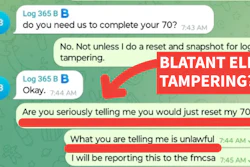
Overdrive recently reported on allegations of a big, Chicago-area fleet cheating on HOS compliance with a series of foreign-controlled ELD companies.
Liberatore said FMCSA "recently started a new vetting process for ELDs that is really bearing fruit for us" by blocking new registrants and re-registrations of previously revoked devices.
"A lot of those were from providers in some cases that we previously removed" in a way that resembles how chameleon carriers simply keep registering new entities to avoid enforcement.
Secretary Duffy "has tasked a talented, dedicated core group of senior leaders" at FMCSA to "dive into the issue very deeply."
Liberatore said freight fraud and cargo theft represent about $750 million to $1 billion in losses annually, and that's why they're going after it so hard.
Saini, the IT director, spoke about "securing our front door" and the new MOTUS system that should serve as a "one stop shop" for all carrier contacts with the agency. Saini said it was important to balance security with ease of operation, as "99% of carriers are good carriers doing things by the law."
What to do if you're the victim of fraud
Pugh, from OOIDA, spoke of the need for regulators to "raise the barrier to entry" for trucking, both for bad actors overseas and "con artists with nothing but time" domestically.
Pugh said if carriers have any questions about a load, to call OOIDA and ask for the compliance team. More often than not, they can spot a red flag. Most importantly, he warned, if your carrier name isn't on the BOL, don't sign it.
"If the BOL doesn’t match who you supposedly took it for, by all means, scratch that name out and put yours on there," he said. "It's so very important because it starts a paper trail of knowing where these things are."
Chelf, who worked with the Kentucky State Police for 20 years before the last 21 with FMCSA, gave some stark warnings. As someone who responds to the incredible volume of complaints filtering into the National Consumer Complaint Database, Chelf stressed just how difficult fighting fraud is.
"If you file a complaint and I see your complaint, the first thing I’m gonna do is make sure you’re legit," said Chelf. "That’s how paranoid I am, I take nothing at face value."
Chelf often works with the FBI on cases, and stresses in those conversations that "nothing is as it seems." Nearly all fraud and theft, he stressed, involves some form of ID theft.
FMCSA maintains a webpage on phishing scams and how to avoid them. But, if you are the victim of fraud or theft, the panel said to get your local police report and then to upload that police report to the NCCDB.
"You may not like the way the police responded to you, but they gave you a report," he said. "You may not like the way NCCDB responded, but you got a report documented. Two years from now when we're going through complaints, you start going through complaints and" investigators may "find a goldmine of evidence from two or three years ago -- you just connected all the dots, it’s a good day."
Chelf warned against trying to investigate matters entirely on your own, saying that it could take 1,000-2,000 hours to fully hunt down the culprit and even then, unless there are hundreds of other victims, it's unlikely anyone would prosecute the case.
Asked about foreign dispatch services, Chelf warned "almost every dispatch service has led back to outside the U.S."
[Related: Be wary of third-party trucking dispatch services]
Dalilah's Law, making its way through Congress now, would ban foreign-owned dispatch services, like the kind that Extra Mile International appeared to be using in its alleged ELD cheating.
One owner-op who asked a question stated that he's been hit by instances of fraud at least two dozen times in the last few years, and that these days every single load he hauls generates about two to five hours of back-end vetting work.
Chelf said he's seen removable "decals on the truck, screen printed plates on the truck, high quality fraudulent CDLs for the drivers who show up," almost as if the efforts to stop fraud have "opened a whole new door" for fraudsters to still squeak through.
On the issue of fraud, "I don’t think it’s ever going to be completely stopped," said Chelf, even despite FMCSA's high-level investigations to crack down.