










Trucking news and briefs for Thursday, April 23, 2026:
- More legislation aimed at fighting freight fraud, ensuring only legal residents obtain licenses.
- “It’s always a good day when people can walk away from a crash.” --Highway Angel Michael Alpine
Bill to crack down on freight fraud introduced in U.S. House
Companion legislation to a bill introduced earlier this year in the U.S. Senate that aims to address numerous issues related to freight fraud and cargo theft in the U.S. has been introduced in the U.S. House.
The Securing American Freight, Enforcement, and Reliability Transport Act,” or the SAFER Transport Act, was introduced earlier this year by Sen. Todd Young (R-Indiana). Last week, Rep. Brad Knott (R-North Carolina) introduced the bill in the House. As reported when it was first introduced, the bill would strengthen federal efforts to prevent, detect, and punish freight fraud and cargo theft perpetrators across the transportation ecosystem.
Among other provisions, the legislation would require the U.S. Department of Transportation to establish a “Freight Fraud and Theft Advisory Committee” to take public input on how to reduce fraud and theft, and provide input and recommendations to the Transportation Secretary and Congress. It would also require a memorandum of understanding (MOU) between the DOT and the Department of Justice (DOJ) to formalize how agencies handle information related to freight fraud.
"For too long, criminals and bad actors have exploited weak enforcement and outdated systems to target our freight network,” Knott said. “The SAFER Transport Act restores integrity, builds real guardrails, and gives our drivers and businesses the tools to stop fraud and theft. When we secure America's roads, we protect cargo, jobs, families, and our nation’s economy."
[Related: SAFER Transport Act would require prosecution of fraudsters, ban felons from freight]
Other provisions include:
- Phasing out MC numbers within five years of the bill’s enactment.
- Withholding registration and obtaining a USDOT number from anyone convicted of a felony related to theft, fraud and more in commercial transportation operations.
- Requiring motor carriers, brokers and freight forwarders to notify the FMCSA of a change in ownership, including through purchase, sale, merger, acquisition or other transfer, within 30 days.
- Requiring states provide monthly reports to the Transportation Secretary about the number of CLPs, CDLs, non-domiciled CDLs and endorsements issued, as well as the number of, and justification for, revocations, suspensions and downgrades.
- Improving the federal Training Provider Registry by establishing an audit process, requiring providers register a principal place of business (PPOB) and more.
- Requiring FMCSA to develop and implement one or more automated systems to flag suspicious activity in the registration system or by motor carriers, brokers and others. FMCSA would be required to review each flagged user to determine whether they engaged in fraud.
- Improving enforcement of cabotage laws.
- Requiring “foreign dispatch services” to register as brokers. Foreign dispatch services are defined in the bill as those not located in the U.S., Mexico or Canada and that act as a direct licensed agent on behalf of one or more motor carriers.
New Senate legislation links federal funding to states’ license issuance practices
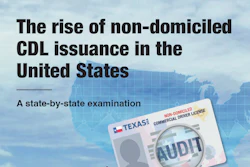
A bill introduced this month in the U.S. Senate would require states to verify an individual’s legal status before issuing a driver’s license, commercial driver’s license, or personal identification card.
Failure to do so would result in a 10% reduction in the state’s federal highway funding, and those funds would be redirected to states that are compliant with the law, should the bill pass.
The bill, titled the “No Licenses for Illegal Drivers or Truckers Act,” was introduced by Sen. John Barrasso (R-Wyoming). It’s co-sponsored by Sens. John Cornyn (R-Texas), Cynthia Lummis (R-Wyoming), and Tim Scott (R-South Carolina).
[Related: DOT pulls $74M from New York over non-domiciled CDL issuance]
The legislation defines “evidence of lawful presence” as “valid, unexpired documentary evidence issued by the Secretary of Homeland Security” that an individual is:
- A citizen of the United States
- An alien lawfully admitted for permanent residence as defined in the Immigration and Nationality Act
If a state fails to comply and loses 10% of its federal highway funding but later comes into compliance, the Homeland Security Secretary is required to apportion the withheld funds back to the state for that fiscal year.
The bill was referred to the Senate Committee on Environment and Public Works, where it would need to be approved to advance to the full Senate for a vote.
[Related: Dalilah's Law passes committee as Congress debates non-citizen drivers, ELP, CDL mills]
Trucker’s quick actions at crash scene recognized
The Truckload Carriers Association named ABF Freight truck driver Michael Alpine a Highway Angel for his swift and selfless response following a serious crash on I-5 in California.
 Michael Alpine
A small passenger vehicle abruptly moved in front of a tractor-trailer, causing the truck to swerve, overturn, and crash down an embankment. Debris from the truck, including lumber, scattered across the roadway.
“I saw the brake lights of the truck come on and then immediately swerve ... and then it started rolling over,” Alpine said. “It was dangerous.”
Without hesitation, Alpine pulled over, called 911 while the crash was still unfolding, and began taking action. Drawing on nearly four decades of experience and first aid training, he quickly moved to secure the scene before assisting those involved.
“The first thing I needed to do was protect myself and then try to protect the scene,” he said. “I have little LED flares, so I immediately threw those out ... because the lumber was across both ways of the road.”
After ensuring traffic was slowing, Alpine checked on the occupants of the vehicles. The driver of the passenger car was conscious but suffering from neck and back pain. Two individuals from the overturned truck had managed to climb back up the embankment with injuries, including visible head trauma.
“I kept asking them if they were OK. ... One of them had blood all over his forehead,” Alpine said. “But they were moving, and that was a relief.”
He remained on-scene, relaying critical information to dispatch and helping stabilize those involved until emergency responders arrived roughly 20 minutes later.
“I reminded them help was coming and told them to stay put,” he said. “It’s always a good day when people can walk away from a crash. You can replace material things -- you can’t replace people.”
Alpine encouraged his fellow truckers and others “to get first aid and CPR training. Sometimes we are the first responders out there.”