












Word to the wise from Roadcheck, Day 1, Giles County, Tennessee: The approach to the scale just past the Alabama line on northbound I-65 might make it appear that your PrePass or Drivewyze system will give you the bypass, but the mile-long facility is 100% pull-in.
For the Commercial Vehicle Safety Alliance's Roadcheck event this year, ongoing through Thursday, May 14, Tuesday saw five Tennessee Highway Patrol troopers inspecting and weighing trucks, three operating solely within the scale facility.
Two others, though, were on I-65 itself stopping those who failed to heed the "All Trucks Must Exit" signage.
 Inspectors still utilize sorting capabilities of the two common weigh station bypass systems, but the bypass actually runs behind the building within the facility, as noted stretching an entire mile from initial exit until it rejoins I-65. The point of bypass is visible in the image here -- the truck in the background is taking it, while the Peterbilt in the foreground is inching up to the weight platform.
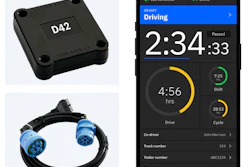
THP Lieutenant Christopher Brooks noted this year's Roadcheck features a mixture of the routine and novel in areas of emphasis -- load securement, something that's long been a focus of vehicle inspections, and backend electronic logging device manipulation in efforts to deep-six evidence of hours of service violations.
THP trooper Freddy Hart's learning on the latter front, he said, noting a hotshot operator with a Texas-headquartered small fleet he stopped for a Level 3 driver-only inspection recently. The hotshotter was running without a sleeper, and his logs showed multiple sleeper-berth 10-hour periods on the summary (and a totally blank day for the day prior to the inspection) upon an initial look.
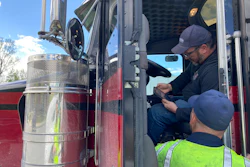
 Trooper Freddy Hart (center) inside the scale facility building off I-65.
By the time trooper Hart got the logs record transferred into the federal/state system for analysis, though, the logs looked entirely different. The operator in question said he had no idea how it happened, suggesting maybe someone in the back office knew he was being inspected and had the logs changed without his knowledge.
Hart hadn't documented what he'd initially seen, and so had no way to prove a violation in that instance.
Good way to tie up some more of your time at inspection, though. The Level 3 driver-only check then got elevated with a Level 2 walkaround as well.
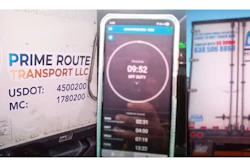
[Related: Prime Route, a Super Ego chameleon fleet, accused of ELD cheating with video evidence]
Elsewhere around the country, Wisconsin Highway Patrol Captain Karl Mittelstadt said his state's inspectors are getting better at documenting issues seen initially.
"It's rampant out there," he said of remote logs-data manipulation.
Speaking late last week, Mittelstadt in fact gave an example that closely resembles Tennessee's on-road/weigh-station combination of officers ongoing.
In the case of a driver blowing the scale, officers increasingly take steps to back up the logs record at the initial driver contact before escorting them back to the weigh station, he said. In such situations, officers are instructed to immediately "forward ELD records to the portal."
What typically follows: "Escort back to the scale, weigh, inspect the vehicle, get all the info we need," he said, then print it all off to a PDF.
There have been times that inspectors then get ready to submit the full inspection and the logs are all different, though the original record is preserved. "I've got some guys who are really good" at detecting just who changed the record, he said, whether it "was the driver or was some outside source."
In Tennessee, noted Lieutenant Christopher Brooks, "we've seen a lot more of that" in recent times. "I don’t know that we’ve got it figured out where we spot every single one, but we’re improving."
When inspectors do record an instance, "we’re working with our FMCSA partners," and "we forward that information to our division office ... to make sure they’re aware of the severity of the issue," ID'ing not only the carriers and drivers involved but the particular ELD, too.
[Related: FMCSA administrator wants to end self-certification for ELDs, training providers, more]
FMCSA's been quite vocal that allowing self-certification of ELDs by software/hardware providers in the federal registry was a mistake, and the agency's ongoing clean-up effort there has yielded numerous certification revocations for devices not up to spec with the rules. (At once, the agency and device/software providers are both typically vague about particular reasons for any revocation of the device.)
With any records-manipulation case referred up the chain to the Tennessee FMCSA office, the feds get a clear ID of just which ELD was used. And with respect to device revocations, Brooks said it's "something they are recently doing a very good job trying to get a grasp on," in his view.
He's hopeful efforts to keep bad actors, whether device providers or "chameleon carriers" evading enforcement consequences, out of the system "on the front end" bear fruit, Brooks said.
The new Motus registration system should help. (Reminder: Today's the last full day to take these preparation steps for the transition for owner-operators registered as carriers with FMCSA; much more information at the link and in the Monday Overdrive Radio podcast, embedded at bottom.)
"We want to work with [FMCSA], and we can do a lot better job … with clear channels of communication with our partners," Brooks said, making reference not just to FMCSA but to longtime owner-operators.
"The floodgates of being able to commit fraud in this industry have negatively affected it" in the public perception of all trucking companies and drivers, Brooks believes.
 Lieutenant Christopher Brooks, Tennessee Highway Patrol administrative lead for the Motor Carrier Plus dedicated unit, with 103 officers around the state. Those officers are part of well more than 1,000 total inspection-certified officers total for THP, most with other responsibilities in regional districts.
Keep communication lines open, Brooks advised, with scales you pass. Get to know the inspectors, what they look for. "If you see bad actors, don't be afraid to report it" to your lead Motor Carrier Safety Assistance Program Agency.
A 50-state contact list you'll find here.
[Related: FMCSA registration to go dark: How truckers can prep for Motus]
A little bit of the routine at Roadcheck Day 1: Tires, brakes
Turns out it's true what they say: Air disc brakes up and down the rig, if they're working, will get you through an inspection more quickly than drum brakes.
That's according to THP Trooper Jason Johnson, who noted just that after he quickly got this sharp rig on its way yesterday after a clean inspection:

 Pictured here with carrier-screening displays and a view of a rig being weighed, Trooper Johnson noted that there's no single factor that most influences any decision to pull in a unit for inspection. Given the Giles County scale's 100% pull-in rate, though, "we see a lot of the same trucks in here every single day," he said. Inspectors get a good feel for who's on top of their game and who's not, regardless of a company's Inspection Selection System score. (Bypass systems utilize the ISS score in their software to deliver bypass or pull-in instructions to operators.)
Trooper Jonathan Pulley had a little more to deal with under the drum-brakes-outfitted trailer of this tractor and dry van, marking and measuring push rods and stroke, all in order ultimately.
 THP Trooper Jonathan Pulley
Yet walking around the rig and quite literally kicking the tires, he noticed more give in the inside tire of the forward dual drive pair on the passenger side of the vehicle.
Tire pressure read 58 psi, just 3 pounds better than what could have gotten an out-of-service order for the operator: half of the tire's rated 110 pressure.
The cause was fundamentally unclear to Trooper Pulley initially, likewise the truck's operator, hauling for a fleet headquartered in nearby Lawrenceburg, Tennessee: No visible objects in the tread other than a rock here or there caught in deep grooves between blocks.
 Nothing obvious in the tread, but a valve extension through the outside wheel of the pair to the inside tire, Pulley noticed, had a hole chafed by the rim in its metallic cap.
 "This could be your problem," Pulley noted, showing it to the operator after unscrewing it.
The trucker had one more issue, too -- his CDL required use of corrective lenses. When Pulley started the inspection, he wasn't wearing them.
"You corrected that just by putting your glasses on," he told the operator near the end of the inspection.
With some additional air, and some confirmation the damaged extender was the problem, the operator was on his way, back toward the yard.

Roadcheck report from the Northeast: Inspectors 'behind the curve' on new breed of ELD cheats