










Trucking news and briefs for Friday, May 1, 2026:
- The Teamsters have vowed to fight new California rules allowing autonomous trucks.
- More time to comment on proposed UCR fee increase.
- “I dove right in there without hesitating.” --Highway Angel Wade Dickinson, about his help pulling a fellow trucker from his wrecked sleeper and administering aid.
California clears way for autonomous trucks, Teamsters raise concerns
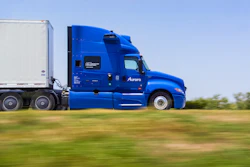
The California Department of Motor Vehicles (DMV) this week adopted new autonomous vehicle (AV) regulations, which will allow AV manufacturers to apply for permits to test and deploy heavy-duty autonomous vehicle technology on California roadways.
The rules also expand safety and oversight requirements for all classes of AVs, enabling law enforcement agencies to cite AV companies for moving violations committed by their vehicles, requiring AV companies to respond to first responder calls within 30 seconds and authorizing local emergency officials to issue electronic geofencing directives to clear AVs from active emergency zones.
Under the regulations and implementation of AB 1777, local emergency officials may issue a temporary “do not enter” or “restricted area” zone to manufacturers in response to a public safety issue. AVs would not be permitted to enter the area for the duration of the incident. Any AV already inside the zone must exit and no additional AVs may enter. AVs that violate such a restriction may be subject to permit restrictions or suspension, depending on the circumstances of the incident.
The regulations also establish safety readiness criteria in the permitting process, new standards for remote operations personnel and broader data reporting and enforcement tools.
“California continues to lead the nation in the development and adoption of AV technology, and these updated regulations further demonstrate the state’s commitment to public safety,” DMV Director Steve Gordon said. “These updates support the growth of the AV industry by enhancing public safety and transparency while adding additional accountability for AV manufacturers.”
The new regulations require that manufacturers begin with testing, using a safety driver, and progress to driverless testing before applying for commercial deployment. Manufacturers must complete 50,000 miles (light-duty) or 500,000 miles (heavy-duty) of testing at each phase and prepare a structured safety case demonstrating the safety of vehicle hardware, software and operations.
[Related: Aurora adds 1K-mile 'driverless' lane: Will HOS regs apply for the in-cab observer?]
The new regulations have been officially adopted. Certain provisions are in immediate effect, while others will be phased in over the coming months, pursuant to effective dates. The effective dates can be found in the regulatory documents available on the DMV website.
The International Brotherhood of Teamsters union decried the new rules and vowed to “use every tool necessary to stop it -- including taking this fight to the courts.”
“We have been clear from the start: a change this sweeping should be handled through the legislature, out in the open, with real transparency and accountability. Instead, the DMV is making major public policy behind closed doors,” Teamsters California Co-Chairs Victor Mineros and Peter Finn said in a statement released Thursday.
Mineros and Finn added that the California DMV “happily greenlit technology that companies still won’t fully disclose safety data on, thereby threatening the livelihoods of the professional drivers who keep California’s economy moving.”
[Related: Will owner-operators have to compete with truly driverless fleets?]
Proposed UCR fee increase: Comment period extended
The Federal Motor Carrier Safety Administration is giving motor carriers and other registered entities more time to comment on a proposed increase to Unified Carrier Registration fees for the upcoming year.
The agency announced its intention to increase the fees in an April 7 Federal Register notice. For the 2027 registration year and subsequent years, the UCR Board recommended a fee increase averaging 20%, with varying increases between $9 and $9,329 per entity, depending on the size of the fleet.
The comment period on the proposal was set to close May 7, but FMCSA is now giving interested parties through May 26 to file comments. The extension, granted at the request of the Small Business in Transportation Coalition, is “to provide an opportunity for the public to access the supporting documentation regarding fee calculations for the 2027 registration year,” the agency said.
SBTC requested the extension on April 24 because certain supporting documentation referenced in the proposal was not uploaded to the docket. That material was added to the docket April 24 and is viewable here.
“FMCSA believes it is in the interest of the public to ensure that commenters have access to these documents for a full 30 days, as originally intended, to allow for meaningful input on this proposal,” the agency said in extending the comment period.
[Related: FMCSA floats UCR fee hike for 2027]
Driver’s quick response to truck crash earns recognition
Nu-Way Transportation truck driver Wade Dickinson has been named a Highway Angel by the Truckload Carriers Association for his quick thinking and heroic response following a serious crash in Clinton, Illinois.
Around 3 a.m. on April 3, Dickinson was traveling along Highway 10 near Clinton when he witnessed a truck suddenly appear through a tree line and begin to overturn.
 Wade Dickinson
As the out-of-control vehicle came toward him, Dickinson had only seconds to react.
“I’ve got two options -- I can’t go left, and I don’t want to put my truck into the ditch,” he said. “So I’ve got to go straight. ... Thankfully, he did not hit me.”
Once clear of danger, Dickinson immediately pulled over and rushed toward the crash scene.
“I threw the truck on the shoulder, pulled the brake. ... I just jumped and took off running,” he said. “I had to run about a football field.”
Calling 911 as he approached, Dickinson quickly assessed the situation. He found the driver thrown into the sleeper berth, seriously injured and bleeding heavily.
“I saw him way back in the bunk," he said. "I didn’t know if the truck was going to catch on fire. I just knew I had to get him out.”
Without hesitation, Dickinson climbed into the wreckage and pulled the driver to safety. “I dove right in there,” he said.
The driver had suffered a severe wrist injury and was losing a dangerous amount of blood.
“It was squirting blood all over the place,” Dickinson said. “I knew I had to cut the circulation off.”
Using items he had on hand, Dickinson improvised a tourniquet to stop the bleeding until first responders arrived.
“I grabbed what I could and twisted it until the bleeding stopped,” he said.
Dickinson remained on scene as the sole responder for several minutes until emergency personnel -- including multiple police units, ambulances, and fire crews -- arrived. Despite being relatively new to professional driving, Dickinson relied on instinct, composure, and a deep-rooted sense of responsibility to act.
“With everything going on in the world, we all bleed the same color,” Dickinson said. “Why not help when I can?”