











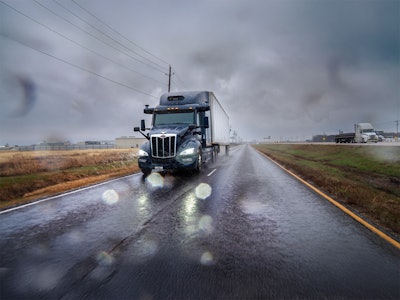
Autonomous truck tech developer Aurora Innovation on Feb. 11 announced it was tripling its automated-truck network with the launch of a software update, expanding its footprint.
“Expanding across the Sun Belt and introducing customer endpoints enables us to provide our customers with the capacity they need to move goods at a scale that wasn't possible before,” said Chris Urmson, co-founder and CEO of Aurora. “Being a carrier is a game of margins, and if autonomy can work around the clock, it will be key to growing our customers' businesses.”
The company’s latest software release is its fourth since deploying commercially operating trucks in April 2025. The first release was deployed on lanes between Dallas and Houston, the second adding night operations, among others. The third release deployed on the lane to El Paso from Fort Worth.
This fourth update, through, the company said, is deploying on the Fort Worth to Phoenix lane, at approximately 1,000 miles, longer than a solo driver can legally complete in a daily duty cycle under the hours of service regulations.
[Related: When will owner-operators have to compete with truly 'driverless' fleets?]
An Aurora spokesperson said, for now, an observer will be in the trucks along this route and the trucks will comply with hours-of-service regulations.
Yet that doesn't necessarily mean standard solo-driver HOS regs are in play. John Sova, Roadside Inspection Specialist with the Commercial Vehicle Safety Alliance, noted that if autonomous vehicles are operating in SAE Level 4 or 5, the vehicle does not functionally require a human inside and must be able to safely operate or go into a minimal risk condition (such as safely pulling to the side of the road in the event of a problem) without any intervention by a human.
The Aurora Driver automated driving system (ADS) is a Level 4 sytem, according to the company.
“An observer in the vehicle would not be subject to the hours-of-service limitations," Sova said, "because they have no interaction with the vehicle.”
However, “if the vehicle is testing these levels of autonomy and the observer is a safety driver that is there to intervene for the system, then the driver would be subject to HOS, since they may need to take over the controls of the vehicle,” Sova added.
As noted, the Fort Worth-to-Phoenix lane is longer than a human driver can complete in a daily duty cycle. Aurora turned plenty heads with its claim that the Aurora Driver autonomous system will effectively cut transit times in half once fully validated.
[Related: DOT says it's full steam ahead on autonomous trucking rollout]
Aurora said it's also leveraging what it called "verifiable AI," which means the AI system is transparent and its decisions can be verified, to generate high-definition maps after just a single manual drive, allowing the company to rapidly add direct-to-customer lanes. To that end, Aurora said it has begun supervised autonomous freight deliveries with a driver in the cab.
Aurora said these direct-to-customer routes have not yet been validated for true “driverless” operations, so a safety operator is required in the truck. Routes being tested with carriers include:
- Hirschbach Motor Lines' run between Dallas and Laredo for Driscoll’s
- Detmar Logistics between Midland, Texas, and Capital Sand’s mining site in Monahans, Texas
- An unnamed "leading carrier" from its Phoenix facility
The latest update also addresses what has been a major hurdle for Aurora and other autonomous truck developers: weather.
Last year, inclement conditions -- fog, rain, heavy winds -- sidelined Aurora’s fleet roughly 40% of the time, the company said. The new software allows the trucks to navigate these conditions safely.
[Related: FMCSA clearing path for autonomous rigs with recent waiver?]
With 250,000 miles run autonomously as of January 2026, and what it said is a perfect safety record -- zero Aurora Driver-attributed collisions -- the company believes it's laying the groundwork for scale.
Aurora is prepping to launch the next generation of its hardware kit on the International LT truck platform without a ride observer in Q2. Aurora confirmed its plan is for these trucks is to operate without an operator or observer -- based on CVSA’s explanation, not subject to HOS regs.
"Since the Aurora Driver is responsible for all driving tasks on our driverless routes, observers aren't required to follow 'driving-time' Hours of Service limits," an Aurora spokesperson added. "However, as CDL holders, observers remain subject to 'on-duty' rules, and company policy provides them with lunch and bio breaks. Looking ahead to Q2, when we expect to deploy our International fleet without observers, these breaks will no longer be necessary."
Aurora expects to have more than 200 truly driverless trucks in operation by the end of the year.
[Related: Driverless trucks: Owner-ops worry over crashes, cyberattacks, competition]