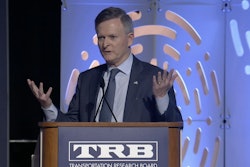












Department of Transportation Deputy Secretary Steven Bradbury made news last week promising to use AI to hunt down fraudsters and carriers hiring illegal drivers, but in the same speech, he put support behind a more existential threat to truck driving: Autonomous vehicles.
After saying "illegal foreign drivers" are pushing down rates and "eating the lunch" of American truck drivers, which owner-operators largely agree with, Bradbury in the next breath pivoted to driverless trucking, pledging to ease barriers to autonomous vehicles' use on the roads.
"We have some reform initiatives that have a particular relevance to new technologies and to unleashing the power of American innovation," said Bradbury, who then pointed to autonomous vehicles and "our approach to regulating them."
[Related: Driverless trucks: 'One big accident away from being banned' on public roads]
"The secretary has made it clear we're going to develop a clear national framework for the regulation of AVs, and the effort is a joint effort among many components of the DOT," he said. "We have a working group on that also very actively led by the National Highway Traffic Safety Administration."
That agenda dates back to the first Trump administration and, Bradbury admitted, stalled during the intervening years. Yet "We're picking it up again and moving it forward" by amending the Federal Motor Vehicle Safety Standards (FMVSS), he said.
Current standards are a "barrier to the commercialization and rollout of AV vehicles, and we're we're looking to amend them so that they will not be a barrier," he said.
Under the leadership of Secretary Sean Duffy, DOT in April touted an "Innovation Agenda" to speed up AV adoption and commercial rollout.
“America is in the middle of an innovation race with China and the stakes couldn’t be higher," said Duffy back in April, when DOT published a Federal Register notice seeking “comments and information to assist DOT in identifying existing regulations, guidance, paperwork requirements, and other regulatory obligations that can be modified or repealed" to reduce regulatory burdens on businesses.
Since then, the department seems to have found some FMVSS blocking AV innovation.
[Related: DOT launches Autonomous Vehicle 'Innovation Agenda']
“Federal Motor Vehicle Safety Standards were written for vehicles with human drivers and need to be updated for autonomous vehicles," NHTSA Chief Counsel Peter Simshauser said in September while announcing three rulemakings designed to help driverless trucks get on the road.
Those three rulemakings mostly sought to remove the requirement for vehicles to have manual controls for lights, shifters and defoggers. While seemingly minor, the need for manual activities have held back commercial trucking AV adoption.
In 2023, Waymo petitioned FMCSA for an exemption to the rule requiring a driver to put down warning devices 100 feet back on the road from a stopped truck. In 2024, under Biden, FMCSA denied that exemption.
DOT now seems eager to cut that red tape.
"Removing these requirements will reduce costs and enhance safety. NHTSA is committed to supporting the safe development of advanced technologies and advancing a new era of transportation,” said Simshauser.
Simshauser "was the chief legal officer and chief compliance officer of Motional, a joint venture to develop, deploy and commercialize automated vehicle technology," according to his DOT bio.
Similarly, FMCSA Administrator Derek Barrs during his time at Florida Highway Patrol once gave a talk on Florida's "leading role in autonomous vehicles."
The Autonomous Vehicle Industry Association put out a statement supporting Bradbury's posting as Deputy Secretary, saying they look forward to working with him on rolling out fully driverless commercial trucking.
"We're also going to accelerate the process for exemptions for AVs and provide greater guidance," Bradbury said in his recent speech. DOT will look at adjusting "performance standards and requirements for the automated driving systems, the computer that drives the car in AVs."
He promised work on helping the disabled use AVs in the interest of expanding transport accessibility and "driving the numbers down of fatalities on the nation's highways."
Finally on this topic, Bradbury invited guests at the Transportation Research Board, where he was speaking, to check out an autonomous shuttle bus parked outside the venue. That bus would make crosstown rides from the DOT office to places around Washington D.C.
While DOT, on the one hand, looks to provide protection from competition with foreign drivers, AVs and tech innovators DOT looks to unleash might just be next in line to eat the lunch of American truckers.
[Related: Will owner-operators have to compete with truly 'driverless' trucks?]