










Trucking news and briefs for Wednesday, Dec. 10, 2025:
- Diesel prices down 20 cents since hitting 2025 high.
- A Texas oil-field fleet will add 30 autonomous trucks to its operations next year.
- No additional HOS break for storm-relief fleet.
Diesel prices down 20 cents in last three weeks
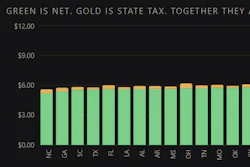
Since hitting a 2025 high point during the week ending Nov. 17, diesel prices have moderated, the national average falling 20.3 cents during that time.
The U.S. average price for a gallon of on-highway diesel was $3.67 during the most recent week ending Dec. 8 -- the lowest national average since the week ending Oct. 20, when prices stood at $3.62 a gallon, according to Energy Information Administration data.
Despite the improvement, fuel prices are still 20.7 cents higher than the same week a year ago. During the most recent week, prices fell for all regions across the country. The biggest decline came out West in the Rocky Mountain region, where prices fell 16.7 cents, followed by the Midwest region, where prices dropped by 12 cents.
The nation’s cheapest diesel can be found along the Gulf Coast at an average of $3.33/gallon, while the most expensive fuel is in California at $4.86/gallon.
Prices in other regions, according to EIA:
- New England -- $4.04
- Central Atlantic -- $3.95
- Lower Atlantic -- $3.62
- Midwest -- $3.64
- Rocky Mountain -- $3.50
- West Coast less California -- $3.94
ProMiles’ diesel averages during the same week fell by 6.6 cents to $3.69/gallon nationwide. According to the ProMiles Fuel Surcharge Index, the most expensive diesel can be found in California at $5.04/gallon, the cheapest in the Gulf Coast region at $3.32/gallon.
[Related: The push to 12 mpg: How Joel Morrow's doing it with this VNL spec]
Texas frac sand fleet Detmar to deploy 30 Aurora autonomous trucks in 2026
 Supervised autonomous operations between Detmar’s facility in Midland, Texas, and Capital Sand’s mining site in Monahans, Texas, will begin early next year.Aurora Innovation
Autonomous truck developer Aurora Innovation has reached a commercial agreement with Detmar Logistics, a provider in dry bulk and frac sand logistics solutions, to autonomously transport frac sand and other materials used for fracking for a large multinational oil and gas company.
The deployment will mark the first time frac sand will be hauled autonomously on public roads and highways in Texas’s Permian Basin, Aurora claimed. Another autonomous truck tech developer, Kodiak Robotics, began operating its autonomous trucks in the Texas oilfields in 2024 with Atlas Energy Solutions operating the units on its private lease roads.
The contract with Detmar establishes one of Aurora’s initial routes between customer sites -- the company said it was a milestone in a bid to expand its network beyond terminal-to-terminal operations next year.
Chris Urmson, co-founder and CEO at Aurora, pitched the ability to help Detmar "achieve nearly 24/7 asset utilization and effectively double its capacity to move sand for a leading energy producer.”
[Related: Driverless-truck tech: Owner-operators worry over cyberattacks, crashes, competition]
Supervised autonomous operations between Detmar’s facility in Midland, Texas, and Capital Sand’s mining site in Monahans, Texas, are planned for early 2026.
The route combines high-speed driving on I-20 with local and private roads surrounding Detmar’s facility and the mining site. Notably, Aurora is delivering advanced capabilities at the mining site, including autonomously navigating overhead filling silos for loading, the company said.
Under the initial contract, Detmar is committing to using 30 Aurora Driver-powered trucks in 2026, each unit hauling sand for more than 20 hours a day. Alongside their human-operated fleet and network of valued independent contractors, Aurora said Detmar also plans to own and operate an expanded fleet of Aurora Driver-powered trucks in the future as the technology is adopted.
[Related: Two more autonomous trucks moving frac sand in Texas]
Storm recovery fleet’s HOS exemption request denied
The Federal Motor Carrier Safety Administration has denied a petition from a 72-truck, Wisconsin-based fleet seeking an exemption from the maximum driving time limits in the hours-of-service regulations.
Earlier this year, Northern Clearing Inc. requested the waiver to allow the company “to provide continued restoration, clean up, and re-construction services in North Carolina, under the same conditions set out in the FMCSA Regional Emergency Declaration and Extension of Emergency Declarations Number 2024-008, which was in effect from October 4 through December 26, 2024.”
FMCSA’s regulatory relief for operations providing direct assistance in emergency response to Hurricane Helene did not cover long-term infrastructure rehabilitation once the immediate threat had passed. Northern Clearing requested that it be allowed to continue operating under the conditions outlined in the emergency declaration and align its HOS practices with the “utility service vehicle” exemption in 49 CFR 395.1(n).
In denying the request, FMCSA said the company “did not explain why it should be treated the same as the utility service vehicle drivers or how its operations would likely achieve an equivalent level of safety with the applicable HOS rules.”
The agency reiterated that, after the Dec. 26, 2024, expiration of the emergency relief, “motor carriers engaged in the long-term recovery of these communities are expected to comply with the HOS rules.”
[Related: No winter-long HOS waiver for propane haulers: FMCSA]