










Trucking news and briefs for Monday, Dec. 8, 2025:
- Inspectors want guidance about paper medical cards while states still work to roll out FMCSA's electronic filing system.
- Legislators look in a new direction to bring more help to the fight against cargo theft.
- The ECU in these trucks could stop working, leading to a recall.
CVSA calls for med-cert guidance for inspectors
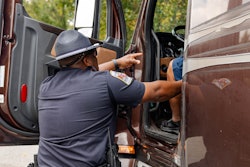
The Commercial Vehicle Safety Alliance last week sent a letter to the Federal Motor Carrier Safety Administration urging the agency to provide guidance to enforcement personnel related to the delayed rollout of the electronic medical certificate system.
As reported, FMCSA has issued temporary waivers that allow truck drivers to continue relying on a paper copy of the medical examiner’s certificate as proof of a driver’s medical certification as some states still work to implement the fully electronic system. The current waiver is in effect through Jan. 10.
The waivers followed FMCSA’s implementation of its National Registry II (NRII) final rule, which required states to implement an electronic process for medical certification -- with examiners transmitting exam results to FMCSA via the National Registry of Certified Medical Examiners and FMCSA transmitting the results to state driver’s licensing agencies to post to the driver’s motor vehicle record (MVR).
As of Dec. 8, there are nine states that have still not implemented NRII -- Alaska, California, Florida, Kentucky, Louisiana, New Hampshire, New Jersey, New York and Oklahoma.
CVSA in its Dec. 5 letter requested that FMCSA provide guidance to enforcement officials that a paper copy of a medical examiner’s certificate is permitted to demonstrate compliance with the applicable requirements during a roadside inspection and motor carrier safety audits and investigations until all of the issues around NRII are resolved.
As a result of the nine states yet to fully implement the electronic system, CVSA said, “[m]otor carriers continue to grapple with the effects of this partial implementation of the NRII requirements. Currently, if a motor carrier has a driver whose medical certificate is not transmitting in the system correctly, they are forced to either temporarily cease using that driver until the issue is resolved or resubmit them for an additional medical certification exam, to ensure that they can prove the driver is qualified.”
Additionally, because carriers are not notified when a driver’s medical certificate is properly associated with that driver’s MVR, “motor carriers are also forced to query drivers’ Motor Vehicle Record (MVR) more frequently to monitor when the driver’s Medical Examiners Certificate is posted to CDLIS,” CVSA added.
To address these and other challenges, CVSA is requesting that FMCSA provide the guidance to enforcement “until all issues associated with integrating the state driver’s license administrations’ systems with the medical examiners’ systems are resolved.”
[Related: FMCSA’s electronic medical certification system takes effect -- in most states]
Bipartisan legislation takes aim at cargo theft
U.S. Senators Marsha Blackburn (R-Tennessee) and Amy Klobuchar (D-Minnesota) on Dec. 4 introduced the “Cargo Security Innovation Act,” which would take a new approach to the fight against cargo theft.
The bipartisan legislation, the senators said, would ensure that those on the front lines of the fight against cargo theft have state-of-the-art technology to protect their operations.
“Cargo theft significantly impacts the supply chain, harming American businesses and consumers, especially food shippers,” Klobuchar said. “When criminals break into shipments, businesses are forced to return containers and dispose of compromised products. Our bipartisan legislation would equip law enforcement with the resources to combat these crimes -- creating a pilot program that invests in technology to curb cargo theft.”
The Cargo Security Innovation Act would require the Transportation Security Administration (TSA) to establish a pilot project to evaluate the “effectiveness of advanced law enforcement and cargo security technologies at combatting cargo theft in transit and at and around intermodal transportation hubs and rail yards with elevated levels of cargo theft.” Specific technologies to be used are not identified in the language of the bill.
It also requires a report to Congress on the results of the pilot project within two years of its deployment.
The bill was referred to the Senate Committee on Commerce, Science, and Transportation.
As reported extensively in recent years, cargo theft activity has skyrocketed in recent times, including a 57% increase in 2023 with reported losses exceeding $400 million.
[Related: Prime time for cargo theft: $18M vanishing every single day]
ECU issue prompts recall of International trucks
International Motors is recalling approximately 678 trucks of various models for an issue related to the electronic control unit (ECU).
Recall documents from the National Highway Traffic Safety Administration note that in the affected trucks, electrical noise and low signal to the power line carrier may cause the ECU to incorrectly process commands or stop working.
Safety systems that depend on the ECU, such as Automatic Traction Control, ABS, Electronic Stability Control, Active Cruise Control, and any Collison Mitigation System, may have diminished or lost functionality, increasing the risk of a crash.
International models affected by the recall include:
- 2016-‘23 International LoneStar (3 units potentially affected)
- 2018 International 8600 (2 units potentially affected)
- 2018-’23 International LT (15 units potentially affected)
- 2021-‘26 International MV (106 units potentially affected)
- 2022-’23 International RH (3 units potentially affected)
- 2023-‘26 International HX (192 units potentially affected)
- 2025-’26 International HV (356 units potentially affected)
International will work with Bendix to reprogram the ECU, free of charge. Owner notification letters are expected to be mailed Jan. 19. Owners can contact International's customer service at 1-800- 448-7825 with recall number 25525. NHTSA’s recall number is 25V-817.