











Update March 18, 2025: An amended variant of legislation discussed below, now called Dalilah's Law, passed a vote in a House committee sending it to the full chamber. Notably, the current version does not contain the provision requiring recertification of all CDLs. Original story follows.
The Federal Motor Carrier Safety Administration's chief, Derek Barrs, Thursday said the agency is working with Congress on the recently introduced and President Trump-endorsed "Dalilah Law."
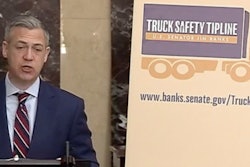
A first version of the bill, which came to prominence when President Trump urged its passage during his State of the Union address Tuesday, came to light the following day, introduced by Sen. Jim Banks of Indiana and referred to the Senate Committee on Commerce, Science and Transportation with five Republican cosponsors.
The bill seeks to codify in law the approach of FMCSA's Final Rule all but banning CDL eligibility for non-U.S. citizens but for immigrants with Legal Permanent Resident status or non-immigrants who hold one among three types of temporary work visa. The bill would also require both CDL skills and knowledge tests to be administered fully in English, and tie state compliance with rules therein to federal funding.
It directs states to undertake a recertification process, too, that holds some potential for speeding up revocations for non-citizens whose CDLs' active term ends more than six months beyond the legislation's date of passage, should it become law.
Yet it goes farther than just directing recertification for non-citizens. Its terms demand states recertify every CDL issued -- to be completed within 180 days of passage. The bill directs states to recertify that every CDL holder:
- Is eligible for the CDL with respect to citizenship and immigration status.
- Holds English proficiency commensurate with regulatory requirements for drivers in 49 CFR 391.11(b)(2)
- Took both skills and written tests for the CDL in English.
[Related: What does the Dalilah Law mean for your (and my) CDL?]
After Barrs' prepared remarks to attendees of the Specialized Carriers & Rigging Association's transportation symposium in Birmingham, Alabama, Thursday morning, the first audience question out of the gate pertained to the Dalilah Law, asking for agency perspective on and/or detail about it.
"We are working to enhance that," Barrs said. "We will work with Congressional staff," both House and Senate. Barrs noted he'd been on the phone both that morning and the previous evening about it to "continue to put in the right things and the guardrails" necessary.
 Derek Barrs, speaking during a general session Thursday, Feb. 26, at SC&RA symposium
Recertification for citizen drivers might take many forms, and could be a simple matter, amounting to basic paperwork shuffling and records checks for states.
On the other hand, should truckers expect to be called into state licensing offices to present birth certificates or passports to re-prove citizenship? To take English-language tests?
Queried about the legislation's provision, neither Sen. Banks' office nor multiple state licensing agencies responded to Overdrive inquiries Thursday. But for California, whose Department of Motor Vehicles wouldn't comment on pending legislation.
Overdrive asked FMCSA's Barrs whether the recertification provision might be akin to one of the "overly broad" restrictions SC&RA transportation committee chair Joanna Jungels noted just the prior day the association was on guard for with aggressive agency enforcement and regulatory action aimed at "bad actors." Jungels had cautioned officials against unnecessary restrictions that could hinder business operations and make maintaining “our standards as professional operators” so difficult “we run the risk of losing out.”
[Related: Massachusetts bill would increase 'superload' permitting weight limit]
"I want to make sure we've got the qualified driver behind the wheel," Barrs said. "I'm not going to go into what the final process is going to look like."
Initial versions of legislation like the Dalilah Law commonly undergo copious revisions through the committee process, with versions both in the House and the Senate.
Barrs went on to stress the agency is committed to an aggressive approach to ensuring CDL driver qualification at the licensing level.
For states to satisfy the recertification provision, were this current Senate version of the bill to become law, "whatever that looks like, and what the process is going to look like, we will start looking to iron that out moving forward," he said. "We are moving aggressively to make sure that we have the most qualified folks behind the wheel."
Statements to that effect during his public remarks at the SC&RA symposium were among various moments that drew applause from the assembled motor carrier and pilot car company management/personnel, state permitting department officials, and some drivers in attendance.
"I’m a boots on the ground guy," Barrs said early in his remarks. "I want to thank the drivers," then recognizing those in the audience.
"These are the people that we depend on ... as you move things every single day," he added, noting in particular the specialized nature of most of the companies in attendance. What such drivers do is "highly technical, highly visible and absolutely essential to the American economy."
Barrs' talk wasn't limited to updates with respect to licensing, touching on FMCSA moves in the last year on hours of service flexibility pilot programs and upcoming rulemakings boosting enforcement powers and prevention mechanisms with respect to so-called "chameleon carriers" gaming compliance/safety systems, electronic-logging-device provider vetting, and CDL school certification in the agency's Training Provider Registry. Catch the full talk via the following Overdrive Radio podcast edition, published subsequently:
[Related: FMCSA announces rapid actions to shut down 'chameleon carriers,' CDL mills, ELD cheating]