










Trucking news and briefs for Friday, Sept. 11, 2026:
- How FMCSA’s Motus is impacting trucking companies.
- “Illegal alien” truck driver charged in fatal crash.
- “I did a sternum rub and stuff like that. Got him somewhat conscious.” --Highway Angel Brian Koppenhaver
Six Motus errors threatening carriers, as one reports being stranded at weigh station
Since the launch of the Federal Motor Carrier Safety Administration’s new registration system, Motus, in May, motor carriers have been dealing with numerous issues with the system -- so much so that FMCSA is holding off on USDOT number inactivations for fleets that have failed to complete their required biennial updates since June 1 as a result of the rollout.
A recent webinar hosted by Central Analysis Bureau (CAB), a company within Overdrive parent company Fusable's brand portfolio, highlighted six issues that have emerged from Motus' clunky rollout. Full explanations of the issues can be found in Overdrive sister publication CCJ’s coverage of the webinar.
The six highlighted issues:
- Inaccurate out-of-service designations
- Arbitrary changes to insurance limits
- Failures in “cancellation by replacement,” where a new insurance filing would previously automatically "cancel" the prior one filed
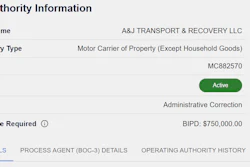
- Presumably inadequate insurance, yet active authority
- Authority canceled for no reason
- Excess insurance filings displayed incorrectly
[Related: What's wrong with this picture? Motus mess costing small fleets thousands]
In a real-world scenario, just as Overdrive July Trucker of the Month Jeffrey Crise had worried when his own authority was arbitrarily canceled, Motus issues left one carrier stranded at an Oklahoma weigh station when inspectors discovered a River Oaks Couriers truck’s operating authority inactive.
As reported by CCJ’s Jason Cannon, the truck wasn’t shut down for any equipment or driver violations. The shutdown was instead triggered by an administrative glitch in Motus.
River Oaks Couriers President Kevin Clark said that the agency’s system purged the carrier’s process agent designation (Form BOC-3) without warning or notice Aug. 20, wiping out a compliance record that had been untouched since at least 2008.
"Oklahoma completely understands what's happening based on what the driver said," Clark said, "but they're not willing to go ahead and let us roll, knowing that we're marked inactive because we don't have a BOC-3 agent, even though there's a BOC-3 agent listed in the box."
Despite what Motus showed, Clark said River Oaks Couriers clearly had a Form BOC-3 on file. The process agent "has been out there for 20 years listed. I almost forgot who they were," he said with a laugh. "All of a sudden, that field is blank."
The BOC-3 deletion automatically deactivated the company’s USDOT number, leaving a loaded truck stranded. Clark brokered the load to keep it moving, but the unearned shutdown highlights ongoing issues within FMCSA’s system.
The Commercial Vehicle Safety Alliance of law enforcement and motor carriers, noted state inspectors should at least be aware of the issues. "CVSA has provided guidance to the jurisdictions on how to verify carrier status while the Motus issues are addressed," said CVSA Deputy Executive Director Adrienne Gildea.
She added, however, that it's been an ever-evolving situation, as Clark's and others' stories show. "We are doing our best to work with our partners at FMCSA and in the states to respond as the situation develops," Gildea said.
River Oaks' shutdown wasn’t the company’s first Motus-related issue, CCJ reported. In July, during an insurance renewal, Clark found the system had overwritten the business’s legal name on its DOT account with Preferred Logistics, the name of his company's separately registered brokerage, nearly costing the company its insurance renewal.
Read more about River Oaks Couriers’ Motus nightmare, and temporary workaround, in CCJ’s report here. It includes a stopgap Champion Trucking owner-operator Steve Lapp had been attempting to rely on, utilizing a Texas intrastate authority to keep up and running.
For Lapp, at least, the strategy proved mostly unworkable, given carrier vetting/onboarding systems like Highway and RMIS seemed unable to account for his intrastate-only authority. Brokers increasingly utilize those systems, some with little recourse to override the selection rules built in.
Fortunately, as of earlier this week Tuesday, Lapp's interstate authority was corrected administratively. Lapp, as so many other truckers have reported, experienced next-to-no success actually speaking to an FMCSA registration representative at headquarters, and "I don't know which of my attempted contacts finally worked," he said.
Read more about his case and some success at least getting through to his state FMCSA division office via the Related link below.
[Related: FMCSA cleaning up Motus mess one carrier at a time]
ICE lodges detainer for California-licensed ‘illegal alien’ involved in fatal Ohio crash
U.S. Immigration and Customs Enforcement (ICE) has lodged a detainer for an alleged illegal alien who has been charged with causing a crash that killed a woman in Ohio.
According to local reports, truck driver Manjit Singh, of Fresno, California, was charged with aggravated vehicular homicide following a head-on crash along U.S. Route 68 near Pleasant Township, Ohio, on Sept. 2. Reports indicate that the 2019 Volvo tractor-trailer driven by Singh was passing a northbound vehicle when it collided with a southbound Chevrolet Cruze head-on.
The driver of the Cruze, identified as 50-year-old Brenda Watson, died at the scene.
A Department of Homeland Security press release alleges that Singh is an “illegal alien” from India. ICE lodged a detainer with Brown County Jail the day after Singh was arrested. Singh had been granted a CDL in California.
According to DHS, Singh illegally entered the United States through Arizona in October 2023 and was encountered by the U.S. Border Patrol. He was then released into the country. In July 2024, he applied for work authorization, which was granted by the Biden Administration in August 2024.
He's been “charged with aggravated vehicular homicide after allegedly causing a semi-truck crash that killed 50-year-old Brenda Watson in Ohio,” said DHS Secretary Markwayne Mullin. “He has no business being in our country or on our roads, but because of the reckless open borders of the Biden Administration and the sanctuary policies of Gavin Newsom’s California, he was able to obtain a CDL that allowed him behind the wheel of a semi-truck. ICE has lodged a detainer asking officials in Ohio to commit to not releasing this killer back onto our streets, so that ICE can remove him from our country. My thoughts and prayers are with Brenda Watson’s family.”
[Related: Not just sailboat fuel in that trailer: Inspectors find $3.8M in cocaine]
Driver's actions to help accident victims honored
Melton Truck Lines driver Brian Koppenhaver has been named a Highway Angel by the Truckload Carriers Association for his actions after witnessing a devastating crash along I-70 in Ohio.
 Brian Koppenhaver
“I watched the impact happen, so it’s not like I drove up on it,” Koppenhaver said. “I just put the turn signal on and got over on the right shoulder and ran back to offer assistance.”
When Koppenhaver reached the scene, he found the box truck severely crushed and its occupants critically injured. One of the occupants, a passenger named Mario, was trapped inside the wreckage. Recognizing that the trapped man needed immediate assistance, Koppenhaver climbed through an opening in the wreckage to the vehicle.
“When I got in there, Mario, his head was where the dash was supposed to be, and his feet were back towards where the cab of the truck was,” Koppenhaver said. “He wasn’t breathing. He’s not responsive.”
Koppenhaver cut open Mario’s shirt and began assessing him and attempting to stimulate a response. He said he was particularly concerned about possible spinal and head injuries and tried to keep Mario’s neck as still as possible.
“I did a sternum rub and stuff like that. Got him somewhat conscious,” Koppenhaver said.
As Mario began moving, Koppenhaver recognized the possibility of serious injuries and called 911 to relay what he was seeing and request additional medical assistance.
Mario had suffered massive lacerations to his left arm, and both of his legs were pinned beneath the wreckage. Koppenhaver remained with him while emergency personnel made their way to the scene.
He also helped prepare rescuers for the difficult extrication. When emergency medical personnel arrived, he requested a cervical collar for Mario. Firefighters then began working to cut through the heavily damaged vehicle with the jaws of life.
Mario was ultimately freed from the wreckage and transported for emergency medical treatment. According to Koppenhaver, Mario remains hospitalized in intensive care and has suffered severe injuries, including the loss of both legs.
A U.S. military veteran and retired U.S. Postal Service employee, Koppenhaver brought experience, composure and a determination to help to a chaotic and dangerous crash scene. His actions exemplify the courage, compassion and quick thinking that define the Highway Angel program, TCA said.