











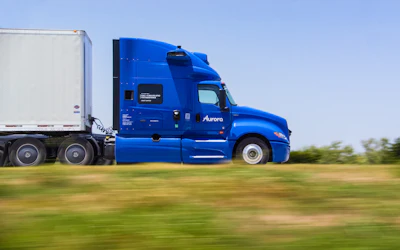
The Federal Motor Carrier Safety Administration defended its continued issuance of a waiver allowing certain autonomous truck operators to use cab-mounted warning beacons in lieu of federally required warning triangles or fusees (flares).
- Cargo van operator Kostas Giannoulias’ Sept. 21 petition for review was filed with the 7th Circuit Court of Appeals, arguing FMCSA had no authority to grant the latest, July 9 waiver to Aurora and other autonomous trucking companies who simply opt in.
- In response, FMCSA argued Giannoulias failed to make his case for why the waiver should be put on hold.
- The agency asked the court deny the petition to stay the waiver.
- Giannoulias hit back with another filing, noting the agency confirmed the facts as outlined, and a stay was warranted.
As reported Friday, Giannoulias had argued against the legality of FMCSA's July 9 waiver, exempting Aurora and other companies who inform FMCSA of their intent to operate under the waiver from the warning device placement and steady-burning lamp requirements.
Giannoulias established grounds for the petition by noting he hauls freight in a cargo van on lanes where autonomous trucks are operating in Texas. That “exposes him, in a far lighter commercial vehicle, to the particularized roadside hazard of driverless Class 8 trucks using cab-mounted beacons instead of federally required warning triangles,” he said.
FMCSA countered arguments in detail and requested the court deny Giannoulias’ request for a stay pending review.
[Related: Operator mounts legal challenge to FMCSA's autonomous truck warning-device waiver]
“Giannoulias’s theory is that he might encounter a truck covered by the waiver during his occasional trips to Texas, that the truck might be disabled, and that the purported safety difference between beacons and fusees/triangles could cause an accident,” FMCSA said in its court filing. “That speculative theory does not suffice for standing -- let alone the irreparable harm that Giannoulias must prove to obtain a stay.”
Additionally, even if the court sided with Giannoulias on those points, FMCSA argued he is unlikely to succeed on the merits of his claims because, according to FMCSA:
- He cannot seek judicial review under the Hobbs Act because he was not a party to the waiver process and, as such, is not aggrieved under the statute.
- Federal law authorizes FMCSA to issue waivers, and the challenged waiver is not materially different from waivers FMCSA has issued previously.
- The “remaining equitable factors favor FMCSA because the attenuated and speculative harms that Giannoulias alleges pale in comparison to the government’s interest in authorizing warning beacons.”
In addition to Aurora, other autonomous carriers -- Kodiak Robotics, Waabi Logistics and Stack AV -- have signed onto the waiver, FMCSA noted. As of March 10, 2026, Kodiak had deployed 20 driverless trucks, the agency said, while Waabi and Stack have yet to deploy any.
[Related: DOT clearing way for driverless trucks with wiper, mirror, steering exemptions?]
Waiver or exemption?
FMCSA also clarified in its response that it has the authority to grant both waivers and exemptions -- two different things.
- Waiver authority allows FMCSA to grant one if it’s determined “that it is in the public interest to grant the waiver and that the waiver is likely to achieve a level of safety that is equivalent to, or greater than, the level of safety that would be obtained in the absence of the waiver,” the agency said. Those waivers can be for no longer than 3 months and must be “limited in scope and circumstances,” and “for nonemergency and unique events.”
- Exemptions may be granted for a five-year period, must be requested through specific procedures and must undergo notice and comment.
FMCSA also has authority to “conduct pilot programs to evaluate alternatives to regulations relating to, or innovative approaches to, motor carrier, commercial motor vehicle, and driver safety,” which “may include exemptions from a regulation,” the agency said. Pilot programs also have to undergo notice and comment.
Waivers are not subject to the same rules, the agency said. “The waiver at issue here is different from exemptions and pilot programs in significant ways. ... Unlike exemptions, the waiver does not apply in blanket fashion to an entire class of regulated parties; it applies only to Aurora or another carrier that affirmatively accepts its terms and conditions and notifies FMCSA. The waiver could not be a pilot program, either … because at the time it was granted, the potential participants were unknown and it was unclear whether there would be ‘[a] reasonable number of participants necessary to yield statistically valid findings.’”
FMCSA previously denied an exemption to Aurora that sought an industry-wide exemption to allow cab-mounted warning beacons because it was too broad.
The agency did, however, note that Aurora and others could seek narrower exemptions.
“Although FMCSA has not issued an exemption, it has issued four three-month waivers that ‘allow Aurora to use cab-mounted warning beacons in lieu of the warning devices’” required under federal regulations, the agency said, adding that the waivers are “narrower in scope than the broad exemption request” that it previously denied.
[Related: Autonomous trucking firms want warning-device waiver extension]
FMCSA’s arguments against Giannoulias’ petition
On Giannoulias’ claims, FMCSA said he did not meet the legal threshold for “irreparable harm,” noting that “it is doubtful that he will even encounter a truck covered by the waiver before October 9” -- the date the waiver expires.
“He resides in Illinois, not Texas, and may not even take a trip on any routes that Aurora operates,” the agency said. “Even if he travels to Texas, counting both Aurora and Kodiak, there would only be approximately 45 self-driving trucks operating under the waiver. Giannoulias alleges that those trucks operate across the entire state of Texas: from El Paso (at Texas’s far west) to Laredo (at its far South) to Dallas (near its Northeast). Texas has more than 3,000 miles of interstate highway.”
The odds that he even encounters a truck covered by the waiver “are vanishingly small,” FMCSA said, adding that “the odds of his encountering such a truck when it was disabled (emphasis in original) are even smaller.”
The agency added that he also didn’t demonstrate “that there is a meaningful safety difference between the waiver-authorized beacons and fusees/triangles."
“Giannoulias has thus entirely failed to provide the Court any reason to believe that if he encountered a disabled truck covered by the waiver, he would face any greater risk of injury because cab-mounted warning beacons were used instead of external fusees/triangles.”
Since it began issuing waivers to Aurora last October, the agency added, “no crashes involving a beacon-activated CMV have been reported at all, let alone crashes attributable to a difference between warning beacons and fusees/triangles.”
Issuing sequential waivers is also not out of the ordinary for the agency, FMCSA said, highlighting two waivers issued during the COVID-19 pandemic that were issued seven times each.
Finally, FMCSA said granting the waiver “is in the public interest … to promote innovation and to enable commercial deployment” of automated driving system (ADS)-equipped commercial vehicles “to enhance safety and mobility for the American public.”
“That public interest, which is supported by evidence demonstrating the likely equivalent or greater level of safety of cab-mounted warning beacons relative to fusees/triangles, should not be set aside because of a single driver, who may never encounter (let alone crash into) a truck equipped with those beacons,” FMCSA concluded.
[Related: FMCSA clearing path for autonomous rigs with recent waiver?]
Giannoulias fires back
“FMCSA’s response confirms the facts,” Giannoulias said to open his rebuttal to the agency’s response. “Stack AV joined after the Administrator signed it; prior participants need not reapply; and the reports let FMCSA ‘gather critical data.’"
Giannolias added that “those admissions describe prospective class enrollment, automatic continuation, and a data-gathering program -- not a one-person waiver for an event completable within three months."
Additionally, he refuted FMCSA’s claims that he only occasionally hauls freight in Texas, noting that his “declaration documents six July-August trips involving Dallas, Houston, Austin, Laredo, and El Paso, including Dallas-Houston; night driving; and his intent to accept a Texas-corridor load before October 9” when the waiver expires.
Giannoulias goes on to further counter FMCSA’s arguments and asks the court to:
- Enter an immediate administrative stay and a stay pending review of the waiver.
- Prohibit additional carrier opt-ins and any successor waiver.
- Direct FMCSA promptly to identify every carrier operating under the waiver and lodge the certified administrative record and record index, including the written delegation for the first waiver issued last October, the requests and staff recommendations for each waiver, the complete term reports, and all crash and activation materials.
- Order expedited merits briefing and disposition.
[Related: When will owner-operators have to compete with truly 'driverless' trucks?]