












David McKinney has been trucking as an owner-operator since the mid-‘90s, but it hasn’t always been smooth sailing for the Lexington, Alabama-based small fleet owner.
McKinney bought his first truck at 22 years old after moving with his family from California to Alabama. “You had to know somebody to get a good job” in the area where he lived, “and I didn’t know anybody here, really” he said, other than some truck-driving cousins.
At age 21, he hopped in a truck, and bought his first Peterbilt the next year. “I bought my house on a Friday and a Peterbilt on a Saturday,” he said.
He leased on with a company hauling air freight and ran with them for a few years, building the business up to four trucks. Everything went south by 2001, though, and he ended up filing bankruptcy.
“Lost everything but our home,” he said.
There's something you should know about David McKinney, though. He’s not a quitter.
After six months off the road at the time of the bankruptcy due to a shoulder surgery, he went to the bank and was able to work out a deal -- with a less than favorable interest rate, no doubt -- to get a loan for another truck.
“I worked six days a week and got ourselves out of a hole,” he said. With the loan from the bank, he bought a less-than-stellar Peterbilt 359 just to get back on the road, as he tells it, and found another company to lease to. Times were still tough as he dug out of that hole, and he walked away from his lease over a payment discrepancy on a pair of loads he hauled.
The sun was shining on him in this case, though. A logging company called him that very night “and wanted me to start hauling chips to the paper mill, and I showed up the next morning pulling their trailer, pulling chips to the paper mill.”
 This is the last of several Small Fleet Champ semi-finalist profiles that have aired over the last weeks. (Access all of the published stories via this link.) Two finalists in each category (3-10 trucks, 11-30 trucks) will be announced later in the week.
Six-eight months passed hauling chips before he landed work with a company he still hauls for today, some 20-plus years later -- Sims Bark Company.
“I just worked six days a week and worked every day I could,” McKinney said. “And then I was fortunate enough to buy another truck." Things really started falling in place.
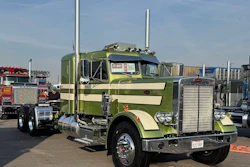
 David McKinney with one among his many show-quality Peterbilts.
McKinney got his authority and was fully on a path to growth and success in the years that followed as McKinney & Sons Transfer LLC.
Before a lot of the growth, in 2012, his father passed, sadly. But just about two weeks before he passed, he alerted David to a Peterbilt for sale in nearby Athens, Alabama.
“I picked him up and put him in it; he was too weak to get in it,” McKinney said. “We test-drove it, and he said, ‘Dave, you need to buy this truck.’ And I said, ‘I don’t know what the hell I’d do with it, Dad. … I don’t have a driver or nothing.’”
“If you’ll buy this truck, you’ll be all right,” his dad said.
So he went to the bank, “I begged money to borrow from the banker, and we bought it, and we just started kind of growing our business from there.”
The truck ended up being McKinney's third at the time, as his brother had moved to Alabama from Pennsylvania when their father was diagnosed with cancer and was running with him. Following the advice of his father, McKinney began growing the company into what it's become today.
Humble beginnings to an enduring team
McKinney had two “good contracts” at that point with customers, and ran the trucks and the business on his own for the next couple of years.
His wife, Connie, worked for an accountant. After one of his contracts fell off about eight months before it was supposed to, he told his wife he was going to “rent an office, buy an office or build an office” to hire somebody to handle much of the business side of the company, “and that somebody needs to be you,” he said.
After the next tax season, she joined McKinney & Sons, “and we started running trucks out of our bedroom,” David said.
 When the family moved to the 14-acre plot of land where they live and run their business today, McKinney noted they “built a shop and an office” so they both have the space they need to do what’s needed for the company. His shop is shown here.
Over the next 14 years, McKinney would grow to between 15-20 trucks at any given time, and it’s a family affair, even beyond his wife. His two sons and a daughter-in-law are also involved in the business dispatching and/or driving.
He estimated that 90% of his company’s work is “all direct shipper freight now,” adding that “we don’t factor any bills; we’ve never factored the first bill.”
Greenbush Logistics terminal manager Dylan Michael, one of McKinney’s customers, said he’s personally been working with McKinney for more than six years, though the relationship goes back much farther than that. Greenbush is the trucking arm of Great Southern Wood, which produces the well-known YellaWood treated lumber brand.
“Because YellaWood is such a recognizable and respected brand, we are very particular about the carriers we select to represent our company,” Michael said. “Appearance, safety, customer service, professionalism, and overall reliability are all extremely important considerations.”
McKinney & Sons hits all of those marks, he added, noting that McKinney and his team “routinely go above and beyond in every aspect of their service, both for our company and for the customers we serve.”
Michael said McKinney’s fleet has hauled nearly 5,000 loads for Greenbush from 2024 to the present.
“Neither McKinney & Sons nor Greenbush Logistics would be successful without the customers we serve, and David and his team demonstrate that same commitment with every delivery,” Michael added. “They are professional, dependable, knowledgeable, and true experts in their field. Having a carrier like McKinney & Sons gives me confidence that our customers’ loads are being handled with the same level of care and professionalism that we expect from our own organization.”
[Related: Rocking, rolling: KST Logistics stacks honors after founder's passing]
A home for drivers
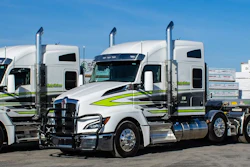
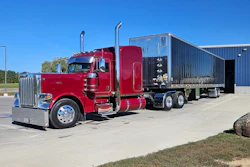
 A typical truck-trailer combo on any given day in McKinney's fleet is a head-turner on the highway.
Building a long-term home for truck operators, McKinney been guided by this principal: “I tried to take the things that I didn’t like about the trucking business” when he was hauling for other companies, he said, and fix them for his drivers.
All of McKinney’s drivers get home every night, as their loads of treated lumber and mulch take them outbound from the Muscle Shoals, Alabama, area to points north: Nashville, Clarksville in Tennessee and up to Paducah, Kentucky.
Return loads include lumber from Paducah, zinc or block out of Clarksville, concrete from Franklin, Tennessee, all to points headed back south in Tennessee or north Alabama.
“It’s kind of a go-and-come operation, which is pretty simple,” he said. “My guys may run 2,200 miles a week, but it’s out-and-back, and they make pretty good money, and they’re home every day.”
Customer demand led the decision-making on growth through the years, dovetailing with McKinney’s own goals to grow.
He said the company could probably grow even more and still have plenty of work to do, “but what hinders me is we run from Muscle Shoals, so if you don’t live between Muscle Shoals and Nashville, within about 20 miles, 25 miles off of the highway, I can never get you home.”
While 2,200 miles a week sounds easy, drivers have their hands full, flabed work adding another layer to it all. “Sometimes you’ve got to hump it pretty hard to get your day done,” he McKinney said.
 The National Association of Small Trucking Companies sponsors the Small Fleet Championship. Finalists receive a year's worth of membership in the association, with access to a myriad of benefits from NASTC's well-known fuel program to drug and alcohol testing services and much more. All are recognized at the association's annual conference, where the winners will be announced later this month in Nashville, Tennessee. Find more about the association via their website.
While all but one of his drivers are company employees, “I’m looking for a guy who wants to be treated like an owner-operator, because I do treat my guys like that.”
His drivers also know a day ahead of time what their next day will look like -- dispatch texts the schedule to them by 10 a.m. the day before the runs start, so they can plan accordingly. It’s up to the individual to be where they’re supposed to be, when they’re supposed to be there.
Dispatch's text also includes a picture of the driver’s rate sheet with what it’ll pay the driver and all of the contact information for where they’re headed, so they can coordinate.
McKinney pays a percentage of the load for the regional work -- 25% starting out with the company, with a top-out rate of 30% after five years with the fleet. Drivers also receive a bonus at Christmas, safety bonuses and health insurance as a benefit.
[Related: Leighton Transport: Big-fleet clout with boutique care]
Show-quality equipment across the fleet
David McKinney abides by the rule that, with his drivers, he’s “not ever going to ask you to do anything I wouldn’t do, and so I wouldn’t ask you to drive a truck that I wouldn’t want to drive myself.”
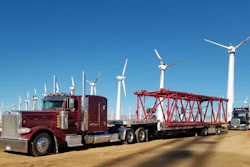
 There's not one truck “that we couldn’t clean up and take to a truck show,” he said of the units that make up the fleet. That goes beyond the tractors, as well. McKinney said he also only buys top-notch trailers with Mac and Reitnouer flatbeds.
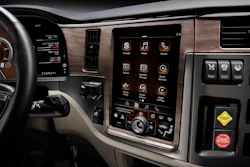
The company's all Peterbilt, ranging in age from a 1986 359 all the way up to a 2027 589.
Units are maintained in-house, as well. McKinney has had the same mechanic working for him since 2013, save for a year-and-a-half time period he left before coming back.
“He’ll come in the evenings and fix anything that needs to be done, or he comes on Saturday,” McKinney said. Unless a repair is covered under warranty on a newer unit, all of the work is done in McKinney’s shop -- engine work and all.
McKinney works with Peterbilt of Nashville (Rush Truck Centers) on his truck purchases, paint work and any warranty repairs.
“They’ve striped about every one of my trucks and done some sort of paint work to it,” he said. The dealer “has always been super good to me.”
McKinney knows the luxuries that come with direct shipper customers that he can rely on, and who can rely on him -- a special situation for a small fleet. With the big run-up in fuel prices this year, most were understanding of his own needs given they also run their own trucks.
“They see the cost of fuel, they see the cost of insurance,” he said. “So, when fuel went up, I just called them” and asked what the plans were “because I can’t absorb it all,” and they adjusted the rates, no problem.
That’s been the case with any big changes in the wider trucking business, he added. “We try to take care of our customers,” and they do the same for him.
“I dug out of the bottom by myself and started this,” McKinney said. “And then when my wife came to work for us, she really did an amazing job doing our billing. And when she first started, she would dispatch trucks all day and then work till midnight invoicing and billing. I’m very proud of who I am and what we have and where we came from.”
He's come a long way from the bitter bankruptcy pill of his early years. "They come get all your [stuff], everything but our house. … That is a hard pill to swallow for a young man," he remembered. "You are a failure.”
But “you’ve got to build that back somehow," he told himself. "You’ve got to get out of this hole. And by hard work and dedication, I did that, and then when my wife came to work for me, she helped out that process a great deal.”
McKinney acknowledges the long road he took to where he is today with the company. “We’ve come a long way from being just a poor, dumb truck driver,” he said. “And now we try to run the equipment to show that.”
[Related: Drumroll, please ... Meet your Small Fleet Champ semi-finalists]