











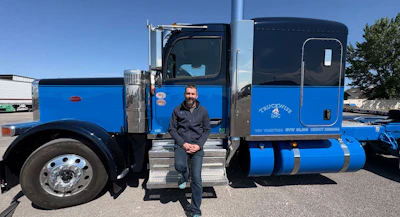
Tremonton, Utah-based Kevin Haderlie first bought a truck in in his mid-20s in 2014, leasing on with the company he’d been driving for, Doug Andrus Distributing.
He’d been driving trucks for about seven years by then, from the time he graduated high school in 2007, then part-time while he attended college from 2010 through 2014. Hauling for the Andrus flatbed fleet, Haderlie became a driver trainer, then moved into the office as an after-hours dispatcher for the fleet’s reefer division for about a year before he bought that first rig.
He wouldn't stay leased for long. In early 2016, Haderlie went independent with his authority. He'd prepared for the move to full business ownership for years.
“I’ve got notebooks from my time as a company driver for Doug Andrus," he recalled. "I’d be driving from them, and I just have ideas come to my mind of, ‘This is going good, I like this, this could be better if we changed it like this.’ So for years I was just sitting and taking notes to myself about what I would do differently if they were my own trucks that were running.”
That first power unit paved the path to where he is today.
- The 2009 Peterbilt 386 had actually been an Andrus fleet truck -- bought brand-new and traded around 400,000 miles.
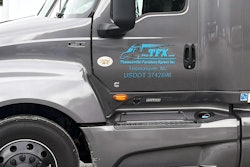
- He launched his authority as Four Falls Transportation, rebranding to TruckWise in 2023 for reasons of efficiency in comms with customers.
- TruckWise sits at 10 trucks today, with drivers paid salary and more growth coming with two new units before the end of the year.
- The company specializes in overdimensional freight in addition to other platform loads, with step deck and RGN trailers.
- "An absolute rockstar," said one customer about Kevin Haderlie.
- Haderlie's a semi-finalist in Overdrive's 2026 Small Fleet Championship, competing in the 3-10-truck division.
 This is one of several Small Fleet Champ semi-finalist profiles that will air throughout the next weeks. (Access all of the published stories via this link.) Two finalists in each category (3-10 trucks, 11-30 trucks) will be announced in October.
He was headquartered in Idaho originally, where four cities have “Falls” in the name. He spent an inordinate amount of time over those first seven years “trying to explain that name or say the name on the phone to anyone," he said. "It turned into a two-minute lecture trying to get the name across clearly, with the correct spelling and everything.”
TruckWise got the point across much more easily, setting him on the path toward growth with efficiency.
From 'trucking gypsy' to direct freight in the heavy-specialized niche
Haderlie started out a self-described “trucking gypsy” working load boards for the first six months or so in business. Yet he “started to get some contacts and some people that were calling me regularly, and things kind of blossomed from there,” he said.
He pulled step decks early on before a customer, Johnny Hooper out of Phoenix, Arizona, asked him to haul some equipment for him. Hooper bought equipment from auctions in Haderlie’s home state of Utah “fairly regularly,” he said, “and he was the guy that kind of pushed me into equipment hauling.”
Haderlie was “doing some small stuff” for Hooper when one day he got a call to haul “some big piece of equipment,” as Haderlie told it. “I said, ‘Johnny, I don’t have a trailer that can do that.’ And he said, ‘Well, go find a trailer, go buy one that can do it and then come haul this for me, and I’ll give you the rest of my big stuff, too.’”
So he did, and has focused on oversize and overweight equipment since. Hooper “was the reason why we kind of stepped over from the general freight world into the specialized freight world -- not really planned, just kind of happened naturally,” Haderlie said.
Growth started there, too, toward where he is today.
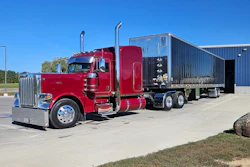
 One among TruckWise's 10 units today is this W990 hooked to one among oversize loads for the agriculture and construction industries.
He didn't get to 10 trucks overnight -- early-years growth was measured, no more than three trucks until near the end of 2019 when the company obtained what he said was its first “high-volume customer.”
The time was right, he felt, to start building, adding trucks, but it didn't come without pains. “Our internal infrastructure … was fine for one or two trucks, maybe three, but beyond that, it wasn’t great," he said. "And our driver structure wasn’t very developed. Our key vendor relationships weren’t very developed.”
The result was “two steps forward, one step back,” Haderlie said. It got to the point early this decade that he opened a brokerage to run some of the company’s direct freight through. Direct customers kept coming in, but Haderlie soon realized brokerage wasn’t the answer.
“Brokerages are great if you’ve got some good carriers you can count on, and even then, they are very challenging,” he said. In 2023, running into the next year, he shifted the business once more to better focus on customer service with his own trucks and drivers.
“I realized if I wanted to control [customer relationships] and produce a consistent, reliable experience," he said, something that could result in "premium rates and premium lanes and all the good things that come with it, we had to be doing the majority on my own trucks, so I could control it from start to finish, what that experience looked like.”
[Related: Getting closer to the customer: Freight beyond the broker boards]
TruckWise’s customers have taken notice.
 The National Association of Small Trucking Companies sponsors the Small Fleet Championship. Finalists receive a year's worth of membership in the association, with access to a myriad of benefits from NASTC's well-known fuel program to drug and alcohol testing services and much more. All are recognized at the association's annual conference, where the winners will be announced in late October in Nashville, Tennessee. Find more about the association via their website.
Nowels lauded the company's dependability. They “communicate well, and make every effort to ensure our freight is handled safely and delivered when expected," she said. "When unexpected situations arise, they are very responsive and work with us to find the best solutions to fixing the problem.”
Haderlie and his team “have taken the time to understand our needs, are very flexible when circumstances change, and genuinely care about the success of our business," she said. "We know we can count on them to follow through on their commitments and to provide honest, straightforward communication.”
Ty Colton, with TruckWise customer C&B Operations, said Haderlie “is an absolute rockstar,” adding that after eight years working with the owner, “I don’t even ask for bids anymore. I just call Kev and tell him what I need.”
Colton added that he doesn’t “have to worry about getting jerked around on a delivery,” which he said was an issue with other trucking companies in the past.
Haderlie keeps his strategy for customer management close to the vest but noted that he believes his specialized program is “unique” and has “a huge impact on how our customers view us.”
And like 2025 Small Fleet Champ Wes Oberman and Oberman Logistics, Haderlie has identified gaps in existing Transportation Management Systems (TMS) on the market, and he’s set out to build his own.
“I have not seen an off-the-shelf product anywhere out there that does exactly what I want it to do, and certainly not what our customers want it to do,” Haderlie said. “So we’re just building our own right now at the moment.”
Some systems do some things really well, and others do other things really well, but none that he’s found do everything really well. Keep tuned for results.
[Related: Small Fleet Champ Wes Oberman harnesses AI coding, builds custom TMS]
Managing the equipment cycle, high prices
 When TruckWise equipment arrives to pick up or deliver a load, “you have some sweet iron to look at with his trucks,” said TruckWise customer Ty Colton.
Haderlie has upgraded since that first new Peterbilt 579 he bought at his authority startup. Almost all of his 10 trucks today are long-hood Peters, with two Peterbilt 567s he bought amid Peterbilt’s transition from the 389 to the 589 to see how the new model performed before buying them himself.
The rest are either leftover 389s or newer 589s Haderlie keeps on a roughly 450,000-mile trade cycle.
“That’s kind of always your goal," he said, to "keep them in that warranty range and get rid of them towards the end. For the people that take the time to sit down and do the economics on a truck that’s both out of warranty and higher mileage, the numbers do not add up” -- particularly after the fleet starts to grow and you’re managing more than just a couple trucks. “There’s a reason large fleets are rotating trucks out every three years. It’s because the economics are there.”
In Haderlie’s fleet, the oldest unit is a 2022 model that cost him around $210,000 with his spec and additional accessories. Another he bought two years later that’s “also dressed up really nice,” purchased at the apex of truck prices, ran him closed to $360,000 fully equipped.
Thankfully, he noted, he recently ordered one of the last Kenworth W900 models to be delivered later this year, and the price had fallen back to around $265K fully outfitted.
[Related: Buy now? Truck prices on the way up with EPA 2027]
Yet, despite the sticker shock of a new, well-equipped truck at the dealer, Haderlie thinks more in terms of his monthly cash flow because, at the end of the truck’s life in his fleet, he said “most often we recover about what we need out of it on the sale.”
So when looking at a truck that costs $265K today compared to one that cost $180K a few years ago, “what does the month-by-month difference look like from that $80,000 sticker change? And the answer is not that much, maybe $400-$500 a month.”
Then he considers how much more he needs to charge his customers and bring home to make up that difference, “and it’s pennies,” he said, in the grand scheme of it all.
As far as maintenance, any work needed that’s covered by warranty goes to the dealer, but almost all of the fleet’s preventive maintenance is done in-house. Trucks and trailers get lubed every 12,500 miles -- about once a month -- and full service with oil changes, filters, etc., is done every 25,000 miles.
TruckWise from the driver’s seat
When a company truck driver starts with TruckWise, they're trained to do things a specific way that aligns with how the rest of the fleet operates, for consistent safety and service.
 While Kevin Haderlie's wife, Jenna, is not directly involved in the day-to-day operation of the business, Kevin said she's his "closest confidant and the brains behind many of the things that we do on a big scale."
All are employed, though he’s in talks with two about potential for leas-purchasing two trucks he’s soon cycling out of the fleet. Haderlie admitted he’s not a big fan of lease-purchases -- “I think they are almost always designed to take advantage of the drivers,” he said. But he’s “trying to build that the right way so that we’re setting our drivers up for success.”
Driver pay is structured with an underlying base salary. Haderlie's tried miles pay, percentage, day rates. Roughly two years back, “the more I thought about it, the more I realized that I think a salary structure is the most easily implemented program that doesn’t disadvantage our drivers in any way," he said, "but allows the flexibility in the company to do what we need to do to serve our customers well.”
[Related: 31 straight years of revenue growth: John McGee Trucking leans on the Golden Rule]
Salaries are tiered based on tenure at the company -- 0-6 months, 6-12, 12-24, then annual tiers after that. Because the schedule is structured for drivers to be home 7 days monthly, salaries are based on a 23- or 24-day month, depending on if it’s a 30- or 31-day month.
“Their salary comes through every Friday, they just count on it,” Haderlie said. “It doesn’t matter if they rolled 3,000 miles that week or 500, or if the truck was broken down and they were sitting doing nothing all week long, their salary comes through every Friday.”
When drivers work extra time during a month and don’t get their full seven days at home, they get paid a day rate for those extra days worked -- currently set at $325/day as of late August.
Drivers are also eligible for bonuses each month for Peer Choice Employee of the Month and “Kevin’s Pick,” chosen by the office team, Haderlie said. The driver selected for each of those receives a $500 bonus. TruckWise also offers a stipend for drivers who choose to take it to obtain health insurance.
He offers an aspiring owner who will listen lessons from growth missteps he's learned the hard way: “Be prepared for things to look way different with any more than one single truck on the road,” he said. "Things change just so fast.
“Our company grew faster than our culture" at first. "It grew faster than our infrastructure. It grew faster than my own ability to actually effectively lead a team and be a true executive, not just a truck driver turned trucking company owner.”
Know your numbers really, really well," he said, and not just what you're presenting to the IRS. That's not showing the "true economics of a successfully-run trucking company” -- the unplanned and unexpected expenses that happen that are often beyond your control.
Many owner-operators transitioning to a small fleet, including Haderlie early on, “get to a point where you realize this is more painful than what it seems like it should be,” so they go back to their comfort zone of being a one-truck owner.
“Looking back on it now, I realize if I just had more information, if I had just thought this through a little more carefully, I probably wouldn’t have retracted,” he said. “I would have adjusted things. It wouldn’t have taken making a major overhaul of our company. I would have adjusted the values just a little bit, and that will make the difference you need so you can push through to the next level rather than retracting and getting back down to that one truck and wondering what went wrong along the way.”
[Related: Drumroll, please: Meet your Small Fleet Champ semi-finalists]