











Greg Labosky is no stranger to Overdrive’s Trucker of the Year competition. The June 2024 Trucker of the Month back then impressed with his attention to detail and effective navigation of challenging market conditions.
The New Haven, Connecticut-based owner of GDL Enterprise has held a CDL since the mid-90s, trucking off and on through the years. Owner-operator Labosky took about a 20-year hiatus from trucking over the period, yet dabbled "in it every once in a while,” he said, working for security firms and other businesses that need a driver every so often.
“I had the CDL where I could easily hop into that and make money … fairly quickly, so I’ve always maintained” the credential, Labosky added. But trucking for a living “took a backseat for a while until I saw the retail field and the security field that I was in start to go by the wayside, and the money and the revenue stream was not maintaining the same … income that would be needed.”
He's been back in business full-time since 2018, and worked as a contractor with a company where “everything was still running fairly smooth,” he said. A year or so later, he could see “the writing on the wall that this company was starting to have financial issues, so I decided to save face and get my own independent authority and start renting a truck on my own.”
He pulled for the same company for a time before his intuition became reality.
They “shut down entirely,” he said, leaving him "high and dry."
Yet backup plans had already been laid. He had an established relationship working with Amazon by that time, and was able to leverage it toward hauling freight with authority.
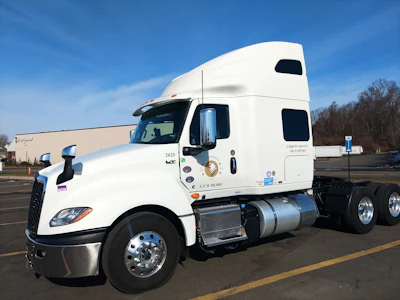
Since that time, around the start of COVID-19 pandemic, Labosky's paid close attention to costs, particularly maintenance on the 2017 Freightliner Cascadia he bought used, as detailed in the 2024 feature about GDL Enterprise. Throughout 2025, as the truck approached a million miles on the odometer, costs crept up due to a variety of issues. On Jan. 20 he traded for a newer unit, the LT pictured up top.
Labosky’s is a case of knowing when to fold ‘em, so to speak -- making the switch before a catastrophic breakdown, the No. 1 reason owner-operator businesses fail, could occur.
Fuel cost savings with great efficiency have been one thankful result as he continues to roll up profits as a power-only carrier in the Amazon Relay system, riding high on the new horse with a lot of road ahead.
A lot behind him, too. Greg Labosky recently crossed the 1-million-mile threshold for his career, honored also by the Owner-Operator Independent Drivers Association for eight years of safe driving.
The total package shows a persistent operator well-deserving of Overdrive’s Trucker of the Month nod for March, putting GDL Enterprise in the running for the 2026 Trucker of the Year award.
 Overdrive's 2026 Trucker of the Year competition recognizes business acumen and unique or time-honored recipes for success among owner-operators. Nominations are open for exceptional owners, whether leased or independent (up to three trucks). Enter your own or another owner-operator business you admire via the links.
[Related: Trucker of the Year John Penn honored at MATS among owner-op peers]
Managing through a turbulent 2025
Despite some optimism coming into last year from many around trucking, hindsight is 20/20. By and large, 2025 was a lot more of the same -- rates not budging much, costs continuing to rise.
 Greg Labosky
He echoes other watchers in attributing some of the improvement to “the industry cleanup that’s going on," he said, with new federal regulations pushing out non-citizen operators, enforcement "trying to clean up the chameleon carriers, and the lack of English seems to be helping,” too.
As noted, Labosky was “starting seeing the major breakdowns coming,” he said, for the 2017 Cascadia. He “was in the high 800 [thousand] range to sort of the 900,000 range mileage-wise. I was seeing a lot of issues with the ignition system. Part of it was the engine possibly needing a true out-of-frame or in-frame overhaul.”
Clutch issues, too, and finding parts for repairs was becoming a challenge. “The manual transmission, as we’ve seen, has been going by the wayside,” he said. Parts could be difficult to come by.
So “the big major components are starting to fail, and the lack of replacement parts and the price of the replacement parts steadily increasing,” he laid out his calculus, documenting nearly $50K worth in parts alone spent in 2025. It was time to make a move.
“Instead of dumping a lot more money in to maintain what level of the truck I had,” he said, he would “start stepping up my pace on purchasing new equipment, which would be a ground zero level where I would have a fresh, clean slate where I know exactly what the truck was that I was getting.”
He made the final payment on the 2017 in January, and traded it that same month for a 2025 International LT from Ascendance Truck Centers in Philadelphia. The truck’s build sheet shows the Cummins X15 rated at 450 horsepower, but Labosky said he’s seeing around 500. The engine is coupled with a 12-speed automated manual transmission.
“Overall with the purchase, I was fairly happy with the choice I made,” he said. “I was looking at several different models,” with a key focus on clearance -- important given he runs largely in the Northeast with its low bridges -- and general features.
“I narrowed everything down, just like I did when I first bought the 2017 Cascadia,” he said. He had hoped to land another manual transmission, but said he would have had to wait a year to 18 months if he ordered a rig spec’d to his specific wants and needs.
He considered an International HX, he said, but the lower-sloped hood of the LT he felt would optimize visibility operating in cities.
His first oil change in the new unit he did early at 15,000 miles, well below the manufacturer-recommended interval of 60,000 miles for normal operations, but he “wanted to remove the break-in [oil] and put the genuine, true oil in and start running from there.”
He’s still planning oil changes at a conservative 18,000-22,000 miles on average as the truck ages, sampling and analyzing oil at each change for the first year “to see how things are going.”
He'll then figure out a long-term plan for sampling.
Cost and rates analysis to beat market pressures
All the repairs in 2025 delivered a hefty dose of downtime. Labosky leaned on his reserve built up in prior years to an extent, yet “once I came back on the road, I started minding my Ps and Qs tighter as far as running the actual business,” he said.
On the occasion he books a spot load with Amazon, he looks to “pull away layers of the onion” to look a the “true base rate per mile,” he said, something he advises other owners to do to determine what the "true cost of the load is instead of going by face value.”
Running in the Northeast -- an area heavy with tolls -- he found an advertised rate might often include toll charges, so he keeps that front of mind when looking at rates.
[Related: Overdrive's Load Profit Analyzer: Ways to use to assess rates, costs]
Labosky maintains an operating cost consistently between $1.65 to $1.73 a mile, above which he profits. In Amazon's Relay system, he will only go below that if he knows he’s getting a fuel surcharge and/or toll reimbursement to “help cover the shortness on the actual base rate.”
He “habitually” uses the Motive system to track his fuel purchases. The new International is delivering dividends compared to the 6.5-7.5 mpg he averaged with the older unit. The LT's clocking 7.9-8.8 mpg.
“I’ve been quite impressed with the difference,” he said. “I’m not sure if it was the engine, or just the actual performance characteristics of the newer technology and the newer engine showing that much of a difference.”
Overdrive spoke to Labosky for this story two weeks into the run-up in diesel prices. In his area in the Northeast, he said he had seen the chain truck stops advertising fuel as high as $7/gal., but a small stop where he bought fuel sat closer to $5 at the time. Amazon had yet to adjust its fixed formula for fuel surcharges, he said, “but hopefully they’ll start working on that soon.”
As previously reported, Labosky maintains a high rating within the Amazon system, unlocking more freight options. Despite the downtime last year, his rating remains in the mid-to-high 90s, he said, keeping his ranking “fairly favorable as far as gaining access to the loads that are out there, as far as getting first looks.”
Labosky schedules work well in advance within the Amazon system, but said he’s watching contract rates and making sure to not schedule too far out to “make sure I don’t shoot myself in the foot by getting too far advanced and getting a lower block rate.”
A block for Labosky is based on a 37-hour contract system, “so you have one built-in layover for the block itself,” he added -- essentially, a full 10-11-hour day, a 10-hour off-duty period, and another 10-11-hour day.
Labosky’s ideal “block rate” is $1,100-$1,300 per block, plus any fuel surcharge, toll reimbursements, etc., “so it makes the load itself pay a decent amount at that point,” he said.
Labosky advises any aspiring owner who will listen to plan well. “Know the actual company you’re going to be pulling for, as far as what your freight source is going to be,” he said, and its characteristics. When you purchase a truck, spec to that application so “you’re not over-spec’ing or under-spec’ing” the truck, improving its reliability.
[Related: When the mentored becomes the master: Trucker of the Month Adam Mackey]