










Trucking news and briefs for Wednesday, April 1, 2026:
- Updated OOS criteria take effect.
- Autonomous truck testing continues in Texas with International, Ryder.
- How common are railroad crossing crashes with trucks? FMCSA provides data.
- Ford Super Duties recalled again.
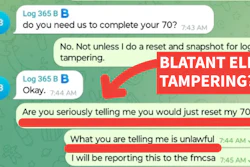
ELD tampering now officially an OOS violation
Truck drivers found by an inspector with a false log violation as a result of ELD tampering will now find themselves out of service, as the Commercial Vehicle Safety Alliance’s (CVSA) 2026 North American Standard Out-of-Service Criteria took effect today, April 1. The 2026 OOS criteria replace and supersede all previous versions, CVSA said.
As reported when CVSA’s inspection bulletin was released earlier this year, with the new OOS criteria in effect, inspectors will now differentiate between:
- Traditional "false log" violations of 49 CFR 395.8(e)(1), and
- False logs that are the result of the growing issue of ELD tampering will be recorded as violations of 49 CFR 395.8(e)(2).
[Related: ELD tampering in crosshairs for CVSA’s annual Roadcheck blitz]
A determining factor at roadside will be whether or not the inspector can "determine approximately when the actual drive and rest periods occurred," according to CVSA Roadside Inspection Specialist Jeremy Disbrow in February. For violations determined to be tampering-related, inspectors will have no ability to make a determination of just when the last rest or drive period was established.
The addition of ELD tampering to the OOS criteria is just one of 17 changes the Alliance made to the criteria this year. Review the full list of changes here.
International's autonomous truck trial in Texas
International Motors this week announced the launch of a joint autonomous truck pilot with Ryder System, Inc. that places a factory-integrated autonomous vehicle (AV) into a live freight operation.
Ryder is International's inaugural customer participating in the truck manufacturer's previously announced autonomous fleet trial program. As part of the pilot, Ryder is operating a daily 600-mile route along the I-35 corridor between Ryder locations in Laredo and Temple, Texas.
Early results from the pilot include a 100% on-time delivery rate and 92% autonomous route coverage, according to the companies. A human safety driver is present in the trucks supervising the operation, the companies said.
As part of the trial, International deployed its second-generation autonomous tractor, equipped with a comprehensive suite of factory-installed sensors -- lidar, radar, cameras -- on an International LT, powered by the S13 Integrated Powertrain and running the latest generation SuperDrive autonomous driving software from PlusAI.
[Related: Will owner-operators have to compete with driverless fleets?]
The test will bring an International autonomous truck to a dedicated route for a Ryder supply chain customer, allowing both Ryder and International to evaluate performance, reliability, and operational requirements under real-world conditions.
The pilot, the companies said, is intended to:
- Validate autonomous technology as part of an active long-haul network.
- Identify optimal use cases and near-term value proposition.
- Gain operational feedback to finalize launch-ready product.
"For Ryder, this pilot represents an important step forward -- moving beyond terminal- and maintenance-focused trials to evaluating autonomy in live operations," said Seth deVlugt, senior director of RyderVentures and new product strategy at Ryder.
[Related: Major truck OEM begins autonomous customer fleet trials]
New public comment sought: FMCSA data on railroad crossing crashes
Last May, as part of its deregulatory push, the Federal Motor Carrier Safety Administration published a notice of proposed rulemaking (NPRM) to amend the regulations related to driving at railroad grade crossings.
Currently, drivers of certain commercial vehicles -- buses transporting passengers, trucks hauling certain hazardous materials -- are required to stop before crossing a railroad track unless an exception applies, such as when the railroad grade crossing is controlled by a functioning highway traffic signal transmitting a green indication.
The agency last year proposed to add such an exemption for any railroad grade crossing equipped with an active warning device that is not in an activated state (flashing lights or crossing gates down, indicating the arrival of a train), which would allow CMVs to proceed across the tracks without slowing or stopping.
Last week, FMCSA issued a notification of data availability (NODA) to alert interested parties about information that FMCSA believes may be relevant. Using data from the Federal Railroad Administration (FRA), FMCSA has identified information on vehicle and railroad collisions, rear-end CMV fatal crashes, and signal failures. That information, which FMCSA may consider it in the context of further regulatory action, is available on the Federal Register docket here.
[Related: Owner-ops' near-miss with a train a wake-up call for regulators?]
The new data shows that very few hazmat-carrying trucks and passenger-carrying buses were involved in vehicle-rail collisions between 2016 and 2024. During the same time period, there were 10 fatal rear-end collisions at railroad crossings actively controlled by signals such as crossing gates and flashing lights, but none at crossings controlled with a highway signal that would show a green light or passive crossings marked with a crossbuck, but not equipped with an active highway or other signal.
FMCSA used FRA data to report, too, that across 71,249 active railroad grade crossings with multiple through trains per day, there are approximately 263 signal failures per year at railroad crossings.
FMCSA is now considering whether to rely on the data in further regulatory action. The NODA is necessary to disclose such possible reliance and to provide the interested public an opportunity to comment on the accuracy and relevance of the information.
The comment period for the initial NPRM ended July 29, 2025. Comments submitted in response to the NODA must be limited to addressing relevant information related to the data. Comments on the data can be filed here through April 27.
[Related: The 18 'burdensome' regulations FMCSA proposes to rescind, amend]
Ford Super Duty pickups recalled for fuel pump issue
Ford Motor Company is recalling more than 7,000 Super Duty pickup trucks that were previously recalled at the end of 2024 and repaired incorrectly, according to National Highway Traffic Safety Administration documents.
In the affected trucks, biodiesel deposits may form on the pump drivetrain roller components, which could lead to failure of the high-pressure fuel pump. Affected vehicles were built between February 19, 2019, and August 23, 2021, and are equipped with 6.7L diesel engines.
The new recall includes approximately 7,105 model year 2020-‘22 Super Duty F250, F350, F450 and F550; 2021-‘22 F600; and 2022 F750 trucks.
Dealers will update the powertrain control module (PCM) software, free of charge. Owner notification letters were expected to be mailed March 30. Owners can contact Ford customer service at 866-436-7332 with recall number 26S17. NHTSA’s recall number is 26V-158.
[Related: Massive Ford recall over trailer brakes issue hits Super Duty pickups]