










Trucking news and briefs for Thursday, Jan. 8, 2026:
- A highway that delivers electricity to trucks as they roll? It’s real on this segment in Indiana.
- NCDOT to truckers: Stay on interstates in Western N.C.
- International’s engine ready for EPA 2027.
Purdue demonstrates wireless on-highway electric truck charging
 An electric heavy-duty truck provided by Cummins charges as it drives along a test segment on U.S. Highway 52/231 in West Lafayette, Indiana.Purdue University/Kelsey Lefever
For the first time in the U.S., a roadway has wirelessly charged an electric heavy-duty truck driving at highway speeds, demonstrating key technology that could help reduce costs of building electrified highways for all electric vehicles to use.
The experimental highway segment tests a patent-pending system designed by Purdue University engineers. Built by the state department of transportation that Overdrive readers named the worst in the nation for highway upkeep in 2025, the segment gives Indiana DOT a bit of a feather in its cap for new builds. It's a quarter-mile stretch on U.S. Highway 52/231 in West Lafayette.
Purdue researchers demonstrated the wireless charging system in the fall using an electric truck provided by Cummins.
“Cummins is proud to play a role in this initiative by successfully adapting a prototype Class 8 battery-electric truck to integrate with Purdue’s high-power dynamic wireless power transfer system,” said John Kresse, chief technology engineer at Cummins. “The on-road testing went exceptionally well, thanks to strong collaboration between our teams. With its high power and promising cost structure, this technology represents a practical, and potentially game-changing, solution for the future of on-highway commercial transportation.”
The demonstration is part of a multistage research project that Purdue and INDOT began in 2018. In addition to its funding from INDOT through the Joint Transportation Research Program at Purdue, the project is affiliated with a fourth-generation National Science Foundation Engineering Research Center called Advancing Self-sufficiency through Powered Infrastructure for Roadway Electrification (ASPIRE).
[Related: Like a 'bronco buster at a rodeo': Truckers' experience of American roads today]
“With this breakthrough system, Purdue has shown that powering large commercial vehicles wirelessly is not just technically feasible but could be a practical and scalable solution for real-world highway transportation,” said Nadia Gkritza, a Purdue professor of civil and construction engineering and agricultural and biological engineering.
The Purdue system demonstrates “dynamic wireless power transfer,” with “dynamic” referring to vehicles in motion, the university said. A few other states and countries have also begun testing roads designed to enable dynamic wireless power transfer. But making this possible for highways -- and particularly for semis and other heavy-duty vehicles -- is a unique challenge. Because vehicles travel so much faster on highways than city roads, they need to be charged at higher power levels.
The Purdue-designed system works at power levels much higher than others demonstrated in the U.S. so far. Using the test segment in West Lafayette, the system delivered 190 kilowatts to a truck traveling at 65 miles per hour. By accommodating the higher power needs for heavy-duty vehicles, the Purdue design is also able to support the lower power needs of other vehicle classes.
Purdue said that with the ability for electric trucks to charge or stay charged using highways, batteries could be smaller in size, allowing the trucks to haul more cargo, which could lower equipment costs and increase revenue.
[Related: Indiana begins construction on wireless truck charging highway segment]
North Carolina DOT reminds truckers to stay off backroads in Western N.C.
The North Carolina Department of Transportation put out a reminder this week to truck drivers that “local roads near I-40 in Western NC are for drivers with four wheels.”
In a video PSA posted to Facebook, NCDOT’s Marion Ferguson said “truck drivers need to stay on the interstate.” The side roads, he said, are “curvy, mountainous roads” that “lead into gravel roads, and trucks can get into bad situations when they leave the interstate.”
Ferguson added that heavy-duty trucks should stay on either a “prescribed detour” or the main highway to avoid issues. Routes for truck drivers heading West out of North Carolina, NCDOT said, are to stay on I-40 through the Pigeon River gorge, or take I-26 West to I-81.
International’s S13 Integrated Powertrain meets EPA 2027 requirements
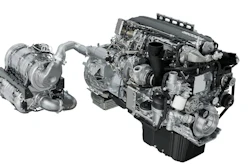
International Motors this week announced its 2027 S13 Integrated Powertrain meets the U.S. Environmental Protection Agency's (EPA) emissions requirements for 2027 model year trucks.
The 2027 S13 powertrain, made up of the S13 engine and T14 transmission, carries more than 90% of the hardware from the current platform, which includes consistency in service tools, parts, and technician training, International said. Truck owners can expect similar fuel economy, driving experience, and powertrain weight as today's S13 Integrated Powertrain.
"We've been preparing for EPA 2027 for years. Our customers won't face surprises, only the same proven powertrain," said Dan Kayser, executive vice president, Commercial Operations, International. "Our customers get a reliable solution without unnecessary complexity."
The S13 Integrated Powertrain enables a compact, efficient design that meets nitrogen-oxide (NOx) regulations without unnecessary complexity.
[Related: EPA won't delay 2027 NOx rule, but plans 'major changes']
New features for 2027 in the powertrain:
- S13 engine: Variable Valve Timing (VVT), which enables Variable Valve Braking (VVB) for improved braking performance, closed crankcase breather, oil centrifuge
- T14 transmission: 24V Transmission Control Module with predictive shifting using GPS/topography data
- Electrical architecture: Reduces complexity by using a standardized 24V electrical architecture across the entire powertrain platform; 24V alternator, starter, and engine controllers for improved cold-crank performance and durability, while retaining a 12V cab and chassis electrical system for battery accessories and body controls.
The 2027 powertrain also eliminates exhaust gas recirculation (EGR), International noted.
The S13 Integrated Powertrain is approved for use with R100 renewable diesel, reducing well-to-wheel carbon footprint without any hardware changes, the company added. Trials for B100 biodiesel compatibility are underway, reinforcing International's commitment to practical sustainability.
[Related: $9,500 tariff on a new truck? 2027 prebuy in question]