











With huge focus from inside and outside trucking on driver training and qualifications, the Federal Motor Carrier Safety Administration has signaled it intends to weed out training providers that aren’t doing what they’re supposed to be doing.
Will that really improve driver training and safety?
 A.J. Frankie
That’s not to mention the Trump administration’s intensified focus on ELP, beginning in April with the executive order to return ELP violations to the out-of-service criteria.
While Frankie generally agreed that ensuring all CDL holders can communicate in English is a good move, he didn’t see that as the biggest safety issue going or the first place to start to improve highway safety.
Frankie said he’s “1,000% for [ELP] being enforced. It should have never not been enforced. … You have to be able to read, write and speak English. I don’t think anybody’s who’s for the [non-domiciled CDL] rule is saying, ‘No, you can’t be a foreigner and get a CDL in the United States, ever.’ That’s not what they’re saying. You just gotta follow the rules.”
The bigger issue from his vantage at the helm of a CDL school is that the Entry-Level Driver Training (ELDT) requirements need to be “reworked,” he said.
“The government’s putting a lot of scrutiny on the [English language proficiency] requirement. OK, great, you guys are doing that so that you make the public feel safe,” he said. “That’s not where the problem starts. The problem starts with the lack of training, and the lack of training is coming from the ELDT requirements. And that’s coming from somebody who’s in a CDL school saying the requirements are not what they should be.”
The ELDT rule was finalized in 2017 and took effect in 2022. It established standards any driver looking to get a CDL had to meet through training. It also required training to upgrade a CDL from a lower class (such as moving from Class B to Class A), or to add hazmat or any school-bus/passenger endorsements.
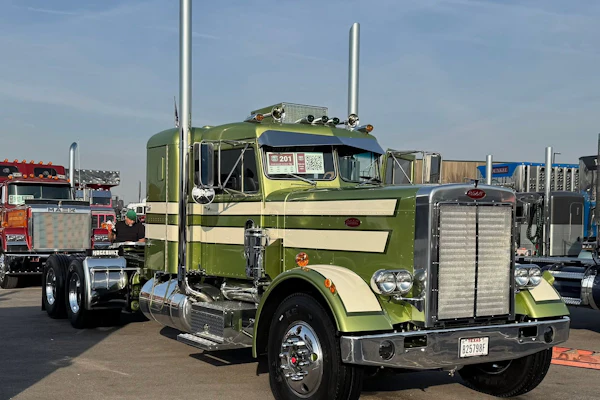
[Related: OTR to CDL school owner: A.J. Frankie and the 'School Daze' '92 T600]
The ELDT rule included requirements for both classroom/knowledge training and behind-the-wheel training, but it didn't include a set number of hours for that behind-the-wheel training.
Current requirements are such that too many training providers just teach to the test, according to Frankie. “They’re not teaching anything else. And so, right now, you don’t really have truck driving schools. You’ve got a four-week training school that’s teaching them this, that and the other, and they don’t really know anything before they leave.”
At his Driving Academy Tallahassee location, he teaches “every maneuver -- blindside, sightside," he said. "We make them back up short trailers in the yard and drive the long trailers on the road, because obviously backing a short trailer is harder than backing a long trailer.”
Trainees get experience “in long trucks, sleeper trucks with long trailers, sleeper trucks with short trailers, day cabs with long trailers, day cabs with short trailers, to try to help them,” he added. “We teach a lot of things that aren’t part of the curriculum” for ELDT.
While some of those maneuvers are included in the behind-the-wheel training requirements, the rules would be better served by more variation in their behind-the-wheel training components, as well as more time required behind-the-wheel, he feels.
Training requirements shouldn't just stop with the license
When a driver leaves a training program, passes the skills test, and gets that first driving job, Frankie feels employing carriers could do a lot better easing them into the work. In fact, he feels new CDL holders should be required to "be with a trainer for a certain number of miles that they drove, not team, that they drove,” he said.
While today it's certainly no universal situation for a new CDL holder to begin employment with more training, Frankie emphasized the quality, or lack thereof, of post-CDL training provided by fleets.
“There should be requirements for what you have to do to become a trainer with these trucking companies," he said. "That’s where our government’s messed up.”
[Related: FMCSA pins 'CDL mills' problem on self-certification: Are owner-ops to blame?]
He echoed sentiment long-expressed by owner-operators about some larger carriers’ practice of putting a driver with only a couple months of experience into a training role with new hires.
“I’ve been driving for 40 years,” he said. “I don’t know everything. I learn something new every day. Can I drive? Yeah, I can drive. But does that make me perfect? No. Does it make me know everything? No. So, they need to change some of those requirements so that you can’t take a student to train a student.”
Frankie sees it as a big reason trucking writ large has a problem retaining younger drivers.
“They get a bad trainer,” he said. “They get a bad taste in their mouth, and there’s a lot of good guys -- I see them come to my school -- they come through, they want to do well. And I tell them, don’t let a bad trainer ruin your career. You know what’s right, you know what’s wrong. We’ve taught you the difference between right and wrong here. Don’t go do something you know you’re not supposed to do.”
Drivers he trains, he said, might end up with a good trainer or a bad one, “but until the government starts changing some of these requirements, we’re not really going to see safety on the road get any better. Until they start checking on these CDL schools -- and yeah, I’m a CDL school saying, 'come check.' They need to be checked on. Until that changes, we’re really not going to improve safety.”
[Related: FMCSA's training-provider purge: 'Crackdown' or cleanup?]
FMCSA's efforts to clean up its Training Provider Registry, as noted up top, are ongoing; recent Overdrive reporting revealed another 4K or so providers removed from the registry. Frankie's urging the agency to conduct real audits of CDL schools.
When the ELDT regulation was negotiated a decade ago, former owner-operator Scott Grenerth was Director of Regulatory Affairs with the Owner-Operator Independent Drivers Association. He and the association urged FMCSA at the time to take a data-driven approach to policing trainers.
Early in the rulemaking process, he presented to the ELDT rulemaking committee a way the agency could itself utilize the safety performance data of new CDL holders to "evaluate the effectiveness of training providers," Grenerth said. It's a phrase memorialized in minutes from more than one committee meeting. If the agency saw new drivers "failing inspections with bald tires or brake chambers hanging off, or getting in crashes" a close look at the trainer might be in order.
In other words, real OTR performance might provide FMCSA auditors an effective way to target enforcement efforts against schools that provide substandard training.
A.J. Frankie might well agree.
Ultimately, in his mind, “if the government really wanted to do something about safety on the highway, they would revamp everything starting at the top, not the bottom up -- not with ELP and work their way up here" to the training providers and the standards they're operating under.
"No," he added, "you should start up here” with driver training regulations, “and say what’s wrong with the training program ... and work your way down.”
[Related: FMCSA removes 3,800 schools from Training Provider Registry amid 'CDL mill' purge]