











"There's a lot of loopholes in a lot of places, systematically, but they're blaming the driver for everything." --owner-operator Jorge Rivera Lujan, about the federal non-domiciled CDL rule changes
Off the top of this week's edition of Overdrive Radio, an introduction to Utah-based one-truck independent owner-operator Jorge Rivera Lujan.
As hinted at in the quote above, he speaks to what he sees as a fundamental flaw in the Federal Motor Carrier Safety Administration’s September Interim Final Rule that would (and already has in some ways) severely restrict non-domiciled CDL issuance to a variety of classes of non-U.S. citizens.
Those include asylum seekers in immigration limbo, as well as many others but for a select group of visa holders.
The rule seeks to cut off CDL access for folks like Rivera, too. He's a recipient of the protections offered by the Deferred Action for Childhood Arrivals (DACA) program since near the time it became policy in 2012, as you’ll hear.
If the owner-operator's name sounds familiar, that’s because he is the named plaintiff in the title of the court challenge to the non-domiciled rule, filed shortly after he and many other non-domiciled CDL holders realized that, under the terms of the rule, they wouldn’t be able to renew their licenses or get another kind of CDL to continue their work.
In his case, it was a direct threat to work and business he's done now for more than a decade. Rivera has been in the U.S. since he was brought here at a very young age by his parents. The owner-operator’s younger brother is in trucking, too, with a small fleet now that’s a separate business from the elder's.
The younger brother enjoys a key difference from Rivera, though -- the brother was born here, and is thus a U.S. citizen. The pair of businesses help each other out where needed, hauling for some of the same direct customers time to time.
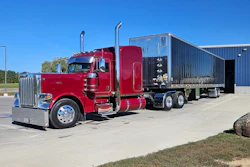
 "I own my equipment," said Rivera Lujan, since 2019 this "pavement-sniffer" aerodynamic 2014 Peterbilt 386, along with a 2022 vintage dry van purchased new during the COVID pandemic, he said. "People just assume that by being non-domicileds that we're just taking cheap freight. If you're a businessman you're a businessman, no matter what your immigration status is."
Aside from some side non-trucking business, Rivera fundamentally is like so many among Overdrive's principal owner-operator readers with motor carrier authority. "I have one truck, and I have some direct customers," he said, "because who says you have to use brokers all the time?"
[Related: Owner-operator holy grail: Decades of direct freight in a custom 1981 359]
Jorge Rivera’s in agreement with many around trucking that the English proficiency standards should be enforced, yet he feels in the wider public's imagination ELP problems are blamed on the non-domiciled CDL as if they were one and the same. Too many paint non-domiciled CDL holders in the country today with a broad brush, ignoring realities of those like him, in business for themselves for years and raised almost entirely in the United States.
Are there problems with many such CDL holders’ licenses extending beyond their legal stay in the country? Sure, as has been demonstrated, but isn't that the issuing state's fault?
Do non-domiciled CDL holders exist who shouldn’t be hauling over-the-road because their English skills aren't sufficient for safe operation or for other reasons? Again, sure, but one might say the same about plenty native-born citizens with CDLs who could use a lot of additional training and whose crash records seem to suggest it.
Fundamentally, he feels those conditions aren't reason to curtail most all non-domiciled CDL issuance, and too many people seem willing to just throw long-term U.S. residents like him and plenty other documented visitors/immigrants -- who pay taxes, who do have legal presence and in his case have built businesses over many, many years -- under the proverbial bus.
Rivera's not alone, either. Our December report showed that while Overdrive readers strongly supported FMCSA's non-domiciled CDL purge, about 10%-15% admitted they recognized that many drivers would get punished for the sins of a few bad apples.
The trucker has a lot to say generally about immigration, about his own path toward as-yet-unrealized citizenship, and the trucking markets writ large post-COVID. Likewise: where he feels regulators might best really focus their attention when it comes to credentialing -- rather than dropping a bomb on the endpoint of the CDL-issuance food chain, as the case may be: the driver.
So far, the U.S. Court of Appeals for the District of Columbia Circuit seems to agree. Hear Jorge Rivera Lujan's story here:
The man is not without a sense of humor, I'll say. When we talked over video conference he raised a coffee mug emblazoned with the logo below, his cheeky way of illustrating his point about the confusion between ELP concerns and the FMCSA's non-domiciled CDL rule change in the public mind.

It reminded me a bit of one owner-operator's old take on the Certified Clean Idle stickers with respect to the state of California back when California banned most pre-2007 power units from operating in the state. Owner-operator Chris Thomas's take back then on many owners' subsequent approach to the state certified the power unit "not to enter the Republic of California."
As mentioned in the podcast:
- New Jersey might not be the only state now at least renewing non-domiciled CDLs -- Jorge Rivera Lujan's CDL expired in November, yet he's still trucking. The state gave him a one-year extension after the court's ruling stopped the new rule for now.
- North Carolina put on notice by FMCSA for non-domiciled CDL problems.
- Nevada ending non-domiciled CDL program entirely.
- Jorge Rivera Lujan v. FMCSA contends non-domiciled rule unlawful.
- Court's stay of the rule.
Interested readers can download the initial lawsuit's petition for a stay of the rule, ultimately successful, in full via this link.
[Related: Even 21% of non-citizens support DOT's non-domiciled CDL purge]