Over the holidays, the state of California worked feverishly to keep some 20,000 non-domiciled CDLs in play despite repeated, plain-language orders from the U.S. Department of Transportation.
At the end of business hours on January 5, that decision cost California $160 million, and new reporting gets inside the state v. federal fight that played out across the month of December.
California chalks up much of the funding loss to getting ghosted on a meeting with the Federal Motor Carrier Safety Administration on Dec. 19.
The $160 million blow represents the culmination of bickering that's gone on since September, when DOT said an audit of non-domiciled CDL issuance in California uncovered that fully 25% of the state's 65,000 such CDLs were issued improperly.
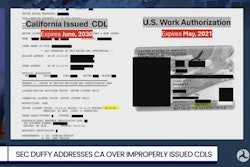
Most of the problem was due to the licenses having an expiration date months or even years after the driver's legal presence or work authorization in the U.S. expired.
At that time, DOT ordered California to revoke all wrongly issued CDLs, but the state objected. In October, California flat-out refused to revoke some 20,000 non-domiciled CDLs that contained errors, saying federal regulations did not in fact prevent CDLs outlasting an applicant's legal presence.
California did, however, admit the state itself has a law requiring CDL expiration dates to match legal presence documentation. As such, it finally agreed to revoke about 20,000 CDLs, starting with a batch of 17,000.
Then suddenly, in early December, the state made an about face. perhaps spurred on by a lawsuit from the Sikh Coalition and the Asian Law Caucus demanding the licenses remain in force. California sought to extend the cancelation date on the 17,000 CDLs from Jan. 5 to March 6.
[Related: Sikh Coalition sues California to get non-domiciled CDL issuance back]
Yet U.S. DOT and FMCSA have been clear since September: California must "revoke and reissue all noncompliant non-domiciled CDLs if they comply with the new federal requirements."
By extending the deadline, California seemed to make clear it simply didn't want to revoke the licenses. The state's Department of Motor Vehicles said it hoped the 60-day extension "allows the parties to find a solution that permits drivers to remain working to serve our communities."
Here's the blow by blow of what transpired in the week before Christmas that ultimately cost California $160 million.
- Dec. 18, California DMV met with FMCSA to review California’s steps to achieve compliance. FMCSA agreed that re-terming, or re-issuing licenses with the correct expiration dates, is reasonable and can be done in phases. FMCSA staff wanted a demonstration for how the re-terming would work. FMCSA in this meeting indicated the need for a follow-up meeting for the next day. The DMV sent out the invitation for a 10 a.m., Dec. 19 meeting. FMCSA regional staff accepted.
- On Dec. 19 at 7 a.m. PST, FMCSA notified the DMV that staff would not be available. The DMV followed up with multiple emails and calls to reschedule, which were unanswered.
- Dec. 22 and 23: The DMV tried to contact FMCSA again but received no response.
- On Christmas Eve, Dec. 24, the DMV emailed FMCSA to notify the agency that the DMV would move the Jan. 5 date and received no response.
- Dec. 30: Overdrive reported that California DMV extended the cancelation date of approximately 17,000 non-domiciled CDLs 60 days, as the worked with representatives of FMCSA to resolve their concerns with DMV's CDL licensing process prior to March 6, 2026.
- The same day, DOT Secretary Sean Duffy said California Governor Gavin Newsom was "lying" about the extension and FMCSA's sign off, and that California faced the $160 million penalty if it didn't revoke the licenses.
- On Dec. 31, Newsom responded in a post saying DOT staff were open to the extension and failed to attend the later meeting. "That’s not California 'lying.' That’s federal mismanagement -- something we’ve unfortunately come to expect under your 'leadership,'" Newsom wrote on X/Twitter.
- On January 7, Duffy shared the below tweet saying it was "reckoning day" for California.
🚨It’s RECKONING DAY for Gavin Newsom 🚨
Our demands to California were simple:
➡️ Follow the rules
➡️ Revoke the unlawfully-issued licenses to dangerous foreign drivers
➡️ Fix the system so this never happens again
Gavin refused. So now I am pulling nearly $160 MILLION from… pic.twitter.com/j2ckDLlRdI
— Secretary Sean Duffy (@SecDuffy) January 7, 2026
In response, California lamented the loss of funding and said it was a threat to road safety.
"We strongly disagree with the federal government’s decision to withhold vital transportation funding from California -- their action jeopardizes public safety because these funds are critical for maintaining and improving the roadways we all rely on every day," a spokesperson for California DMV told Overdrive.
The California DMV said it's "fully compliant with state and federal regulations," despite admitting in October that it had issued thousands of CDLs that expired long after a driver's legal authorized stay or work permission in the U.S.
[Related: California explains why it upgraded Jashanpreet Singh's CDL days before fatal I-10 crash]
DOT said the state's "narrative conveniently omits that the January 5 cancelation deadline was explicitly and mutually agreed upon by both California and FMCSA, and that FMCSA rejected their extension request.
"By unilaterally violating this agreement in brazen defiance of federal safety standards, California is knowingly permitting thousands of drivers holding noncompliant licenses to operate 80,000-pound commercial vehicles, jeopardizing the safety of America’s roadways."
If California remains out of compliance with DOT, it could also lose a similar amount of money next year, and, eventually, lose its ability to issue CDLs at all.
[Related: DOT makes it official: California loses $160M over non-domiciled CDL battle]