











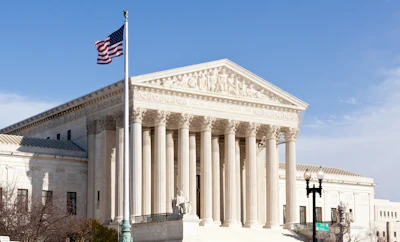
The U.S. Supreme Court on Tuesday declined to hear the state of Florida’s lawsuit against the states of California and Washington stemming from the headline-grabbing, triple-fatal crash on Aug. 12 last year that was effectively the tipping point for the federal crackdown on non-domiciled CDL issuance.
Following the crash involving Harjinder Singh, whose illegal U-turn on the Florida turnpike killed three, Florida sued the West Coast states over California’s English language proficiency enforcement, or lack thereof at the time, and Washington’s mistakes in issuing Singh a CDL.
The lawsuit asked the Supreme Court to make two major judgements:
- "Declaratory judgment that California’s and Washington’s sanctuary laws, to the extent that the laws prohibit agencies administering CDL programs from inquiring into or collecting information about an applicant’s immigration status, are preempted" by federal law, according to the suit, and:
- "Declaratory judgment that California’s and Washington’s failure to enforce proper safety and immigration-status standards is a public nuisance."
The lawsuit went on to ask for preliminary and permanent injunctions "ordering California and Washington and their agents to cease the issuance of Commercial Learner’s Permits and CDLs" to non-citizens who don't have permanent legal status.
[Related: Florida sues California, Washington for issuing CDLs to 'illegal alien' Harjinder Singh]
The Court denied Florida’s request to hear the case without comment. Justice Clarence Thomas, along with Justice Samuel Alito, wrote a dissenting opinion noting that they would have heard Florida’s case “because we cannot refuse to hear suits between States.”
Thomas’ dissent highlighted that Florida was asking SCOTUS for permission to file a lawsuit against the two states “based on how those States provide CDLs to foreign drivers.”
He added that Florida was claiming that federal law preempts state laws “to the extent that they prohibit licensing officials from asking applicants about immigration status. Florida also claims that both States’ disregard of federal commercial licensing standards constituted an actionable public nuisance. According to Florida, enforcement data suggest that neither State is adequately checking CDL holders for English proficiency.”
In his dissenting opinion, Thomas said Congress gave SCOTUS “exclusive original jurisdiction” in cases involving two or more states, “meaning that no other court can hear this case,” he added. “I doubt this Court has discretion to refuse to hear cases within its exclusive original jurisdiction.”
Despite this, Thomas said the Court “has adopted a discretionary approach to its exclusive original jurisdiction based on ‘policy judgments that are in conflict with the policy choices that Congress made in the statutory text specifying the Court’s original jurisdiction.’”
Even under that “discretionary approach,” Thomas added, SCOTUS “likely should have granted Florida leave to file its complaint.” He noted that the Court considers two factors in cases involving two or more states:
- “The nature of the interest of the complaining State, focusing on the seriousness and dignity of the claim”
- “The availability of an alternative forum in which the issue tendered can be resolved.”
Thomas said he believes Florida met both standards with this case.
“This Court declines to even hear Florida’s claims, even though it has nowhere else to bring them,” Thomas concluded. “Because I would allow Florida to file its complaint, I respectfully dissent.”
[Related: Vehicular homicide charges for driver after Florida turnpike U-turn crash kills 3]