










Trucking news & briefs for Thursday, June 11, 2026:
- Broker group TIA says it's petitioned for release of lists of motor carriers with high CSA category percentiles. Congress forbade FMCSA disclosure of category scores in 2015.
- TCA's new policy paper outlines a blueprint for more-comprehensive safety rating.
TIA pushes for public list of 'high-risk' motor carriers, selection standard
Broker group the Transportation Intermediaries Association called on the federal government to establish a uniform safety standard for selecting a trucking company.
TIA said the recent U.S. Supreme Court decision has placed an "untenable" burden on freight brokers. The ruling removed a key defense brokers have used to deflect personal injury suits after a carrier they've contracted is involved in an accident.
TIA formally filed a petition for rulemaking Tuesday this week, the association said, demanding the Federal Motor Carrier Safety Administration determine a federal Motor Carrier Safety Selection Standard for middlemen and others and publicly release a "High-Risk Motor Carrier List" to flag unsafe trucking companies.
The list would be based on internal agency percentile rankings for carriers above intervention thresholds in the CSA Safety Measurement System's categories. TIA, noted President Chris Burroughs in this LinkedIn post, is pushing for a public list of trucking companies whose rankings exceed federal thresholds in:
- Any three or more categories
- Any single category among Unsafe Driving, Crash indicator, Hours of Service Compliance or Vehicle Maintenance, which Burroughs called the "most critical categories."
With the FAST Act highway bill, Congress barred FMCSA from publishing carrier percentile rankings more than a decade ago.
TIA called for change, saying a carrier’s safety issues too often only come to light after a catastrophic crash. "In the interim, the industry and the shipping public need clarity, consistency, and certainty," said Burroughs.
Irrespective of the SMS categories, the group said more than 90% of authorized motor carriers currently operate without an FMCSA safety rating, a responsibility of the agency long required by Congress.
Among the nearly 200 owner-operators and small fleet owners with authority who've so far responded to ongoing Overdrive polling about the rating issue, just less than half of respondents reported having a rating currently.
Safety ratings numbers overall were on a slow upward trend until year 2025, when overall ratings fell off a cliff.
[Related: FMCSA safety ratings fall off a cliff]
TIA in some ways echoed the view of S2 International head and TIA member Jennifer Mead voiced in this week's Overdrive Radio podcast, arguing the current selection-standards landscape effectively forces brokers and shippers to act as regulatory enforcement eyes for the government, without clear rules or enough guidance.
"We should be able to rely on the government" and its ratings, she said.
As have so many owner-operators and trucking associations, TIA credited the current administration for taking more steps to improve oversight than any recent predecessor. Yet the broker group noted those efforts will take time to yield results.
Any proposed federal standard, TIA said, would outline specific, reasonable steps for selecting motor carriers to create a more predictable operating and legal environment.
Recent legislative efforts on a highway bill haven't waded into the FMCSA's safety rating program, though the National Association of Small Trucking Companies recently urged Congressional oversight of safety rating in light of the SCOTUS ruling.
In 2023, FMCSA issued an Advance Notice of Proposed Rulemaking seeking feedback on ways to use data to make safety ratings, principally of the "unfit" variety. There's been no further published action since the comment period was extended late in that year.
TCA outlines its own blueprint for FMCSA rating in policy paper
The Truckload Carriers Association called for federal reforms to modernize FMCSA, warning of a staffing shortage at the agency.
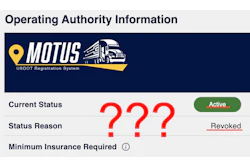
The association's newly released policy paper urged Congress and the U.S. Department of Transportation to realign resources, modernize registration systems (under way with FMCSA's May launch and ongoing rollout of Motus), and update how the government determines carriers' safety fitness.
The current manpower-intensive safety rating process should be replaced, TCA said, with a "single integrated oversight lifecycle that uses all available operational data" -- from registration information to roadside inspection and crash data, warning letters, and targeted audits -- "to produce timely, reviewable, and public fitness determinations."
[Related: Truckers caution against use of roadside data in safety ratings]
TCA's paper goes on to suggest modification or outright removal of responsibility from FMCSA for things that "consume scarce resources without materially improving crash prevention," naming "consumer protection regulations, broker transparency, and driver pay and detention" among them.
Congress should "adopt a general rule that any new statutory duty imposed on FMCSA must be tied directly to crash reduction and core CMV safety oversight and be accompanied by dedicated funding, staffing authority and a clear explanation of why the function belongs at FMCSA rather than elsewhere in DOT or the States."
[Related: What's happened to broker transparency]
TCA President Jim Mullen said that while the agency’s responsibilities continue to grow, resources remain stagnant.
"FMCSA is responsible for overseeing one of the largest and most diverse regulated populations in the federal government, yet it remains one of the smallest agencies within USDOT," Mullen said. "This imbalance compromises safety, weakens oversight, and leaves the motoring public at risk."
The report highlighted that the agency employs just 1,118 workers to oversee nearly 8 million regulated entities. That represents a ratio of one employee per 7,155 entities. By contrast, the Federal Aviation Administration employs more than 45,000 personnel to oversee about 7,400 commercial aircraft operators.
Other TCA recommendations:
- Substantial increases in safety staffing and dedicated funding.
- Pre-operational reviews for FMCSA registrants.
- Strengthened oversight of commercial driver's license testing and training.
- Improved crash causation analysis.
[Related: FMCSA fully engaged with owner-ops: OOIDA]