











Nine years out from the 2017 electronic logging device mandate protests, which inspired the first TenFour D.C. events in the nation’s capital over the next years, Wyoming-based small fleet owner Mintu Pandher reflected on that watershed moment.
“Maybe 2017 was actually a good effort,” he said in conversation with myself and Overdrive editor Todd Dills a few weeks back. “But I would say it didn't take momentum because nobody thought how badly we needed unity. And, you know, we did have something on our mind. … When this ELD would come in … it [was] not going to be beneficial.”
There was nonetheless something special about 2017 in D.C., when a diverse group of truck owner-operators and drivers traveled to D.C., staged with signs outside Congressional offices, parked up along Constitution Ave. near the White House, and otherwise made a case against the mandate in private meetings with regulators and others.
And amongst themselves, no doubt.
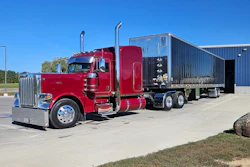
You had this moment when good ol’ boy truckers joined forces with drivers from every race and creed to protest the mandate’s implementation. Groups that hadn’t really spoken much before were in alignment. Small fleet owner-operator Pandher was among those speaking for truckers in D.C. that year, his pristine blue Peterbilt staged outside the White House with a nearby sign that said, simply, “The independent trucker: We will not go away.”
 A picture from the time on Constitution Avenue with Pandher's Pete in D.C.
Anyone who had the privilege of viewing the Punjabi-American’s viral Facebook live video at the time, laying out the case against ELDs to the FMCSA, witnessed a master class in civil engagement. It was a standout moment for Pandher, now a 27-year veteran of America’s highways. I spent quite some time trying to locate that video (apparently a casualty of the platform’s new-ish thirty day expiration date). In it, Pandher, like so many others, warned FMCSA that electronic logs would deliver no safety benefit.
Indeed the rise in post-mandate crash rates reported by Overdrive four years later seemed to confirm the point of view.
[Related: ELDs and highway safety: Crashes, injuries, fatalities rise post-mandate]
Pandher’s current assessment of the mandate’s aftermath describes an industry evolved to run on cutthroat data mining, presenting a bonanza for the larger players.
 Pandher from the time in D.C.
That’s his fundamental take.
“I don’t think ELDs have a lot to do with safety,” he said. “I think it was more of a business-grabbing opportunity. I can definitely tell you the little guys don't have access to [the same] kind of money and … loads anymore.”
[Related: 'Bringing the cultural diversity of trucking together': ELD protest outcomes]
Diesel fuel: Nobody has any control
Mintu Pandher’s in both trucking and fuel businesses, owner of both an 11-truck fleet as well as the Akal Energy fuel stop chain, with locations in Nebraska, Wyoming and New Mexico. Everything’s changed for those businesses as wholesale fuel buyers, he said. Once driven by seasonal, cyclical trends, the fuel market is now more news-driven than ever.
[Related: How much with diesel go up tomorrow?]
“If you know the market is going up 40 cents today, you know, people are definitely going to jack up the prices, not to make money,” he said. “They don't want to buy the high-dollar diesel tomorrow. They want to hold on to it and hope that it will go down day after next, because this market is so volatile. I mean ... nobody knows what's going on. This market is all speculators."
In past, he added, “we used to have a chart based on crop seasons, harvest seasons, you know, tourism. We used to have those basic fundamental rules like, OK, mark summer holidays coming up -- gas prices will go up.”
With market speculation reacting instantly to news all around the world today, price swings come hard and fast, absurd when you really think about it.
He invoked the mental image of a barge full of oil/fuel floating in the ocean. “Their prices are going up just sitting there?” he said. “Nobody has any control. I mean, the market is all online. Basically one little thing and it reacts so bad that you’re thinking, ‘Wait a second, that's not how the rules are set.’ We think about a product sitting here in Artesia, New Mexico. Why [did it] go up a dollar more in three days?”
'Clean up your mess'
FMCSA’s moves against non-domiciled CDL holders in the wake of the Harjinder Singh Florida U-turn fatalities last year have been headline news ever since.
Pandher, a longtime advocate for ensuring legal permanent residency is a prerequisite for driving a truck in the U.S., also warned the FMCSA about unqualified drivers taking advantage of lax enforcement dating back to 2017, according to posts on his social media accounts.
His admonitions to trucking newcomers flouting rules fell on deaf ears.
As he put it recently, “We told a lot of guys, ‘Yeah, you’re taking advantage. [The] system is going to catch up to you. You might want to clean up your mess.’”
He didn’t get a warm reception to the notion, from them or from regulators.
Say “you let anybody become a doctor,” Pandher drew out an analogy. “I mean, you would have chipmunks walking around with stethoscopes around [their] necks. Then you would say, ‘what happened here?’”
Barriers for new entrant CDL holders and trucking companies should be stronger, he felt. “Now they're making [getting] the DOT number hard, but God, how hard was it 20 years ago? I know people who have had a dozen DOT numbers!”
Looking at the Punjabi-American community of which he is a member, he sees a distinction between those who immigrated following Indian-government repression of Sikhs in the 1980s and 1990s and more-recent waves of arrivals.
[Related: 'Our Punjabi brothers' portrait of a protest, a trucking community, and changed hearts and minds]
“People [who] came early, they were very successful,” he said, and “didn't become successful on the back of some … American, or try to destroy the market.”
A reckoning has been a long time coming, he felt, “but the system did catch up ... because the system is based on data. Data will tell you what the [non]-domiciled drivers’ input to the economy is,” likewise “what the outtake is. And when [that] doesn't balance, it's going to tighten its claw against your neck. There’s no ifs and buts about it, you know.”
Authorities, he felt, finally recognized a problem. Harjinder Singh’s triple-fatal attempted illegal U-turn more than a year ago now “was just a final nail on the coffin. But this thing has been brewing for years. You know a lot of states like Wyoming, every time we go to the legislative meeting, I mean, that was the issue. State patrol would come in and beg, ‘Hey guys, could we make some kind of enforcement in the winter time so people that don't speak English, you do not let them on the highway? Because man, as soon as you open the damn highway, two hours later we have to shut this thing down again. Because the guys are doing 90, 80 miles an hour.’...
“When these voices got louder and louder, and that guy made a U-turn, he brought national attention. And it's so unfortunate. We always need a catastrophe or a big misery” to bring change.
Pandher, who came to the U.S. with a history professor father and other family in the 1990s, has trucked here since 1999. Those who came here back in those days “came to the U.S. as a home to stay, because they were [victims] of, you know, persecution back in India. … We all left that, you know, state and country back then. So those people, they had no plan to go back, when going back is imminent death or persecution or political pressure. So people came here. So when you come here for good, this is your home.… Like Irish people left Ireland, you know, Scottish left Scotland, Jews left Germany, France. So they came to [the] USA.”
I had to wonder whether the small fleet owner’s approbation of current FMCSA policy toward non-domiciled CDL drivers was enough to keep him from being swept up in some scalehouse crackdown by an overzealous ICE agent. His belief in the need for change is undeterred.
“I think they’re only going for the non-domiciled,” he said. “I believe that the only reason they're going for non-domiciled, you know, it's the safety. I know a couple of guys in the DOT” increasingly reluctant to be involved with immigration enforcement. “DOT is kind of backing off from that, not much, but little by little, because they are seeing more people making bigger mistakes just to avoid the ICE stops. So the normal traffic stop is turning out to be chaos.”
He told a tale of a driver pulling into a scale in Colorado who, when he saw an ICE agent there, didn’t even get the truck parked before he was out of it and running across the interstate for the forest. Scale personnel were “just kind of flabbergasted, like, ‘wait a second, this truck is rolling and what do we do now?’” as Pandher told it. “One day it's going to be a big catastrophic event on the interstate.”
I wrote about alt-country troubadour Mary Gauthier some years back now here. She’s got a line that aptly illustrates some of these dynamics. “There’s a pendulum in motion, and you can’t outrun this swing.”
As the blunt instrument of federal regulation permanently alters the lives of at least 200,000 truckers via the FMCSA’s final ruling on non-domiciled CDLs, oral arguments on behalf of DACA recipient and Utah owner-operator Jorge Rivera Lujan and others impacted, pleading for nuance, wrapped up Sept. 15.
Still, there are few who disagree with Mintu Pandher that something had to be done. Personally, I’ve been in Wyoming and had my doors blown off on snowy roads by more kids in ragged-out Volvos with taped-on door signs than I care to remember.
A big question remains for me, though: Can the U.S. get by logistically without visitors' labor? Regulators seem to think so, and the visa carveout in the non-domiciled rule does present a path for many to a CDL. What are your thoughts?
Give me a shout: [email protected]
 Overdrive Radio's sponsor is Howes, longtime provider of fuel treatments like its Howes Diesel Treat anti-gel and Lifeline rescue treatment to get you through the coldest temps, likewise its all-weather Diesel Defender and Howes Multipurpose penetrating oil, among other products.
[Related: Lujan v. FMCSA: Non-domiciled CDLs in court, full arguments for and against]