











Truck Parking Club, the paid-parking giant with more than 6,000 locations across the country, also commands a small army of online influencers, and works behind the scenes to shape public opinion, especially reviews.
- TPC insiders told Overdrive the company tracks down drivers behind every single bad review and offers incentives to change their minds.
- TPC CEO Evan Shelley also described financial relationships with about 100 influencers, a few big sponsors, and even one major freight media brand.
- Four former TPC employees alleged a toxic work environment, which Shelley addresses here.
- This is one part of an Overdrive series revealing how TPC has managed marketing and customer/staff relations on its way to the top of the paid-parking heap.
With dozens of paid “partners” posting online about the company, a research paper pushed by a PR agency, and longstanding ties to a major industry publication’s leadership, it's clear TPC cares deeply about what truck drivers think, and say, about it.
Luckily for TPC, there’s a lot of love out there.
“If someone's just making a video to be nice, which we see that from time to time, or they make a post and there's not a promo code in there, there’s a 99.9% chance that there's no partner relationship at all,” said TPC CEO Evan Shelley.
Truck Parking Club has a 4.6 (out of 5) star rating on the Apple App Store. Its locations, on the app, mostly boast good reviews, with many full five stars.
But there's also a sizable amount of venom out there.
Former TPC employees told Overdrive reviews are often not on the level, and Shelley admits the company seeks to get in front of every single bad review ever written.
Furthermore, the TPC employees discussed a demanding and cliquey culture at the company, where all reported feeling pressured to get bad reviews overturned. On Indeed, a website that allows employees to review employers, TPC’s rating is 3.9 of 5, with two reviews criticizing leadership in particular.
Overall, though, even former TPC employees who took issue with management, felt belittled, or had been fired liked the remote work, the nature of the job helping drivers, and the "Airbnb of truck parking" concept.
How Truck Parking Club polices bad reviews
“Every time” a bad review for a TPC property hits, a TPC employee will begin trying to track down the reviewer, hear them out, and often offer them free stays at TPC properties or free hats and gear, said one early employee.
TPC requires customer service reps to be former drivers, which goes a long way toward clearing up misunderstandings with platform users, but sometimes employees are highly incentivized to eliminate bad reviews, several former employees said.
“I got wrote up because [a driver] left a bad review,” one former employee who worked with property owners said. “Every time we got a good review [TPC paid] us 10 bucks.”
Shelley denied that bad reviews, a volatile measure, would be used in staffing decisions or performance reviews, but the former employees all felt TPC’s leadership prioritized online reviews, and used review stats to decide who got promotions or would keep their jobs.
The employee who worked with property owners put it this way: “All the good reviews are garbage, they’re fake, just there because someone got paid to do it,” they said. “All the bad reviews are real.”
That employee did acknowledge sometimes drivers are mistaken, and that outreach helped clear up a lot of those mistakes.
Shawna Taylor, a former driver and former customer service rep at TPC, said she enjoyed helping drivers, but felt top management’s focus on spotless reviews turned the job into a “nightmare,” in her view.
“In the beginning it was great," said Taylor. Management "would drive it into us almost daily about reviews, reviews, reviews. There were even contests: X amount of good reviews and you’ll get a $25 Amazon gift card. Who doesn’t like free money?”
But controlling TPC’s image turned into an obsession, Taylor and other former employees felt, making the workplace toxic.
“It became a nightmare -- if there was one bad review, [management] wanted us hunting them down, to call them, email them, and do everything in our power get hold of the driver and see what could we do to change it, change their mind, fix it," said Taylor. "It didn’t even feel like it was about about fixing [the underlying issue], it felt like it was about about needing to change their mind.”
For Taylor, the presentation of hospitality started to wear thin. TPC management “didn’t even care if the driver was upset,” she said. Instead, they insisted “you must get this driver to change the review or there would be a write-up or something, because we weren’t doing the due diligence.”
Shelley confirmed that TPC tracked down just about every bad review, but disputed employees' characterization of the process. Shelley said TPC doesn’t ask any driver to change their reviews, but drivers are often wrong in the first place.
“The key difference here is we don't ask people to change the reviews,” said Shelley. “Let's say someone says they had this bad experience and we go and investigate and we find out it's patently false. We do try to contact them and say, ‘Hey, we know this is patently false. Why are you saying this if it's patently false?’”
As far as offering people money or swag to change reviews, Shelley said TPC doesn’t do that, and it’s people’s right to speak their mind.
“That's not right to pay someone to take something down,” he said. “I think the nuance there is if someone has a horrible experience, we may give them free club cash and say, 'Hey, we're so sorry this happened. Here's a refund of your original booking. Here's club cash. Please come back and try us again.'”
Shelley said it’s TPC policy “to have reviews that are true to stand,” and there are one-star reviews across the website and Google that show that. The ultimate goal, he said, is to never have drivers have a bad experience.
Toxic workplace? Or culture of ambition
One early employee of TPC said that as time went on, Shelley began listening more to the company's C-suite marketing executives at the expense of other voices. While praising Shelley as visionary and ambitious, that early employee said Shelley can be "an incredibly intimidating" presence in the company's group chats, regularly belittling employees for all to see.
"In the beginning the culture was very much 'we treat you like family,'" said the early employee. Only later did employees come to feel like an "unwanted stepchild," the early employee said.
"There's one toxic person here and it’s the most important person," the early employee said. Three others corroborated the tales of Shelley being "rude" in public group chats.
Shelley responded to some colorful anecdotes from the former employees. For example: calling out an action by a low-level employee by saying, "what were you thinking?" in a public chat in the online workplace.
"I don't use any foul language in group chats," he said. "And I also don't make it personal. So like what you just said, 'what were you thinking?' or anything of that nature. I take a situation, let's say a member wasn't taken care of properly. Let's say they had a bad experience with us," then Shelly would talk to the employee responsible for the interaction "in an open group chat so everyone learns."
For the employees, however, they felt job security rested on their ability to fall in line with management in an ever-growing, ever-changing company and to turn around bad reviews and pocket good ones.
TPC's influencer empire
 When there's ad money incentivizing one side of a debate, is it a fair reflection of what people really think?
The posts you see online of your favorite trucker wearing TPC gear, talking about how they like the service, and plugging in a promo code. ... Those truckers are called "partners," and there's about 100 of them.
Contrary to what some say, however, Shelley noted they're all properly disclosed, and he wouldn't think of doing otherwise.
"If it's a partner, you're going to know it because they're going to be showing their promo code," said Shelley. "That's just a standard kind of affiliate marketing play that you see a lot of other companies doing."
But if someone isn't showing a promo code, it's likely they're just enjoying the service, said Shelley. "I see online sometimes people say that we've got like people behind the scenes we're paying," he said. "That is 100% not the case. There are times where you'll see someone taking up for us and they'll say, 'I'm not paid at all.'"
The former TPC employees didn't say a lot about the company's marketing efforts, as it's not handled in the same departments that are usually only staffed by former drivers, such as customer service.
Another type of paid promoter TPC has would be someone like trucking guru Kevin Rutherford. "I think it's clearly printed everywhere" on Rutherford's materials, said Shelley.
Finally, the company pays for straight-up views. Social media influencers are incentivized to make viral content about the brand, common in marketing today.
"It's like a very standard affiliate deal," said Shelley. "So advertising on a video, if the video gets engagement, then they get some type of affiliate relationship with that, which could include credits on Truck Parking Club, or could include cash."
Shelley stressed that those types of ads are all disclosed up front and aboveboard. "I think that's a shoddy practice," he said of using undisclosed marketing affiliates.
Overall, TPC's network has a big footprint both on social media -- traditional media, too. Craig Fuller, CEO of Freightwaves, holds shares in the company and has gone to bat for it before.
Fuller "was an advisor early on," said Shelley. Fuller "got advisory shares early on" and "he helped me understand the industry early on."
TPC does some marketing with Freightwaves, but Shelley said that's "completely separate" from Fuller's advocacy for the company, and he doesn't see any conflicts of interest in an industry publication owner having a stake in his company.
While TPC's influencer outreach, reviews hygiene and media ties promote a positive image, 2024 Overdrive polling found mostly negative views of paid truck parking, also that about 75% of owner-ops and other truckers never use it.
[Related: Survey says: Paid truck parking generally not utilized, resented by many truckers]
The former TPC employees Overdrive spoke to, including Shawna Taylor, were mostly outside of the media operation, but certainly felt TPC wasn't above trying to buy influence. "You did have to push merch," said Taylor, who recalled telling frustrated drivers, "if you change your review we’ll give you one free night and send you hats and hoodies."
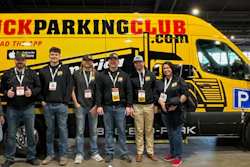
By all accounts, though, they are really comfortable hoodies. Full disclosure: This author once picked up a free hat at the TPC booth at the Mid-America Trucking Show, and it was a good hat in the trucker style, but he's since lost it.
Find the other two parts of this Overdrive series via the links below: