











Diesel prices may be going nowhere fast but up. The U.S. Energy Information Administration's update this week showed a reversal of weeks' worth of slight falls since the big September spike.
Why? Distillate inventories (including diesel and home heating oil) rose through September, but are back down closer to the low point in late August, when FTR Transportation Intelligence Trucking VP Avery Vise warned of a potential crisis at some point in the next six months.
That is, real shortages.
[Related: Is a real diesel shortage brewing? FTR analysts assess economic risk]
 This chart, based on EIA weekly tracking of inventory data, was part of American Trucking Associations Chief Ecoomist Bob Costello's presentation at the org's annual conference ongoing this week.
Inventory volumes impact pricing on the home front, for certain, likewise expectations fuel buyers and sellers bring to the world marketplace based on production and transit all around the world, today hampered by our own war in Iran, and Russia's in Ukraine.
A recent outlook from the team at longtime tracking/visibility tech provider SpaceHawk GPS runs a little more pessimistic on pump price than EIA's long-/short-term. "When diesel passed $6, our team dug into the numbers," said SpaceHawk's Ryan Horban. While EIA in early September predicted a $4.40 average price for all of 2027, getting there could be a long time coming.
"Futures point to about $5.24 at the pump next July," according to Horban. "U.S. distillate stocks are the lowest for early October since 1982."
Shorter-term, Horban and company offered three scenarios for the winter period, when distillate demand rises from the heating-oil side every year. A lot depends on Russian refinery capacity, hampered by Ukrainian attacks, and what Horban's report calls "the biggest swing factor for oil."
That is, stability, or lack thereof, in the narrow Strait of Hormuz off Iran.
 Download the SpaceHawk GPS report via this link.
Fortunately for owner-ops, fuel is the bill an owner-operator can actually move, Kevin Rutherford and his Let's Truck network pointed out this week with announcment of a new tool to help owner-operators reliably estimate what's to be gained with different MPG-improving strategies, using their own numbers.
Also this week, a new tool in the form of a miles-tracking and IFTA-reporting app, minus intrusive data-share demands.
[Related: 80 ways to maximize your truck's fuel efficiency]
The 'Driveline Fuel Calc' from Let's Truck
Most fuel-saving advice uses someone else's numbers. Trailer skirts, low-rolling-resistance tires, or backing off the throttle all might save money, but how much on this truck, at today's diesel price? When does the upgrade pay for itself?
Longtime owner-operator coach and radio host Kevin Rutherford hoped to deliver a way for owner-operators to answer those questions reliably, for themselves. His Let's Truck network's new "Driveline Fuel Calc" web tool allows you to utilize your own miles and MPG, along with the diesel price, to put solid numbers on potential savings from truck or trailer upgrades and dollar impacts from speed and idling -- and calculate a fuel surcharge, too.
It's built for owner-operators to see what fuel mileage is worth in dollars on their own truck.
The tool is free for anyone to use, requiring no login.
Start with three numbers:
- Annual miles.
- Current MPG.
- Diesel price. The tool auto-populates this field with the most recent U.S. average diesel price (as shown above, $6.28 currently), though it's easily changed with your own most recent purchase or purchase average.
Users then pick a question:
- Does a truck/trailer modification pay for itself? (From side skirts or FlowBelow kits to cab extenders/gap fairings and big 6x2 conversions, the tool can show payoffs for 16 different options.)
- What does a speed change cost?
- APU or idle?
- How does a fuel surcharge move week to week? Outputs from this option calculate all surcharges on a 6 mpg basis, also offering average spot rates with surcharge included and without.
- What could the fuel-cost savings grow to if invested?
That last option is labeled "Fuel tax: State pump price and tax." Sounds nondescript, sure, but don't let first impressions fool you -- it could be a key cog in the machine for any owner-operator looking to reduce overall net real fuel cost, letting IFTA miles sort out the tax obligation.
[Related: Fuel taxes: Finding the cheapeast fuel about more than pump price]
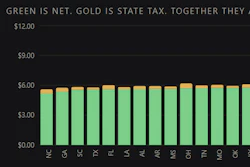
 Lowest current net fuel price (minus state tax) in the nation? North Carolina, Georgia, South Carolina, Texas, in that order from lowest. On the Fuel Calc site, you can sort by lowest net (shown), tax or pump price.
Results can be easily shared, Let's Truck noted, copied as a link, or printed, and owner-ops can get a full fuel report by email, too. A two-minute demo video on the page shows how it works.
"Everybody tells you MPG matters," Rutherford said. "Fine. But what's it worth on your truck? Not mine, not some fleet average. Yours. Put in your miles, your MPG and what you're paying for diesel, and it tells you in dollars whether that upgrade is worth the money and when it pays you back. It's free. Go run your numbers."
Give it a whirl via this link.
[Related: Overdrive's Load Profit Analyzer: How to use to assess rates, costs]
Speaking of IFTA: New tool from across the pond
Ukrainian developer Vadym Hrybov of 7 Heaven Labs wrote in about a new OneTruck app for Android devices after it went live for downloads on Google's Play app store October 7.
It does what other IFTA tools do, whether through an ELD provider or another service: It records miles by state while you drive and enables you to track and keep fuel receipts with photos.
The app will also remind you of IFTA, Form 2290, and IRP filing deadlines, and offers a cost-per-mile tracking and computation assist as well with other expense inputs.
At the end of each quarter you can produce a CSV file for your accountant and a one-page IFTA sheet to file in your state's IFTA portal. The sheet's based on Illinois' system, but otherwise useful with a clear state-by-state breakdown. Hrybov shared this sample output based on invented numbers:

A couple things are unusual about it, accordig to Hrybov:
- No fleet features -- it's built 100% for one-truck operations.
- OneTruck does not request Internet permission at all. Records stay on the phone unless the user exports them.
On accuracy with the miles tracker, using the phone's GPS, "I can only point to my own test so far," said Hrybov. "On a real 19.84-mile trip it came out at 19.84 miles. That is one trip, not a study."
For full functionality there's a subscription fee: $25/month or $199 annually. The first 15 days are free as a trial period.
He's got no paying customers as of early this week, and installs are limited mostly to the testers Google Play requires for the store listing. Asked why the subscription pricing model and not a one-time software purchase, Hrybov noted the work that will come with maintaining functionality, particularly with respect to phone-background GPS and different Android versions.
"Background GPS is the part of Android that changes most often," he said, "and Google requires apps to keep up with each new Android version, or they stop being offered to new users on newer phones. Any of those changes can quietly stop mileage recording, and a tracker that stops without telling you is worse than none."
Then there's IFTA deadline and form changes, and, truly, "fixing what drivers report" back to him ultimately, he said.
Hrybov noted he is a purely solo developer with his 7 Heaven Labs, and not a truck driver himself. "A driver's opinion is worth more to me than anything else," he said, urging anyone who tries OneTruck out to be in touch with him directly.
[Related: Highway doubles down on ELD connections for carrier ID checks]