










Trucking news and briefs for Wednesday, Aug. 5, 2026:
- New DOT safety plan to focus on proper licensing, training for truck drivers, better infrastructure, more.
- Truck driver’s fuel card fraud scheme busted.
- “You just want somebody there for you.” --Highway Angel John Graf
DOT rolls out new highway safety strategy
U.S. Department of Transportation Secretary Sean Duffy on Wednesday rolled out the National Roadway Safety Strategy (NRSS), a new interdepartmental plan to reduce traffic fatalities and improve safety on American roadways.
The strategy focuses on several areas of highway safety, including an increased focus on stopping unsafe commercial vehicle operation, improving infrastructure, and integrating more vehicle safety tech, among other measures.
“President Trump and I are committed to keeping American families safe on our roads,” Duffy said. “In the past year alone, we’ve partnered with law enforcement agencies to step up traffic enforcement, removed dangerous foreign truck drivers off the roads, and launched new educational campaigns on the dangers of distracted driving, drunk driving, and driving without a seat belt. This new strategy builds on that progress by doubling down on our coordination with the police, enhancing our anti-congestion initiatives, and embracing automotive innovation to make our streets safer than ever.”
The strategy outlines three key areas of focus: Safer People, Safer Roads, Safer Vehicles.
“Safer People” initiatives will include:
- Educational and outreach campaigns on safe driving
- Prioritizing safety in rural and Tribal communities
- Reengaging with law enforcement, including reviving data-driven support tools for law enforcement, and enhancing and expanding commercial motor vehicle enforcement
- Helping first responders better respond to emergencies
To support “Safer Roads,” DOT’s plan will promote road designs that make roads safer, improving safety through effective traffic management practices to reduce congestion, and improving CMV safety.
When it comes to CMV safety, DOT’s plan notes that state driver’s license agencies and driver training schools must “ensure only eligible, trained people receive commercial driver’s licenses, and do not unlawfully license people who are ineligible or unqualified to drive a truck.” The plan calls for “reforming commercial driver licensing, training practices, and safe commercial driving standards.”
It also calls for stronger compliance standards and increased investigative efforts to target high risk motor carriers and deceptive business entities.
Finally, it highlights the need for increased truck parking around the nation, calling for activities to “elevate truck parking initiatives to promote safe and efficient movement of goods by expanding availability of truck parking through DOT funding programs.”
Finally, for “Safer Vehicles,” DOT plans to integrate “lifesaving technology into vehicles,” as well as promoting the safe deployment of automated vehicles.
The full plan outline is available here.
[Related: Trucker to Congress: Keep drivers in autonomous trucks]
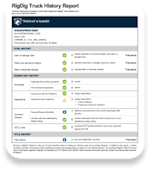
Mark your calendars for later this month, owner-ops, for the annual Brake Safety Week enforcement initiative, Aug. 23-29, from the Commercial Vehicle Safety Alliance of federal, state and local agencies and associates. Read more about this year's focus (core drums and rotors) at this link, and below find a state-by-state look at just where brake violations are most prominent in the enforcement mix, based on our sister data company RigDig's rankings for 2025.
Driver guilty of fuel payment theft
A West Virginia-based truck driver has entered a guilty plea for wire fraud, admitting to stealing more than half a million dollars from his employer through false charges to company-issued fuel cards.
Jeffrey Jeffers, 35, of Williamstown, West Virginia, pleaded guilty on July 30.
According to court documents and statements made in court, between November 2022 and July 2024, Jeffers delivered products by truck for a large provider of industrial gas from its distribution facility in Wood County. The delivery trucks were fueled at the distribution facility and were also equipped with fuel credit cards.
As part of his guilty plea, Jeffers admitted that he fraudulently charged a total of $510,465.19 in fuel costs to the credit cards throughout his term of employment. Jeffers further admitted that the fraudulent credit card payments went to accounts for fictitious service stations he created on online payment processing platforms.
Jeffers admitted that his delivery routes normally never required any refueling outside of the distribution facility.
Jeffers is scheduled to be sentenced on Nov. 9 and faces a maximum penalty of 20 years in prison, up to three years of supervised release, and a fine of up to $250,000. Jeffers also owes $510,465.19 in restitution.
“This defendant exploited the trust placed in him by his employer and turned a company resource into a personal revenue stream,” said U.S. Attorney Moore Capito. “Fraud is not a victimless crime. Every dollar stolen through deception is a dollar taken from a business, its employees, and ultimately the community it serves. This case demonstrates that complex fraud schemes carried out behind computer screens and online payment platforms are no less serious than any other form of theft.”
[Related: Fuel payments providers boost theft protection]
Trucker’s quick response after witnessing crash recognized
ABF Freight truck driver John Graf has been named a Highway Angel by the Truckload Carriers Association for his quick response and compassionate care after witnessing a serious single-vehicle crash in North Carolina.
 John Graf
“It was a pretty brutal hit,” Graf said. “The speed limit was about 70 miles an hour there, and they hit it probably pretty close to full impact.”
Graf, who was about an eighth of a mile behind the vehicle and the only motorist immediately following it, pulled over and rushed to help.
After discovering the driver’s side of the vehicle was pinned against the bridge barrier, he and another passerby climbed an embankment to reach the passenger side. When they found the doors locked, the other motorist retrieved a hammer to break a window while Graf called 911.
The driver was eventually able to climb out through the broken window with assistance from Graf and the other Good Samaritan. A third passerby, who identified himself as an EMT or paramedic, also stopped to help comfort the injured woman until emergency responders arrived.
Graf remained at the scene, providing reassurance and assistance until first responders took over.
Asked why he chose to stop rather than simply call 911 and continue on his route, Graf said his decision was an easy one.
“You just want somebody there for you,” he said. “She wasn’t in a good spot because she was tucked up behind the bridge embankment. You don’t know when the next car might have been. You’re just trying to help others as you’d want them to help you in a situation like that.”