











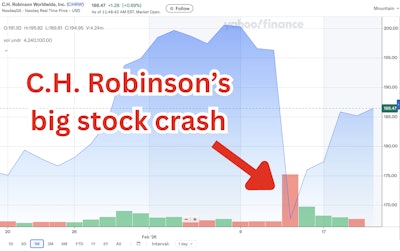
A karaoke company-turned AI firm put out a press release on February 12 that sent shockwaves through the stock market, initiating a "scare trade" that saw billions of dollars wiped from big freight brokerage stocks, and they still haven't fully recovered.
That day C.H. Robinson Worldwide Inc. fell 24% at one point, Landstar System Inc. dipped 16%, and RXO fell 20%. The Russell 3000 Trucking Index, which includes a bundle of transportation stocks, fell almost 7%.
Bloomberg described the stock market beat down as the "worst drop for the sector since April’s trade-war market meltdown."
The episode shows how AI has come to threaten white collar jobs like freight brokering, and the speed with which the stock market can move.
There, too, AI has come to play a larger role in decision-making: AI scares rippled through other sectors' stocks as recently as Monday, Feb. 23, after Citrini Research two days prior published what one watcher called a mere "dystopian tale" about white-collar displacement.
How the broker-stocks 'fear trade' sell-off got rolling
Algorhythm Holdings, Inc., is a publicly traded AI company, and said its "SemiCab platform" in some initial customer deployments was "enabling its customers’ internal operations to scale freight volumes by 300% to 400% without a corresponding increase in operational headcount."
The company claimed AI had figured out how to do the work of freight brokers, more or less -- and maybe even four times faster -- and released a white paper explaining its thinking.
Algorhythm said the few operators using its platform could now manage more than 2,000 loads a year, "compared to the traditional industry benchmark of approximately 500 loads per year per freight broker."
Most of the big brokerage and trucking stocks rebounded somewhat after the big fall Algorhythm's announcement produced, yet remained down as of this writing.
Who picked up on little-known Algorhythm's incendiary release and ran with it, selling off billions in stock? It was AI traders themselves, market watchers say. Industry experts and market analysts with human brains are less than convinced that the stock market bloodbath underscores any real shift in the broker business's fundamentals.

In fact, they think it's crazy.
"So, from our perspective, it would be fair to say that we viewed the reaction less like a disciplined reassessment of competitive positioning and more like an unsubstantiated fear trade that was largely devoid of substance," said Dan Moore, the managing director and senior transportation analyst at financial services company Baird.
Ken Adamo, the chief of analytics at DAT, noted that Algorhythm's SemiCab product "doesn't even seem to be fully in production" and may only have two or three customers in the integration pipeline.
Moore demystified a bit of the hype around AI, too.
"Anyone can automate a business function, but there is a meaningful distinction between streamlining routine tasks and building predictive analytics that deliver a distinguished competitive advantage," he said.
Didn't Convoy and Uber Freight both promise to do much the same by using tech and mountains of transactions data to negotiate and automate freight?
[Related: FMCSA forces broker transparency from Uber Freight after double brokering scam]
Wouldn't it be more reasonable to assume that big players like C.H. Robinson could simply adopt AI rather than a former karaoke company coming out of left field to dominate freight?
"Ultimately, AI requires vast amounts of proprietary data accumulated over time and across multiple cycles," said Moore. "Established domestic and international freight brokers have that data."
Moore said that smaller operators, as well as potential new entrants, like Algorhythm, "simply lack the historical depth, transactional scale, and cyclical experience required to turn algorithms into durable economic advantage."
But Adamo thought AI did hold some potential to disrupt the freight brokerage space.
"AI seems to have the potential to also be a 'cheat code' against needing massive scale to get things done," said Adamo.
[Related: Truckers may get the last laugh on Artificial Intelligence]
Say a new entrant in a very short time could get a few "vibe coders" -- people who build tech by telling AI to write code, rather than writing code themselves -- to "create something that 80%-plus approximates what big companies built with tens (or hundreds) of millions of dollars," Adamo said. It would be an astonishing feat, if it's real.
That's a big if, but Adamo added "there's a growing perception that smaller firms can compete on a more level playing field with the giants via the use of AI development and deployment."
Trucking in some ways has proven tech-resistant. Where giants like Uber completely obliterated most taxi services, Uber remains just another player in the fragmented trucking market. Part of the reason trucking bedevils tech is truly the real-world grittiness that adds lots of friction to automated processes, according to Moore.
"Load theft has also become a serious issue, which is to say that dealing with a known and reliable counterparty has probably never been more important," he said.
[Related: DOT says it will use AI to hunt down fraud, illegal drivers]
Adamo, Moore, and the broader market generally seem to think AI and its massive data centers will reshape white-collar work specifically.
AI might indeed automate much of spot freight booking and require lower head counts at big brokers, but that would be AI killing off some individual brokers, not the brokerage model itself. C.H. Robinson, RXO, and all the rest will likely be situated to compete in such a future.
"Automation will ultimately influence nearly every company in the broader market," said Moore. "Transportation and logistics is by no means unique in that regard. From that perspective, we believe market participants should be less focused on obscure players issuing white paper studies and more focused on asking essential questions, like ... Who has the best tech stack? Who has the best dataset? Who is demonstrating the best execution?"
Even as high-profile brokers have gone bust in recent weeks, some leaving thousands of carriers unpaid millions and millions of dollars, it seems tech talk moves the market more than anyone previously expected.
[Related: Aurora adds 1K-mile 'driverless' lane: How will HOS regs apply for the in-cab observer?]