











Two new court cases bring the hammer down on double brokering and the carriers and brokers who facilitate it, and it could serve as a warning for trucking.
One smaller broker, Aone Brokerage Company (doing business as A1Logistics), and Penske recently got tied up in court cases around double-brokered loads.
Tyler Biddle, a transportation attorney and consultant, recently wrote about the Nevada district federal court's Hardy v. Singh case, stemming from a July 2022 crash that killed one and injured another.
Before the crash, Aone had brokered the load to a carrier that then brokered it to another carrier. The ultimate carrier, Bhupinder Singh, had been a former driver of Lucky's, and still used their fuel card and rented a trailer from them.
Biddle wrote that the case touches on the standard of "reasonable care" that's tied the industry in knots after the landmark Montgomery verdict against C.H. Robinson, but he later told Overdrive it also touches on a separate issue: Vicarious liability. The legal concept holds one party responsible for the wrongful actions or mistakes of another, and can be applied fairly simply in cases of double brokering.
Aone Brokering Company's case
Aone "moved for summary judgment that it could not be held liable for negligence for an accident caused by a carrier it did not directly hire," Biddle wrote. Aone "argued that it conducted due diligence before contracting with Lucky Transport (the carrier that double-brokered the shipment), so it should not be liable for the accident caused by the second carrier."
But Aone may have made a fatal error during the case when its owner, Amandeep Singh, admitted he knew Lucky had double brokered loads in the past.
"There is evidence to show that" Aone "breached their duty of care when they continued to do business with Lucky even though they knew that Lucky was subcontracting their loads," the court wrote. Singh "testified that [Lucky's] Lakhwinder Singh told him that on some occasions Lucky used third-party carriers to transport loads."
"At least he was honest," Biddle wrote.
Aone "contracting with Lucky could have been unreasonable because illegal double-brokering can put more high-risk drivers on the road," the court wrote.
Biddle said this won't exactly create legal precedent beyond this individual court, but plaintiff's lawyers in the future might find it persuasive to mention the case.
Penske's case
In the U.S. Court of Appeals, Fifth Circuit, Penske lost out after a lower court's decision was reversed.
The appeals court looked at "whether a motor carrier that outsourced a shipping job to a second carrier, which then outsourced it to a third carrier, can be held liable for the negligence of the driver hired by the third carrier." The court found that indeed it could, according to court documents.
Penske holds Motor Carrier, Freight Broker and Freight Forwarder authorities, but also has Penske Logistics, a pure Freight Broker, within the company.
The court summarized the case this way: "As is common in the trucking industry, Penske outsourced the job to another carrier -- Liberty Lane -- through Penske's affiliate broker, Penske Transportation Management ('PTM'). Liberty Lane then had its affiliate broker hire a third carrier, OK Trans, which supplied the truck and hired" the driver.
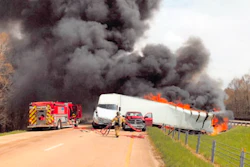
That driver, Satnam Singh Lehal, went on to jackknife, cross into oncoming traffic, and collide with a car and kill the passenger.
The passenger's family argued Penske is vicariously liable for the driver's negligence "as his statutory employer" and that PTM is liable for hiring Liberty Lane.
Ultimately, the court decided Penske was the driver's employer and liable.
"Penske's assumption of control and responsibility of the vehicle" made Penske the employer, the court wrote.
This example might seem more like co-brokering than double brokering, as Penske entities do hold broker and carrier authority, but Biddle said that's all the more reason for brokers with carrier authority (and vice versa of course) to draw clear lines.
"Keep in mind, co-brokerage (between two licensed brokers) is not illegal," he said. "Both Penske entities had brokerage authority. The carrier hired by Penske did double-broker the shipment when it handed the shipment to its affiliated brokerage entity to tender to the carrier that was involved in the accident."
While double brokering has become alarmingly common, and it's an open secret around trucking that related entities often keep loads in-house even if it's technically illegal, courts are starting to see plaintiffs' arguments in these cases as valid, and ruling against parties that do it.
"What is your customer going to say" about a load going from one entity to another? asked Biddle. "A lot of people get tripped up with which hat they’re wearing" with multiple authorities.
Yet carriers and brokers should be careful to "obviously not illegally double broker freight," he added, or tender freight to carriers known for double-brokering. Also, fleets should have procedures in place to determine whether loads are being double-brokered.
With the appeals court giving the go-ahead for Penske to be held vicariously liable, another big verdict could be on the way.
How owner-ops defend against double brokering
Overdrive's recent broker-vetting survey showed how owner-ops are making sure they're dealing with a bona fide, creditworthy broker on any load, with many relying on a factoring company or load board.
 Download the full 2026 survey report via the form below. Find a summary of high points via this link.
Those indicating Other specified a range of ways to vet brokers, many covered in the following chart.

One common way not shown: Cross-checking of phone numbers with any broker’s central website and main office location, along with efforts to verify the voice on the other end of phone line is who they say they are.
Direct calls to the broker’s bonding company to verify an active bond without claims was mentioned by more than one respondent, too.
One owner noted another common strategy -- if a broker’s loads can’t be factored by his factoring company, “I then ask for up-front payment” for the load.
[Related: Hedge against bad brokers: Trucker of the Month insists on cash before unload]
A variation on that strategy referenced by another survey respondent: “If my non-recourse factoring company says no and I want the load, I work out a COD-by-wire-transfer agreement” with the broker before pickup.
More than one respondent flagged the free credit lookup at BrokerCreditCheck.com, operated by the WinFactor factoring company.
Access full results in Overdrive's July-released survey report via this link, or use the short form below to download it here: