











As Congress continues its work on the 2026 highway funding legislation, dubbed the BUILD America 250 Act, one truck driver is urging Congress to rethink its position on several provisions in the legislation related to autonomous trucks.
As previously reported, the highway bill as proposed creates a federal safety standard for commercial vehicles equipped with autonomous driving systems (ADS) operating in interstate commerce. That safety standard would require manufacturers of ADS and ADS-equipped trucks to meet applicable regulations, demonstrate competencies through a safety case, and adhere to reporting requirements.
It would also ensure that ADS-equipped trucks are included under the U.S. Department of Transportation’s preemption of state law authorities.
Another provision would create a “workforce development program to support the commercial motor vehicle workforce by strengthening employment opportunities for professional drivers, mechanics, and others with occupations that affect the safety and operation of commercial motor vehicles,” Congress said in an explainer document.
That document includes a summary of all provisions of the bill. The autonomous truck-related provisions can be found in Subtitle E - Safe Integration of Autonomous Commercial Motor Vehicles.
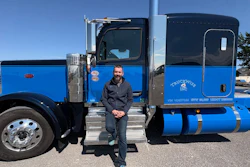
 Jonathan Wood
Wood worked in aviation maintenance for 21 years before changing careers and becoming a truck driver five years ago.
His father worked in the textile mills in South Carolina, and when the North American Free Trade Agreement (NAFTA) was enacted in the 1990s, much of that work left the U.S., leaving many workers to have to retrain to do other jobs.
[Related: Trump talks AI threat to trucking jobs, re-industrialization, fuel prices at Mack Trucks]
Wood’s father was one of those workers. Without a high school diploma, he was forced to get his GED and learn a new skill, and the stress of that coupled with trying to support a family, Jonathan Wood said, led to him suffering from a heart attack and landing him on disability for the rest of his life.

Wood is concerned that could be the fate of many a truck driver if the BUILD America 250 Act passes with the autonomous trucking-related provisions still in place.
“When NAFTA happened, they moved all those textile jobs to Mexico, and I kind of view this as the same thing going on with trucking,” he said. “It’s a profit motive for corporations. The biggest two expenses that trucking companies face are driver pay and fuel. If they can eliminate one,” namely drivers, it would be a huge financial benefit, he added.
In a letter penned to Congressional leaders, DOT leaders and others, Wood outlined his concerns, provision-by-provision.
“Some truck drivers will not be able to simply start over,” Wood said in a prepared statement should he be called to testify before Congress on the matter. “Many have spent years sacrificing their bodies and minds to this industry. The isolation, long hours, irregular sleep, road diet, stress, physical strain, and time away from family take a real toll.”
[Related: Driverless-truck tech: Owner-ops worry over cyberattacks, crashes, competition]
Wood makes clear, however, that he’s not against autonomous technology in general. He just wants to ensure truck drivers have a place as the technology and the regulations around it continue to advance.
“I am not against technology,” he said. “I am against removing professional drivers from 80,000-pound trucks before the safety case is proven, before there is real accountability, and before the people who built this industry have any real protection.”
After 20-plus years in aviation, Wood pointed to the fact that commercial aircraft have had automation for decades. Yet federal regulations still require at least two pilots.
[Related: Another large fleet makes autonomous move]
Beware of self-certification
Perhaps Wood's biggest concern with the autonomous trucking provisions in the legislation, however, is the ability for autonomous technology companies to essentially “self-certify” their technology with a “safety case.”
The text of the bill states that manufacturers of ADS or ADS-equipped commercial motor vehicles would be required to meet the safety standard established in the legislation “through a safety case, which shall be updated prior to making any significant material changes to the ADS or ADS-equipped commercial motor vehicle” that provides claims, supported by arguments and evidence, that support the manufacturer’s conclusion that the tech will provide an equal or greater level of safety as a non-ADS-equipped truck.
Wood said this raises an alarm to him based on his background in aviation and the issues in recent years involving the Boeing 737 MAX aircraft.
“They were allowing them to self-certify the Boeing 737 MAX,” he said. “When companies have billions of dollars of profit motives, they should not let them self-certify. They should be independently tested.”
In the case of autonomous trucks, “there should be a public forum, and also truckers should be involved,” he said.
The self-certification “concerns me because the companies trying to profit from this technology would be able to argue, with their own evidence, that their system is safe enough,” Wood said in his letter to Congress. “I do not believe corporate self-certification and polished safety claims should be enough to put an 80,000-pound driverless truck beside American families on public highways.”
[Related: OOIDA warns against driverless-truck-tech 'self-certification,' part of new bill]
Using technology to help truck drivers, not replace them
The key overall point of Wood’s letter to Congress is to keep truck drivers behind the wheel of trucks. One reason for that, beyond the livelihoods of millions of transportation workers, is that he believes the technology is just not ready yet.
Operating himself for a large fleet driving a 2026 Kenworth T680, Wood said he’s experienced the automatic braking system “slam on the brakes, I mean lock it up,” when there was no threat around. “If I wasn’t there to realize” that the technology “was doing something wrong and hit the gas, hit the brake and try to get the auto braking disengaged,” the result could have been catastrophic. “The technology works, but it’s flawed.”
“The safest path is to keep a qualified human driver in the truck, using technology as assistance and backup instead of removing the person who can inspect equipment, respond to emergencies, communicate with law enforcement or first responders, secure the load, place warning triangles, and make judgment calls when the real world does not match the computer model,” he said.
Drivers themselves should be part of the overall safety system, he added.
In his letter to Congress, Wood made his stance clear -- “When something goes wrong at highway speed, the consequences are not theoretical. People die.”
Ultimately, Wood is asking lawmakers to “slow down and put safety and workers first,” he said. “I am not asking them to ban technology. I am asking them to not hand over the future of trucking without proof, accountability, and protection for the people who built the industry.”
He outlined the following points for what he’s asking elected officials to do:
- Keep a qualified human driver in the truck as the human safety layer while technology is tested and used as assistance, not as a replacement.
- Require independent safety testing before broad deployment of autonomous commercial trucks.
- Require public reporting of crashes, serious incidents, disengagements, minimal-risk events, cybersecurity incidents, and remote-assistance interventions.
- Make liability clear: manufacturer, software provider, fleet, remote operator, maintenance provider, or another responsible party.
- Require cybersecurity standards that are verified, not just written into a company policy.
- Test these trucks in real conditions: weather, construction zones, mountain grades, blown tires, emergency vehicles, bad lane markings, and unpredictable drivers.
- Give working drivers, owner-operators, and small carriers a seat at the table.
- Treat retraining as only one part of a real workforce plan, not the whole answer.
Wood’s full letter to Congress can be read here.
[Related: Teamsters vow fight after California clears road for autonomous trucks]