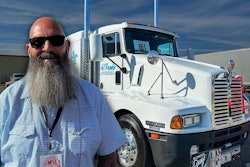











At the 2025 Mid-America Trucking Show, Overdrive's 2024 Trucker of the Year, Alan Kitzhaber, took advantage of his time at the show to do what a big event like MATS affords any inquisitive truck owner.
Access to equipment manufacturer reps on-hand afforded opportunity to ask Caterpillar a question Kitzhaber and no doubt many around trucking still wonder about today: Is Caterpillar ever getting back into the on-highway truck engine business? As you'll see in the video above, he found a few answers.
Kitzhaber famously built his entire career as an owner, and now his retirement, on a Caterpillar 3406E-powered 1995 Kenworth T600 that logged more than 4.1 million miles under his tutelage, with three engine overhauls before he finally sold the truck a couple months following MATS 2025.
Once among the most commonly spec'd engines in Kenworth and Peterbilt trucks, Cat power still pushes a huge number of trucks down the road today, many of them more than 20 years old, still hauling.
Why did Caterpillar walk away from new on-highway truck engines?
Part of the answer lies in how modern trucks are built.
At MATS, Kenworth reps explained the company's integrated powertrains with Paccar-built engines, transmissions and rears with software designed to help all work together as a single system. The approach is a big contrast to the mix-and-match drivetrains more common in the 1990s.
[Related: J.P. Transport's journey to maximum trucking efficiency]
While truck makers' vertical integration played a role in Caterpillar's move away from on-highway engines, the decisive factor was emissions regulation. As Environmental Protection Agency regs tightened in the late 2000s, Cat chose not to invest further in meeting on-highway standards, officially ending production of new highwa-truck engines with the 2010 changes.
Even as integrated powertrains have become more common in new long-haul trucks, traditional engine brands, including those once made by Caterpillar and (still made by) Cummins, continue to power a large share of the on-highway fleet. Caterpillar remains committed to supporting the hundreds of thousands of engines still in service today through parts, service, and remanufactured engines.
As mentioned in the video up top from Kitzhaber's time at MATS 2025, Overdrive Trucker of the Year competitor John Treadway recently told his story of purchasing a factory-reman Cat to replace the power plant in his 1998 Peterbilt 379, for instance. Hear Treadway's story in the recent Ovedrive Radio podcast episode below.
[Related: Up to 175 truck set to compete in MATS' PKY Truck Beauty Championship]
Narrator voiceover: At last year’s Mid-America Trucking Show, our 2024 trucker of the year Alan Kitzhaber asked Caterpillar if they might ever be getting back into the highway truck-engine game for new equipment?
Zach Barrett: Not that I'm aware of. I haven't heard anything about us getting back in the industry, but we are still supporting, you know, over a million engines that we have out there on the road right now.
Narrator: Alan Kitzhaber built his career, and current well-deserved retirement, with a Caterpillar engine. It came factory installed in his 1995 Kenworth T600.
Alan Kitzhaber: I've driven this truck since it was new in January of 1995. And it's got a Caterpillar 3406E engine in it, 550 horsepower, 13 speed transmission, and a single drive axle with the tag axle. No, I don't think I did mention that I have 4 million miles. Actually I don't. It's 4.1 million miles. It's actually 4,105,000. Almost. So, now, not bad for driving a truck. Same truck for 30 years. More than 30 years now. Same engine. Has been overhauled three times.
Narrator: Like many owner operators, Alan Kitzhaber’s sworn by his Caterpillar power, and for good reason. In its day, the 3406e was among the most well-used engines on the road.
Zach Barrett: One time, Cat's engine was a leading engine sold in a Kenworth truck. And Peterbilt as well with Paccar. I mean, if you look at the average life of our engine, our average age of our engine nowadays is over 20 years old. So a lot of them can, you know, go buy a drink or go buy a beer at a bar.
Narrator: Why did Caterpillar stop making their engines if they were so popular and beloved among owner-operators? Alan guessed the answer may have sat within a fundamental difference between his old Kenworth and newer trucks, like this modern T880. We spoke with a Kenworth rep at Mid-America.
Brian Ward: this truck has evolved in a few different ways through the powertrain. Now we have our fully integrated powertrain. So this is the Paccar MX 13, 510 horsepower engine. It also has a Paccar 12 speed automated transmission and Paccar axles in the rear. So that fully integrated powertrain is obviously focused on the aerodynamic, you know, on-highway segment, provide better fuel economy. For the driver, more money in your pocket.
Alan Kitzhaber: Something you brought up about everything being integrated from the engine, transmission through the rear ends. When you bought my truck, like in 1995, in that era you bought one brand of engine, another brand of transmission, another brand of rear end, where now everything's all integrated, all by the manufacturer, which means that you have more control over what goes on and everything works together. Rather than trying to go to different manufacturers to get all that stuff to work together can be a real challenge.
Brian Ward: A lot of the OEMs, International behind us, they have a fully integrated set-up. Daimler obviously has their own set-up. But yeah, it's essentially with all those working pieces it creates better efficiency, better longevity. And also keeps the cost down for the operator.
Alan Kitzhaber: Makes my truck sound like an antique.
Narrator: Are integrated powertrains the reason Cat stopped making engines? Alan asked after our visit with Kenworth.
Alan Kitzhaber: My understanding was that Paccar decided they wanted to develop their own engine integrated with the transmission, and they wanted to do it all themselves. And that's why Caterpillar kind of got out of it?
Zach Barrett: I'm sure there was a part of it to that, to it. I mean, we knew that there was a lot of vertical integration going across all of the companies. Yeah, whether with Peterbilt, but, you know, Volvo and Freightliner. As far as a relationship with Kenworth for Caterpillar, it's always been great. Kenworth has been a great partner for us for many, many years. So, it's just there was certain circumstances that came around. And so we decided to exit the, you know, original equipment supplier business, but we're still supporting all the industry.
Narrator: Vertical integration within truck powertrains by truck makers was certainly a contributing factor, but it wasn’t the only reason Caterpillar exited the on-highway engine market. The official breaking point was emissions.
By the late 2000s, diesel emissions regulations for both particulate and nitrogen oxides were getting much stricter. Caterpillar stuck in out through the onset of the 2010 changes, when most all other engine makers added the selective catalytic reduction systems we see today, featuring the use of diesel exhaust fluid. In 2008, they officially ended production of new on-highway truck engines.
So, would the trend of integrated powertrains have spelled the end for Caterpillar engines anyway? We’ll never know, but it certainly would have made competition harder.
Even as integrated powertrains become more common in new long-haul trucks, traditional engines like CAT and Cummins still power a large portion of the market. For many owner-operators, CAT engines remain the backbone of long-haul trucking. As Overdrive 2025 Trucker of the Year contender John Treadway’s experience showed, too, Caterpillar still supports owners with availability of factory-remanned engines like the one that Treadway replaced his 1998 Pete 379’s engine with after a catastrophic failure last fall.
Cat engines’ future, for Alan, seems simple.
Alan Kitzhaber: So the future is, just continue to maintain, or continue to service and support the products that are out there for a long time.
Zach Barrett: As long as it’s up to everyone out there, and we hope they continue purchasing the parts and services, we’ll continue supporting it.
Alan Kitzhaber: Well, hey, Zach, thanks for the time you spent with us. And, yeah. Maybe talk again in the future.
Zach Barrett: yeah, I hope so. And I hope you enjoy your retirement.