











Merriam-Webster’s defines good guy as "a morally correct person, a hero." What if I told you the good guys also roll on 18 wheels?
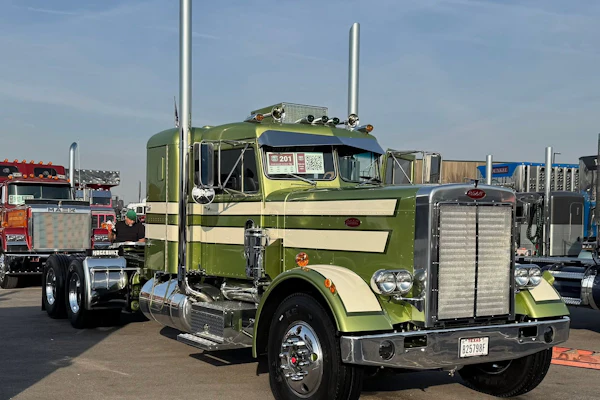
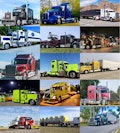
Back in October I was invited to Searcy, Arkansas, to attend the “American Truckers Jubilee,” a community truck show and convoy held annually at White County Fairgrounds. Lee Owens, the organizer of the event, introduced me to the crowd and the vendors set up near the music stage. I made my way around the grounds photographing trucks competing in various categories, interviewing the owner-ops and drivers like Randy Victory in his award-winning 1986 Peterbilt 359, Tim Sander in his 2010 fully custom Freightliner Classic.
Among the vendors, a woman sat alone at a table in her small booth. A driver walked by, picked up a brochure.
The banner behind the table showed a bright-eyed young man smiling with a large trophy held proudly in his hands.
“That is Connor,” she said. “He is my son.”
She smiled, but with a certain weariness.
“This is my first truck show, my name is Mellissa Dzion,” she said. “I have not done this before, but it is important to me to keep Connor’s story out there.”
She stopped to hand out a few more cards to passersby. When the traffic slowed, I asked if I could sit down next to her. She looked down, cleared her throat, and told her story.
“My son, Connor Dzion, died September 4, 2017" in Nassau County, Florida, she said. “He was a freshman in college killed on Labor Day weekend during his very first solo road trip away from home. He had traveled back to the Florida-Georgia line from visiting his girlfriend at a South Carolina college when an illegal truck driver, who may have fell asleep, came upon Connor and 21 other cars who were stopped on the highway.”
Her eyes filled with tears. Her son had been just 45 minutes from home. “When the semi hit his car, he was killed instantly. He was only nineteen years old,” she said.
[Related: Connor's Law: Congress looks to codify ELP requirements for truck drivers]
Dzion was advocating for legislation introduced in the U.S. House in May last year, named Connor’s Law after her son. A companion bill also sits in the U.S. Senate, introduced around the time of the American Truckers Jubilee show.
Connor's Law aims to codify the regulatory English-language-proficiency (ELP) standards for CDL holders in law, better ensuring they’d be enforced under future administrations. Though the bills haven't advanced beyond committee, similar language was included in government funding legislation passed and signed into law just yesterday, making Connor's effectively the law of the land for now.
[Related: Funding bill signed into law enshrines ELP as an OOS violation]
I sat with Mellissa, talking through Connor’s life, her family in Florida, and her advocacy, mother to mother.
The truck that ultimately took her son’s life was driven by a man who was found not to be able to read the signs Florida Highway Patrol had placed warning drivers of stopped traffic ahead. The traffic itself was a result of a truck on its side after the driver was distracted by his phone and crashed.
There are more than 700 different signs in use on highways today, and they’re not universal country to country. Knowing how to read English while driving commercially in the United States is certainly very important, and has seen a boost in enforcement with President Trump's executive order to return ELP violations to the out-of-service criteria last year.
[Related: Trucking English-language enforcement: The toughest and most lax states]
Mellissa, for her part, is now something of an unwilling advocate for the legislation that would more permanently strengthen enforcement -- with her primary goals being education, change, saving lives, and keeping Connor’s legacy alive.
It had to be difficult for this mother just to be at the show, given such a devasting loss on account of a truck driver’s negligence. Yet she pulled on her boots, came to a truck show, and bravely answered questions while meeting drivers face to face, meeting fear while vulnerable.
Such a move takes courage, self-drive, both qualities an over-the-road driver can respect, I suspect.
Several owner-operators over the course of my time with her asked just how they might help. They wanted to thank her for coming and to make her feel welcome.
“I am so glad I came to the show,” she said. “I was anxious and kind of dreading it. I have not been this close to a semi-truck since Connor’s death.”
Truck drivers work all week and then spend hours cleaning and prepping for charity truck shows like American Truckers Jubilee to raise money for those in need. These drivers are husbands, fathers, wives and mothers who just want to deliver the load and return safely home when the work is done.
They are by and large dedicated professionals who care about the safety of the families with whom they share the road, mile after mile. It made me positively proud to see them reaching out to this grieving mother, offering her reassurance and cheering her on in the fight for positive change.
There may well be unqualified truck drivers on the road, yet one thing is for certain -- the overwhelming majority respect the job, service their equipment and keep America moving. They are the good guys.
As the show ended, I watched the trucks pull back out onto the highway. Several drivers honked or blinked their chicken lights, waving goodbye as they rolled out.
The last of the bunch, Aaron Mattingly, pulled around in his black and green 2015 Peterbilt, the bumper stickers clear as day on his trailer urging support of enactment of "Connor’s Law."

[Related: Meet the owner-op who stopped FMCSA non-domiciled CDL purge]