











Craig Betcher grew up in the trucking business under the tutelage of his father, who started the company Betcher owns today in 1947 following World War II.
Betcher graduated college in 1971. The lackluster job market at the time meant he simply “came home, started driving,” he said. Almost five years later, January 1976, he bought his first truck and leased on with his dad. “Then I bought another truck when I got that paid for, and then another truck.”
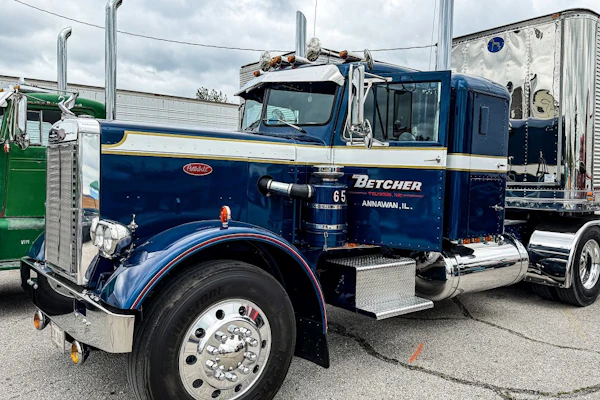
In 1984, Betcher “bought my dad out” and took over the business, today running as Craig Betcher Trucking in Annawan, Illinois. He's more than a small-fleet owner, though -- the classic truck enthusiast's passion for old iron is exemplified by the 1965 Peterbilt 351 featured in the video up top, fully restored (twice) for show.
We caught the unit out at the Annual Convention & Truck Show of the American Truck Historical Society back in June, where it was parked up with hundreds of others.
Betcher's fleet today runs around a 12-15 trucks, specializing in agricultural products -- anhydrous ammonia, propane, liquid and dry fertilizer, and seed corn depending on the season.
“We do harvest with walking floor trailers, and then we deliver the seed corn in the winter,” Betcher said. By summer, “we pull dump trailers and do construction work.”
 Craig Betcher
Betcher operates under the “age-old thought that it takes four trucks for every person who’s not bringing money in, so that’s counting secretaries, mechanics and owners,” he said. The fleet’s size today is “at that level.”
Growing much beyond that, he said, “I think you need to jump to about 20 trucks to where you can have a full-time dispatcher and mechanics and more people in the office,” he said. Under the current business model, personnel all “wear a lot of hats, but if you can keep busy and keep your rates up, which is not easy, you can turn a profit at that level.”
At the time of the ATHS, this year in Springfield, Missouri, the commodities his company hauls he called necessities for farmers and other customers, so business remained steady through the turbulent times in recent years.
[Related: Classic trucks in spotlight: Scenes from Day 1 of massive ATHS show]
Fuel’s surge this year, too, while met with complaints from customers at times, has been covered by surcharges, he said.
The classic 1965 351 he purchased from an owner in Manitowoc, Wisconsin, he said, where it'd still been hauling steel but "hurting pretty bad” at that point. “I restored it. ... Completely disassembled it.”
It got all new wiring harnesses, new gauges, hoses, valves -- just about everything on it was new. Unfortunately, that wasn’t the only time he had to rebuild it.
He was pulling a load of dry fertilizer one day “and somebody pulled out in front of me and knocked the front axle out, and I rolled it,” totaling the truck.
 The aftermath of the wreck wasn't pretty.
Knowing the truck’s potential, he bought it back from insurance and “basically restored it a second time.” This time around it was extremely complicated -- needing a different cab, hood, fenders, bunk. In effect, the entire truck had to be pieced back together.
The process took place over five years, and he was able to source all the parts and get it into the show-quality shape it’s in today.
As noted in last week’s Pride & Polish series entry, 1965 was the first year Peterbilt introduced the tilting hood on conventional tractors with the Model 358.
 Betcher’s ’65 is the older-style 351 model, however, featuring a butterfly hood and narrow nose.
Today, the rig sports a Cummins Big Cam II with a 13-speed transmission, which replaced the original 335 Cummins with a twin-stick 4 by 4 transmission.
 The blocks of both engines, Belcher noted, are about the same size, so he was able to just bolt in the Big Cam II without further mods to the rig.
He stuck with a “somewhat” period-correct paint scheme, he said, with a dark blue that “shows contrast with the white stripe and the chrome.”
All of the work was done by Betcher in-house during both rebuilds, except for the paint on the cab, hood and bunk. Betcher painted the frame in his own paint booth.
The bunk he found in Oregon, “and the only thing I saved on it was the skeleton and two corners,” he said. “Otherwise, it’s all new sheet metal. So, it took, part time, probably a year just to do the bunk.”
 The truck’s interior is made to be mostly period correct with some upgrades for driver comfort, like the Bostrom seats and carpeted floor. The gauges are all stock.
 The bunk is still a small hole rather than the popular big-hole modification.
“This has still got a small sleeper hole you gotta crawl through to get in,” he said. “It’s easy to get in the sleeper, but it’s hard to get out.”
When sourcing parts for both builds, he worked with Courtland Truck Works in California for many of the parts. He also knew the right people, like Eldon Jaeger, who sold him the cab and sleeper after the crash.
“He came up to me after I wrecked the truck and told me, ‘Don’t worry about it. I got a cab for you and a bunk,’” Betcher said. “They actually had two cabs to pick from and two bunks to pick from, and he wouldn’t sell them to just anybody.”
[Related: ‘Destination unknown’: New project 359, cancer cure effort from Eldon Jaeger & co.]
At the ATHS show, Betcher had the rig paired with a stainless steel 1972 Great Dane van that still had “all original sheet metal on it, including the rear doors.” The biggest issue with the trailer when Betcher found it was the frame was rusted out.
 As far as Betcher knows, it was originally an Atlantic Bottling trailer out of Atlantic, Iowa, used to haul Coca-Cola.
“The inside of the trailer’s not beat up,” Betcher said. “I would guess that it had the same driver on it for years, because there’s no dings in the side of it. If you had a bunch of rookie drivers in it, somebody would have put it into a stop sign or a telephone pole.”
Finding a trailer that age in that good of shape is “pretty unusual,” Betcher noted. “It’s really hard to find old trailers that you can restore. It’s actually way harder than to find a tractor.”
[Related: This look like a cabover? 1969 Pete 358 came stamped as a 352]
For custom-equipment features and videos delivered to your email inbox, subscribe to Overdrive's weekly Pride & Polish newsletter via this link and access all videos in the YouTube playlist below.
Craig Betcher: It's a 1965, and what makes it a unique is it's got a butterfly hood on it, like a Model A, it folds up and doesn't pull ahead, and it's got a narrow nose, which means that the radiator fits inside the frame, not out in front of the frame. This is the first year I'm told that you could get a pull-ahead hood, but this truck is the old style, and it was part of the reason I bought it to start with.
My name is Craig Betcher. The name of the business is Craig Betcher Trucking, and we're located in Annawan, Illinois. My dad started the business in 1947 after World War II. So we've been in business, we're bumping 80 years pretty quick.
Overdrive: All right, well, you know, you've got a beautiful truck sitting behind you. Can you tell me the history on it? A little bit about the details of it.
Craig Betcher: I bought it from a guy in Manitowoc, Wisconsin, and he was using it to haul steel, but it was hurting pretty, pretty bad. And I restored it, completely disassembled it. It's got all new wiring harness, all new gauges, every hose, valve, everything's new.
The sad thing is, I was hauling fertilizer with it, dry fertilizer, and somebody pulled out in front of me and it knocked the front axle out, and I rolled it and it totaled it. I bought it back, and then I basically restored it a second time. I got a different used cab, hood, fenders, bunk, everything. That took me five years to redo that. So now here it is. I'm showing it redone, so I know pretty much every nut and bolt on it.
Overdrive: Yeah. What kind of engine transmission are you running in it?
Craig Betcher: OK. It's got, it was born…. I got the line setting. It was born with a 335 Cummins and a two-stick, 4 by 4. And now it's got a Big Cam II Cummins, which is about the same size as 335, the block is, so you know, it bolts right in. And it's got a 12513 [transmission]. So it's simple, and you can still get parts for it.
Overdrive: Is the interior, the cab interior pretty much as it would have been originally?
Craig Betcher: I think it's a little nicer, but the like the pattern is period correct. Oh, it's got carpeting in it and it's got new lowrider Bostrom leather seats, which is way nicer than it would have been back in ‘65. It's still got a little hole. Most people put a big sleeper hole in it where you can walk in this still got a small sleeper hole. You gotta crawl through to get in. You know, it's easy to get in the sleeper, but it's hard to get out.
Overdrive: What's the trailer you've got it paired with today?
Craig Betcher: Well, this is a 1972 Great Dane. It's got all original sheet metal on, including the rear doors. We're lucky to find it. Pretty sure it was originally Atlantic Bottling trailer out of Atlantic, Iowa. That's a Coke bottler. They still run a few stainless-steel trailers. And I would guess that it had the same driver on it for years because there's no dings in the side of it. It's pretty unusual. It's really hard to find old trailers that you can restore. It's actually way harder than to find a tractor.
Overdrive: I can imagine, yep.