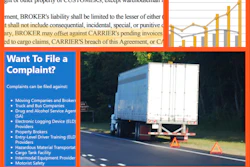












Small fleet owner Leander Richmond, never one to take any guff from brokers, filed a complaint in the DOT's National Consumer Complaint Database (NCCDB) asking for mega-broker TQL's operating authority to be suspended until it stops using broker transparency waivers in contracts.
Richmond's complaint follows a long legal saga involving TQL and the broker transparency regulations.
[Related: 'TQL PAY ME MY $8,000': Owner-op confronts broker over nonpayment]
In 2023, following a load of ice cream gone wrong, owner-operator Dakota Springfields invoked her rights under the transparency regs, codified in 49 CFR 371.3 and requiring brokers to keep detailed records on transaction histories and hand them over to the carrier on a load when asked.
TQL, like many brokers, includes a clause in broker-carrier agreements asking the carrier to waive their right to invoke 371.3, but Springfields persisted anyway, eventually getting the Federal Motor Carrier Safety Administration itself to step in.
FMCSA demanded TQL hand over the documents to Springfields, also requesting it remove the broker transparency waivers in contracts. While TQL complied with the former, it seems to have completely ignored FMCSA's other request.
[Related: FMCSA investigates TQL as fight over broker transparency rages]
Springfields said the records revealed TQL banked 44% of the grss of that load of ice cream, setting off something of an industry-wide debate on broker margins. Thereafter, Springfields sued TQL over its refusal to show transparency documentation on some 14 other loads she hauled, as well as its use of waivers in the contract. In November, the lawsuit was dismissed, yet Springfields has since filed an appeal.
Now, with FMCSA hinting at increasing scutiny of "illegal brokering" all around the freight markets, a new call for action on TQL's broker waivers emerged.
"I respectfully request that FMCSA suspend Total Quality Logistics’ brokerage authority until it returns to full compliance with the OP-1 oath under which that authority was granted," wrote Richmond, referring to the name of the document brokers submit to get authority with FMCSA.
Richmond's complaint continued [emphasis his]:
When TQL obtained broker operating authority, it certified under oath that it would comply with all applicable federal laws, rules, and regulations. That oath is a continuing condition of authority and precedes and supersedes any private contract, broker-carrier agreement, or purported waiver offered by TQL. This is not a matter of interpretation or industry practice -- it is a foundational condition of operating authority.
Since Springfields' suit, FMCSA's new notice of proposed rulemaking indicated that it does in fact want brokers to comply with 371.3; at once, the agency is taking its time.
[Related: Broker transparency: About boosting rates? Or a fight for carrier rights]
Comments on the Federal Register on the broker transparency rulemaking from carriers stressed that any new rule must make clear that brokers cannot simply waiver themselves out of granting a carrier its rights. Indeed the very text of the broker transparency rulemaking sought to frame it as a "regulatory duty" of brokers, rather than simply a right carriers may or may not exercise.
"TQL’s position that contractual waivers override mandatory federal regulations directly conflicts with its OP-1 certification, and cannot be reconciled with the requirements imposed on all regulated entities," wrote Richmond.
Pointing out how carriers, often inspected and observed by law enforcement, "are routinely held to their oath of compliance during roadside and regulatory enforcement actions," Richmond further called for the "same principle of oath compliance" to "apply equally to brokers.
"Either the OP-1 oath is enforceable against both carriers and brokers, or it is enforceable against neither. Selective enforcement undermines the integrity of the regulatory framework."
In Richmond's complaint, he included an email from a TQL representative that dismissed his right to broker transparency by nodding to a bit of a history lesson brokers are fond of when it comes to 371.3.
[Related: Why brokers don't want to give owner-ops transparency in freight transactions]
"We appreciate you reaching out seeking documents you believe you are entitled to under 49 CFR 371.3," a legal claims specialist from TQL wrote Richmond in response to his transparency request.
The rest of TQL's reply:
TQL purposes to follow all applicable law. This particular provision was implemented during a time when it was a commission-based pay structure on a single-pick up, single-delivery approach. Today, the industry operates differently, on a shipper-to-broker structure resulting in a broker-to-carrier transaction in order to move freight. Therefore, TQL requested that you voluntarily waive this provision, which is acceptable under the law, which you did when you signed our Broker-to-Carrier Agreement. We appreciate you honoring the terms of our agreement.
Richmond wasn't satisfied.
"TQL’s continued refusal to comply with mandatory federal regulations, while operating under an oath to do so, constitutes willful non-compliance with the conditions of its operating authority and warrants immediate suspension until compliance is achieved," Richmond concluded.
TQL did not respond to Overdrive inquiries about Richmond's complaint.
FMCSA's complaint website in September 2025 got a complete overhaul including more ways to report bad brokers. The overhaul came as part of a Pro-Trucker Package DOT unveiled in June, which included a "commitment" from DOT to "address unlawful brokering."
Yet complaints filed on the site don't exactly lead straight to the president's desk, or even rise to the top of DOT's agenda. At last check, the NCCDB had tens of thousands of unaddressed complaints, and few FMCSA resources to cover them all.
But a final rule on broker transparency could hit as early as later this year. We'll see then if FMCSA took Richmond seriously and if obligations under oath apply equally to brokers and carriers.