











The Department of War's U.S. Transportation Command (Transcom) admitted to awarding loads to unauthorized carriers and stands accused of letting military vehicles with classified technology slip into a "shadowy" web of unknown carriers.
That's while sending millions in freight, often way above market rates, to a fleet owner convicted in past of fraud and public bribery.
- Fleets have for years reported systematic anomalies and suspicious carriers hauling a seemingly impossible volume of freight with only one FMCSA-registered truck.
- ATA has now written DoW demanding action to restore confidence to Transcom's Global Freight Management system.
- Industry sources say concerns have been routinely dismissed, and now they've had enough.
- Transcom, the combatant command of the Department of War responsible for global transportation of military material, admitted to tendering loads to unauthorized carriers in private communications to fleets, but denied any mismanagement in comments to Overdrive.
On Thursday, the American Trucking Associations, on behalf of its members, wrote a letter to the Department of War demanding action.
“It goes without saying that military hardware should never disappear into a shadowy maze of brokers and unknown entities, but that now appears to be happening on an alarming scale," an ATA spokesperson said.
Huffman Monk, who did time for bribing U.S. military officials, and the one-truck wonders
While the concerns around Transcom's freight awards includes command staff having personal ties to carriers booking hundreds of high-value loads and the unauthorized brokering of military hardware to unknown carriers, much of the concern centered around a single actor: Huffman Monk.
Monk in 2013 pleaded guilty to wire fraud and paying bribes to a U.S. Coast Guard Transportation Officer.
Yet today, two of Monk's fleets move a tremendous amount of Transcom's freight, often what are called "signature and tally" loads, which are forbidden from being brokered, despite each fleet only listing one truck with the DOT.
"Signature and Tally Service," also called "675" loads, Transcom wrote in an October 2025 advisory, "will exclude brokers from supporting the movement."
ARTRANS, the Army's division of Transcom, had "received complaints that some shippers are knowingly awarding 675 shipments to asset-based carriers who broker them without authority or in violation of 675 requirements," the advisory said.
But as of 2026, Monk's fleets, Arafet Freight LLC (DOT# 3209088) and Marine Trucking Inc (DOT# 3414791), continued to haul millions' worth in freight without apparently possessing the equipment to do so. (Both are registered with FMCSA with just a single truck.)
Arafet's filings at SAM.Gov, the platform used for government contractors, lists Monk as the owner, while Marine's Motus page lists him as the owner.
Records reviewed by Overdrive show these fleets contracting to haul dozens of simultaneous loads across the country with more than a dozen different trailer types.
In a 90-day period from April 27 to July 27, Arafet contracted to haul 360 loads in Transcom's Global Freight Management system totaling $1.4M in revenue with 13 different trailer types. Marine similarly contracted a high volume of diverse hauling for Transcom with just one registered power unit and zero term-leased trucks. Sometimes Marine lands eight loads a day from Transcom.
Marine also didn’t have insurance from May 20, 2026 through July 16, 2026, and was not federally authorized to haul freight from July 16 to July 31, yet over that period, Transcom awarded the company 40 shipments.
A representative at Marine said that they "didn't think" Monk "would be interested" in talking to Overdrive.
Asked how these fleets could land so much freight with just one truck and zero leased trucks on their filings, Transcom staff told Overdrive everything was aboveboard.
From Transcom:
Current carriers have been vetted by the Freight Carrier Registration Program (FCRP) and meet requisite criteria to serve as transportation providers in the Domestic Tender Program. Maintaining the integrity of the defense transportation network is a top priority. As part of our active program administration, ARTRANS utilizes a dedicated carrier compliance and vetting response cell to monitor industry trends and engage with commercial stakeholders. Reported allegations of fraudulent or illegal activity are taken seriously and promptly referred to the appropriate federal law enforcement agencies with the authority to investigate. Taking administrative action to exclude an eligible provider without formal due process would be improper.
Communications seen by Overdrive between Jeff Olenick, Transcom's Chief of Surface Deployment and Distribution Command (SDDC), and Dale Prax, FreightValidate owner and a former military investigator, confirm at least that freight had been awarded to uninsured carriers.
Asked why Transcom would award hundreds of loads, many simultaneous loads, to one-truck carriers, Transcom pointed to individual Transportation Officers within its ranks as calling the shots.
"Procedures for awarding domestic freight shipments are decentralized to individual installations, organizations, and agencies across the DoW," a Transcom spokesperson said. "Specific award decisions are executed locally by Transportation Officers at the point of origin; therefore, individual Military Services or Agencies would have to comment on specific local award decisions."
As for how Transcom's Global Freight Management (GFM) system allows one-truck carriers without brokerage authority to haul so many different types of freight with different types of trailers, Transcom said the system relies on the Federal Motor Carrier Safety Administration for verification of operating authority.
"GFM is designed to prevent freight awards if the FMCSA lists a carrier's status as inactive or revoked; however, if a carrier maintains an 'Active' operating authority status on the FMCSA SAFER system, GFM recognizes them as eligible," Transcom said. "Claims regarding improperly reported commercial assets or operating profiles fall under the jurisdiction of the USDOT/FMCSA for investigation and remedy."
Prax found this response well below par for industry standards.
Transcom "has said on conference calls with motor carriers that it updates its screening of carriers once a year while within the industry we vet carriers on every load," he said.
Staff at military installations don't appear to be making sure the carriers that arrive are those contracted for the load. Each truck needs to have the correct DOT number, and leased carriers need a long-term lease that requires them to have the same markings on the truck.
Are military staff not trained to spot correct trucks like many commercial shippers are?
"Transportation operations are decentralized to individual installations, organizations, and agencies across the DoW," Transcom said. "Customer Advisories have been published to local Transportation Officers providing guidance on how to verify lease information and vehicle markings at the time of loading."
While Transcom said it offers "recurring educational opportunities to DoW Transportation Officers and transportation personnel," the "individual compliance and administrative oversight of these personnel remain the responsibility of their respective employing Military Services and federal agencies."
By DoW edict, nonetheless, Transcom is in charge of the individual Transportation Officers.
Industry sources, long frustrated by problems seen in the freight awarding system, have sounded the alarm publicly after raising detailed, verifiable reports of impropriety since at least 2024.
Military vehicles transported in "shadowy" network
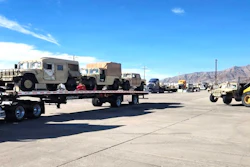
In particular, Transcom was alerted by a fleet that military vehicles, M1151s, were being moved by unauthorized carriers in November of 2025.
The incident in November did not involve Monk-owned fleets, but dozens of similar, highly successful one-truck fleets operate similarly within Transcom's system.  Transcom learned the very vehicles that protect troops in war zones, and have secret specifications with regard to armor and capability, were hauled by unknown carriers. U.S. Army photo by Staff Sgt. True Thao
"At least seven of these armor-integrated M1151s are on the highway right now in equipment that does not match any of the four awarded/approved" carriers, the whistleblower wrote the command.
The whistleblower sent pictures of the M1151s on the wrong trucks and laid out serious national security concerns with the hauls.
"The M1151 incorporates factory-integrated armor (A-Kit) and field-installed B-Kit/Frag-Kit upgrades whose exact composition, material layering, thickness, and blast-deflection geometry remain Controlled Unclassified Information (CUI) or proprietary," the whistleblower added. "Even limited close-up photography or physical measurement in transit can provide adversaries with data needed to design shaped-charge warheads, penetrators, or other countermeasures that directly endanger U.S. warfighters currently operating these vehicles downrange."
Despite the major lapse, the carriers awarded the freight remain active even as others might not for minor lapses like insurance changes.
On Thursday, ATA's Chief Advocacy and Public Affairs Officer Henry Hanscom wrote DoW Secretary Pete Hegseth to get answers.
"I am writing to raise a serious issue and present an important opportunity to strengthen military readiness, freight security, and public trust," Hanscom wrote.
From the letter:
ATA members have identified troubling patterns within the military freight transportation system that deserve prompt attention. They have provided verifiable information to the U.S. Army Transportation Command (ARTRANS) indicating that some military shipments have been awarded to service providers that lack valid USDOT operating authority and required insurance, or do not appear capable of meeting basic shipment requirements. We have also seen instances in which shipments were awarded outside normal competitive processes, manually bypassing the Global Freight Management system, or directed to providers with little to no apparent asset capacity.
In many cases, these awards appear to involve rates far above those offered by compliant, asset-based transportation providers. ATA members have also provided information to ARTRANS showing that military freight has been awarded to service providers affiliated with individuals with prior federal convictions involving fraud and public corruption. These facts raise serious concerns about whether the current system is doing enough to protect taxpayers, support legitimate carriers, and safeguard sensitive freight.
The scope of the problem is significant. Over a 90-day period in 2024, ATA members reviewed activity at 12 GBLOCs out of roughly 400 and identified more than $20 million in shipments that we believe may have been improperly awarded. At those locations, approximately 80% of reviewed shipments appear to have been mishandled or awarded in a manner inconsistent with longstanding Department policy.
ATA concludes that "this issue can be addressed" by reinforcing "the same safety and enforcement principles that USDOT and DHS have advanced across the broader transportation sector" and ensuring "that military freight is handled by legitimate, vetted, properly insured, and safety-compliant carriers is not just a contracting issue."