











The Federal Motor Carrier Safety Administration is moving forward with two previously-announced pilot programs to test increased flexibility for truck drivers’ hours-of-service regulations.
After FMCSA Administrator Derek Barrs invoked truckers' longstanding clarion call for hours flexibility, and the pilot programs themselves, from the stage last week at the TenFour D.C. advocacy event and truck show on the National Mall, the agency submitted formal information collection requests (ICRs) to the White House for review and approval.
The move opened a comment period for the public to weigh in through early December.
Split-sleeper flexibility: One of the pilots will collect data on truck drivers to determine if more flexible split sleeper berth options, including 6/4 and 5/5 splits, improve working conditions and quality of life for truckers. Approximately 256 drivers will participate in the study. It will provide FMCSA with data to examine driver fatigue and driving performance while operating under current HOS regulations and while operating under more flexible split-sleeper exemptions.
Split-duty: The other pilot program will allow drivers to pause their 14-hour “driving window” with between 30 minutes and 3 hours of off-duty, sleeper-berth, or on-duty/not-driving time (provided it is taken at the location of cargo delivery or pickup). Like the split-sleeper pilot, approximately 256 drivers will participate, allowing FMCSA to examine driver fatigue and driving performance while operating under current HOS regs and the split-duty period exemptions.
[Related: HOS-flexibility trial: FMCSA wraps pre-tests, plans for full pilots]
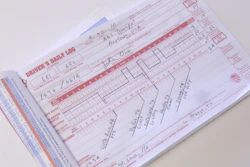
According to the ICRs submitted to the White House Office of Management and Budget (OMB), both tests will include data collection via pre- and post-study surveys, psychomotor vigilance task tests, subjective sleepiness ratings, a wrist actigraphy device, drivers' record of duty status (RODS), and a non-intrusive telematics device. Data obtained will provide information on drivers' schedules, the use of exemptions, fatigue, and driving performance.
Drivers who agree to participate in the studies will participate for 16 weeks, FMCSA said, and Barrs actively solicited truckers at TenFour D.C. to speak to agency team members on hand at the event about participating.
Eligibility is based on carrier and driver safety records. Carriers, including independent owner-operators, must meet the following criteria:
- Must have applicable interstate operating authority and registration
- Must have the minimum levels of financial responsibility under 49 CFR part 387, if applicable
- Must not be a high or moderate risk carrier
- Must not have an “Unsatisfactory” safety rating
- Must not have any FMCSA enforcement actions within the past 3 years
- Must not have a driver or vehicle out of service (OOS) rate above the national average
[Related: The 20-day clock on your authority application: How to manage, avoid Motus snags]
Participating motor carriers must also:
- Grant permission for drivers to participate
- Agree to comply with all pilot program procedures
- Grant permission for the Virginia Tech Transportation Institute to gather RODS information for each participating driver throughout the study duration
- Grant permission for drivers participating in the study to operate under the applicable exemption
Drivers' eligibility hinges on status in the Drug and Alcohol Clearinghouse. Drivers will be ineligible if they are ID'd there, regardless of whether they've completed the return-to-duty process, likewise if during the 2-year period immediately preceding the date of participation the driver had his or her license suspended, revoked, or canceled, or has been disqualified for a conviction of one of the disqualifying offenses listed in 49 CFR 383.51.
[Related: FMCSA stops short of saying 2020 HOS changes caused more crashes]
Additionally, participating drivers must:
- Possess a valid CDL
- Maintain a valid medical certificate from a healthcare professional on FMCSA’s National Registry of Certified Medical Examiners while participating in the pilot
- Be employed by a motor carrier who has been approved for participation in the pilot program and/or certify as an owner-operator
- Agree to the release of specific information to FMCSA for purposes of the pilot
- Agree to comply with all study procedures, including the use of actigraphs and RODS
Both ICRs are open for public comment through Dec. 7. The public is asked to comment on any aspect of the information collection, including:
- Whether the proposed collection is necessary for the performance of FMCSA's functions
- The accuracy of the estimated burden
- Ways for FMCSA to enhance the quality, usefulness, and clarity of the collected information
- Ways that the burden could be minimized without reducing the quality of the collected information
Comments on the split-sleeper ICR can be filed here, while comments on the clock-pause, split-duty ICR can be filed here.
[Related: Sleeper berth: Will truckers be able to split as they see fit?]