











The Federal Motor Carrier Safety Administration vowed action after a motor carrier confronted its investigators with firsthand evidence of electronic logging device fraud. A driver parked at police headquarters and had his hours reset on the spot.
In a statement after the meeting with Illinois State Police on Wednesday in Dekalb, Illinois, FMCSA vowed to hold fraudulent ELD makers accountable.
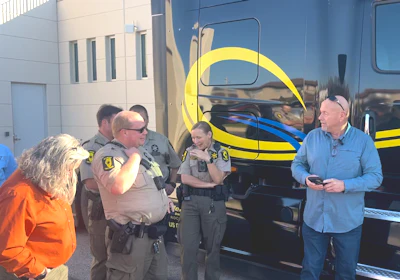
"I always figured if I was surrounded by state police, it would be for something different," said Meiborg Inc. driver Francis Buchanan as he waited on hold with a federally registered ELD provider.
On the phone, Buchanan was prompted to select English or Punjabi before giving an operator his company and truck numbers and asking for his hours reset. In about 10 minutes, his logs showed perfect compliance and a fresh set of hours. The entire episode was captured on video by Meiborg and FMCSA staff.
 The moment Meiborg driver Buchanan demonstrated his the ELD being reset after that quick call.
Education for enforcement, plea for help for carrier
For the state police gathered, the meeting provided an opportunity for education on how to better spot the new breed of ELD cheats that invent logs out of whole cloth to cover over violations nearly without a trace. But for Zach Meiborg, CEO of the Meiborg Companies, it was a cry for help.
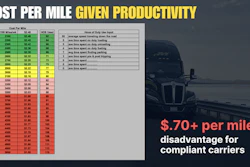
"A truck costs $200,000, a trailer is $50,000 to $100,000, a compliant English-speaking driver costs $100,000" a year all-in, said Meiborg. "It costs us $300,000 to send a truck down the road, and if I can only work it eight hours a day, then my cost-per-mile is tremendously higher than these guys overseas that are running guys 16, 18, 20 hours a day."
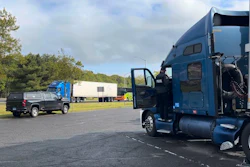
 Meiborg Inc.'s truck at the Dekalb Police Station in Dekalb, Illinois.
Meiborg's thesis, the reason he bought and runs a fraudulent ELD and brought it to police headquarters, is that hours cheating has broken the trucking industry.
"We’re getting our asses kicked by these guys because we simply can’t compete," Meiborg said.
[Related: How 1M ELD fraudsters broke trucking, and how to save it]
For the FMCSA investigators on-site, the episode represented "another example" of ELD fraud, hardly the first it had encountered.
In a statement after the meeting, FMCSA touted its recent actions on the ELD registry.
"FMCSA aggressively investigates and cracks down on fraud across every corner of the commercial motor vehicle industry including electronic logging device manipulation," a spokesperson for the agency said. "Deliberately manipulating hours-of-service records is a crime that endangers American lives."
Since January 2025, FMCSA has significantly accelerated enforcement, revoking more than 95 non-compliant ELDs from the federal registry for failing to meet minimum standards, and enhanced vetting implemented in 2025 has blocked 552 additional applications.
"FMCSA and our law enforcement partners will hold violators fully accountable," FMCSA's spokesperson said.
"The front door is locked, but the house is packed," Mieborg said of FMCSA's efforts to lock down the the ELD registry. As for the 900 or so registered ELDs, about two thirds of which some estimate allow tampering, "we need to get the bad guys out now."
[Related: 'White label' ELD cheater network uncovered in NMFTA research]
By Meiborg's estimate, fully one million trucks could be running fraudulent e-logs.
"Those one million trucks are running twice as much as compliant carriers, so they're really hauling two million trucks' worth of loads," he told police and FMCSA. "This is a real problem really affecting American-owned and -operated surface transportation companies."
As of April 1, 2026, the Commercial Vehicle Safety Alliance's Out-of-Service criteria includes a new ELD tampering violation as a separate OOS code, distinct from simply misusing personal conveyance or other false logs violations.
[Related: ELD tampering officially an out-of-service violation]
Illinois State Police doesn't really chart among top states for enforcing this kind of hours violation, but officers there said that's because the state records the violation differently.
Below find Overdrive's latest state-to-state accounting with sister Fusable company RigDig, charting just where inspectors are finding the new violation, recorded in these cases as the 395.8e-HOSPELDT violation as advised by the Commercial Vehicle Safety Alliance.
Note notable success ID'ing tampered ELDs in Oregon and Arizona as previously reported, while Alabama and a few other states have since intensified efforts to issue the violation.
Overall, the top states shown have led intensified volumes month-to-month since the violation code became available to state inspectors in April, reaching a high point in August, the month of the Brake Safety Week nationwide inspection blitz.
Several thousand different carriers' DOT numbers are represented in RigDig's accounting of federal data above, further illustrating the widespread extent of the issue.
Illinois said that despite recording zero tampering violations under the new code to date, "we're enforcing it," according to one of the officers on-hand with Meiborg. "The issue is above our pay grade, this is a federal issue, and we don't have authority to tow a truck."
ISP officers and Meiborg all acknowledged the reality that even in the rare case when one of manipulated-ELD operators is caught, a significant lift for roadside investigators, the driver mostly just needs to sit for 10 hours before they can drive again.
Despite the limitations, ISP officers on-site emphasized the need to get a read on the logs as soon as possible, advising other troopers to stay on top of drivers during stops. It can take just a few minutes for drivers to call into their fraudulent ELD's call center and get their hours reset, the troopers noted.
"With such a massive problem, the best thing I’ve come across is to stop the truck immediately, get out of the car as fast as possible," the officer said. "I would love to have discretion to tow a truck if the driver is doing something shady."
[Related: How troopers tackle remote ELD manipulation, 'chameleon' operations]
Zach Meiborg suggested tools like GenLogs or Flock cameras to produce photo records of a truck's whereabouts, then using that to spot ELD frauds. ISP officers brought up different legal hurdles for accessing this kind of commercial tech.
"I'm begging you guys for some old-school policing tactics," said Meiborg. "A little bit of that old-school policing and we can blow that scheme out of the water."
Meiborg noted police could call shippers to confirm details on a Bill of Lading to catch fakers in progress.  Meiborg briefs ISP and FMCSA investigators on ELD fraud.
An FMCSA investigator said they'd seen lots of talk from brokers promoting safety, but in practice, if FMCSA calls a broker and asks for info on a load, they rarely get what they're after.
"Brokers who want to see change [in the industry] are highly encouraged to cooperate" with investigators, the FMCSA employee said. "We should all be on the same team."
Awareness of 'chameleon carrier' density increasing
In the room at the Dekalb Police Station roughly an hour due West of O'Hare airport in Chicago, most everyone had an awareness of the Super Ego company and the dense network of "chameleon carriers" that operate out of the Chicago metro area. Those ISP officers belonged to Troop 3, which also covers Chicago.
"Chicago is loaded with a bunch of these foreign-owned and -operated" carriers, said Meiborg. "They move their compliance department overseas, their safety department overseas, their dispatchers overseas" to where they're mostly outside the reach of FMCSA and federal investigators.
Running double the hours to compliant carriers creates an unsustainable two-tiered transportation system, Meiborg stressed. "Shippers will pay an extra 10 cents to run with me because I have an English-speaking, compliant driver."
Yet 10 cents isn't cutting it. "They won't pay an extra dollar and 10 cents," he said.
Meiborg proposed to FMCSA a simplified HOS system that has only two lines, 14 hours on and 10 off, that he felt would reduce the competitive advantage of cheats, but FMCSA hasn't commented on that as yet.
Owner-operators Lee and Lisa Schmitt submitted a similar proposal to be bound by the 11-hour driving rule in any 24-hour period, split as they saw fit, not the 14-hour duty period (no other daily drive time limits) and 10 required off that Meiborg envisions.
The Schmitts' proposal was ultimately rejected by FMCSA.
After Buchanan and Meiborg's demonstration, officers returned to their duties and Buchanan continued on his way to Minnesota, down I-90 past thousands of trucking companies and truck yards full of white Volvos and red Freightliners that bear on the side-box doors and sleepers the rash of stickers and magnets replaced over and over again as trucking companies rifle through DOT numbers.
"Please know that these micro-infractions by foreign-owned and -operated entities are crushing us," said Meiborg in his plea. "Worse than that, they're killing people, and it's only going to get worse without enforcement action."
[Related: Beating the '24-hour logbook' competition, with a circle of trust]