











The White House's victory lap over shutting down CDL schools in a "historic interagency effort to crack down on fraud in trucking industry" has almost certainly taken some bad actors out of the game, but one school operator says he's had his rights trampled on after passing FMCSA's audit and getting shut down anyway.
Results from the crackdown so far seem mixed, to say the least.
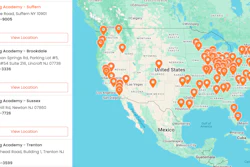
After the "whole of government" response on Monday saw 110 CDL schools shut down with "emergency" orders for graduating drivers who later failed English tests and 160 schools shut down for failing audits, almost all of the biggest CDL schools in the country got notices of proposed removal from the Federal Motor Carrier Safety Administration.
Overdrive also reached out to the schools that got shut down.
Many of them seemed well and truly closed. Websites that don't load anymore, phone numbers that no longer pick up, and emails unreturned. Sometimes it seemed likely the school wasn't on the level: Extensive use of AI images rather than real trucks, offers of incredibly quick or incredibly cheap courses ($25 at one online shop for the theory course).
(A full list of shut-down schools can be found here.)
But a few answered.
Yefim Shpatseman, owner of the Red Hook Commercial Driving School shut down by FMCSA on Monday, said the school was still open, just not doing Entry Level Driver Training.
"In New York state you can go to DMV and pass the permit test not in English, in Russian language this is possible," said Shpatseman, referring to the CDL knowledge test.
Shpatseman said he has "students coming in asking" for different languages regularly. "We teach in anything, Russian, English, whatever."
Another representative at Red Hook put it bluntly. "This is not English school."
As for the skills test, which must be conducted by DMV staff in New York, Shpatseman said "DMV inspector makes the decision" of whether or not to approve the student's CDL.
The Department of Homeland Security said on Monday it would investigate 1,000 DMV employees, motor carriers, and others in CDL businesses for corruption.
Another CDL school, Soler & Soler CDL School in Miami, Florida, detailed a shock removal from FMCSA's registry after the agency's audit report explicitly told them weeks earlier it needed to take no further action.
Here's what FMCSA told Soler & Soler on August 12:
"On July 16, 2026, the Federal Motor Carrier Safety Administration (FMCSA) initiated an investigation to evaluate SOLER & SOLER CDL SCHOOL CORP’s compliance with 49 CFR Part 380, Subparts F and/or G. Based on our findings, FMCSA has determined that SOLER & SOLER CDL SCHOOL CORP has taken the necessary steps to remain listed on the Training Provider Registry. As such, no further action is required at this time."
Yet on August 31, Soler & Soler was hit with a Notice of Emergency Removal. The notice demanded the school "cease all operations as a training provider" and included the following list of prohibited actions:
- Administer any of the training curricula set forth in 49 CFR Part 380, Subpart G, Appendices A through E (FMCSA's ELDT Curriculum), of the Federal Motor Carrier Safety Regulations (FMCSRs).
- Utilize any virtual, classroom, range, or public facilities or roadways to provide ELDT instruction of any kind on or utilizing FMCSA's ELDT Curriculum.
- Utilize any vehicles or equipment to conduct any ELDT behind-the-wheel (BTW) training.
- Utilize any training instructors employed by or on behalf of Soler & Soler CDL School Corp to conduct ELDT instruction.
- Issue certificate(s) of completion to individuals who have completed FMCSA's ELDT Curriculum administered by Soler & Soler CDL School Corp or on behalf of Soler & Soler CDL School Corp.
- Transmit any ELDT training certification records for any individual through the TPR website.
- Make any representations that Soler & Soler CDL School Corp is a training provider under FMCSA's ELDT regulations or hold yourself out as a training provider listed on the TPR.
- Enroll any new students on behalf of Soler & Soler CDL School.
But Florida allows third-party testing, and Soler & Soler said it would continue testing CDL applicants, and that the full slate of students already enrolled could complete the program.
Eli Soler Negrin, Vice President of Soler & Soler, pointed out that the August 31 Notice of Emergency Removal actually acknowledges ELDT training doesn't have to take place in English.
"While FMCSA’s regulations do not require that ELDT instructions be provided in English, the regulations do require training providers to provide theory instruction about ELP and require BTW driver-trainees to certify they will comply with the qualification standards, including ELP," the letter read.
Instead of breaking any specific rule, Soler & Soler got shut down because more than 10 graduates went on to get ELP violations. DOT and DHS said the emergency removals targeted 110 CDL schools associated with more than 5,000 drivers who later failed English language proficiency tests.
Negrin said FMCSA sent "a letter saying that from 2022 to 2025, 13 drivers inspected over-the-road by DOT were unable to communicate in English. What does that have to do with our school?" he asked. "They themselves said in the same letter there's no requirement for me to teach in English, and the [skills] test is conducted in English."
But how do students pass the CDL skills test, which requires communicating in English about the complicated operations of a CMV, if they can't later speak English?
"The test is conducted in English, but they're not supposed to do an essay to explain downshifting, they're just supposed to do it," said Negrin. "They'll be scored on speeding, turns, changing lanes" as long as the "student understand the commands."
A rail crossing probably represents the most English-heavy portion of the test. CDL students need to explain what they're doing every step of the way as they cross the tracks. Negrin said as long as they have those sentences memorized, there's no reason to fail a student.
"As long as they memorize that and I understand how you say it," Negrin said he'd pass the student.
Negrin gave as an example of the English a student would need: "Mr. Examiner, I want to make sure I stay in right lane. I have to stop at the railroad between 50 and 15 feet away, lower my windows, look for the train, proceed, I cannot change gears while crossing, I take off my flashers and then accelerate..."
Negrin isn't alone in finding the English requirements unclear and confusing. The Commercial Vehicle Safety Alliance in 2014 voted to remove English language proficiency from the Out-Of-Service Criteria because they found the regulations around ELP "vague" and "open to interpretation."
Harjinder Singh, the non-citizen driver who on August 12, 2025, attempted a brazen, illegal U-turn on the Florida turnpike and killed three, passed a Level II inspection in New Mexico weeks before the crash. Bodycam footage obtained by Overdrive shows him communicating with the police in limited English, but later federal authorities found him unable to pass the English test. In court, Singh would go on to use an interpreter.
Overdrive didn't find anything in 49 CFR Part 380 stating that trainers can't graduate students who go on to get ELP violations, and Negrin took issue with the arbitrary line drawn at 10.
"We graduate an average of 500 students per year," he said, and the students who failed ELP tests attended his school over a four-year period, meaning just roughly 0.65% of his students, or 13 out of 2,000, had an issue.
"If I was a restaurant and 13 of my 2,000 soups had a hair in them, there's no way that's a willingness put hair in soup," he said. "No way you can prove in any courtroom there’s willingness to not adhere to the regulations."
Negrin said that he can continue to test CDL students, which is the element that actually grants them CDLs, he just can't offer Entry Level Driver Training anymore, despite passing an FMCSA audit and FMCSA finding nothing wrong with his training.
Negrin said he's confident he'll get back on track with FMCSA and keep the business going, and that the FMCSA's system perversely incentivizes him now to be dishonest.
Though Negrin would have to go through the "whole process again" of becoming a third-party tester in Florida, there's "nothing" stopping him from simply registering a new training school and continuing business.
"Same owners, same violations, they're calling it 'chameleon' companies," he said.
But for now, Negrin plans to fight it and get the Soler & Soler name back in good standing.
"We need to keep accepting students," he said. "Business not going to survive without it, it's a mess, there's more than 10 families that rent above the school. The owner of the yard, the landscaper, mechanics -- a lot of people are feeding their families through Soler & Soler. This is a country of law, and we need to be proven guilty or not."