











The tech companies pushing the "driverless" revolution in trucking have been on a glide path under the second Trump administration, but a potential roadblock to full scale deployment remains: Reliance on U.S.-designated "Chinese Military Companies."
A new bill introduced in Congress, which the "driverless" companies have lobbied against, may signal that roadblock is here to stay.
[Related: 'Driver shortage' narrative returns just as 'driverless' rollout accelerates]
Hesai Group, "the global leader in lidar technology for automotive mobility," supplies critical components to the major U.S. driverless trucking companies, including Aurora, Kodiak, and Waabi.
But in 2024, the U.S. military identified Hesai as a Chinese Military Company in accordance with Section 1260H of the National Defense Authorization Act for Fiscal Year 2021, which will prohibit the Defense Department from contracting with Hesai in the future.
Furthermore, the Department of Commerce's Bureau of Industry and Security (BIS) made a final rule imposing controls on companies like Hesai providing parts in passenger connected vehicles under 10,001 pounds.
BIS's rule didn't apply to commercial vehicles, but the agency said it plans to.
"BIS recognizes the acute national security threat presented by foreign adversary involvement in the commercial vehicle supply chain and intends to issue a separate rulemaking addressing the technologies present in connected commercial vehicles -- including in trucks and buses -- in the near future," DOC said in a 2025 release.
Now, Senators Bernie Moreno (R-Ohio) and Elissa Slotkin (D-Michigan) have introduced the Connected Vehicle Security Act of 2026 "to defend the American auto industry from the existential threat of predatory Chinese automobiles by banning them and their connected components from the American market."
That bill, again targeting only passenger vehicles, would "ban the use of Chinese-developed connected vehicle technologies, such as software, and data systems on American roads."
Hesai has denied it's linked to the Chinese military, and has plans to expand in the U.S. in 2026 despite the pending legislation and mounting scrutiny.
Aurora and Kodiak confirmed that they do indeed depend on Hesai for lidar, a technology that uses pulses of lasers to judge 3D spaces, something absolutely critical for driverless trucking.
Both companies said they had taken steps to shield their data from Hesai, but they still use the technology.

"Kodiak uses Hesai LiDAR for its commercial applications," a spokesperson for Kodiak said. "Kodiak has designed its technology to prevent Hesai from accessing data from the sensors, as well as data produced by Kodiak’s autonomous system."
As for Aurora, the company said they have their own lidar, but still use Hesai's, too.
“Aurora shares Congress’s goal of protecting America’s roads and supply chains from foreign adversaries, and that commitment is built into how we design our technology," a spokesperson said.
While the company has developed some lidar in-house, Hesai's still makes it onto the truck.
"Our primary long-range lidar, FirstLight, is designed and built in Montana. We supplement it with off-the-shelf lidar from established suppliers," the Aurora spokesperson said. "Similar to other AV companies, our short-to-medium range lidar is from a China-based company. Those units have no independent software or internet access, and their data stays within Aurora’s system."
Virtually all "driverless" truck companies use some Chinese technology, and because it takes years to plan and build such a sophisticated truck, changing out a critical sensor like Hesai's lidar could represent a major setback.
"We don’t really have a choice, Hesai is the only company on the market that sells a lidar that has the performance that we need to safely operate the vehicle," a spokesperson for Kodiak said. "Sometimes [Hesai's lidar is] portrayed as the cheaper option, but there is not competing product that does what we need it to do."
Industry watchers find it likely that, at some point, the federal government will try to limit use of Chinese components in driverless trucking.
Yet that expectation first set in during the Biden administration years, and the industry has yet to find a suitable Hesai replacement or meaningfully design around it.
But as far as the U.S. Department of Transportation is concerned, the driverless crowd has had some regulatory fog clear.
DOT regularly describes driverless trucking as the future, and a race the U.S. must win against China.
DOT in July announced initiatives to possibly do away with steering, wiper, and brake pedal requirements to full-on sprint toward driverless trucking.
Other longtime regs hang-ups for driverless operation -- like trucks needing warning triangles deployed in the case of a breakdown -- are coming undone.
September saw DOT release a national strategy for automated vehicles, making clear the department anticipates the "transportation system will continue to include conventional manually driven vehicles, even as adoption of AVs increases.”
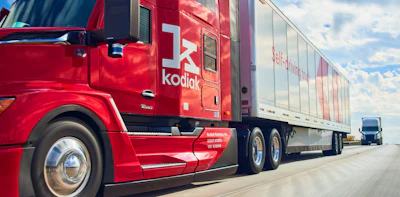
As of June 30, 2026, the Kodiak Driver was already integrated on 35 driverless trucks owned and operated Atlas Energy Solutions. In October, Kodiak said it had reached a 99% Autonomy Readiness Measure, meaning it was on the verge of introducing fully driverless service hauling for Ikea between Dallas and Houston. Kodiak hopes to have 100 trucks in operation by mid-2027.
A Kodiak truck recently ran for 64 days non-stop, without powering off or re-starting, during operations in the Permian Basin, the company said.
Aurora has more than 20 driverless trucks "already built and coming into the fleet," according to its last earnings update. Aurora hopes to have 1,000 driverless trucks running by the end of the decade.