











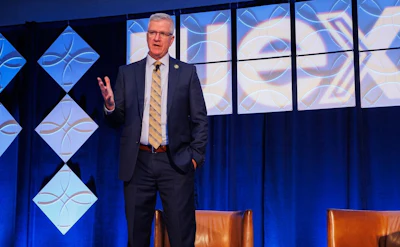
Trucking executives who convened at the Wex OTR Summit at the Marriott Sawgrass Golf Resort & Spa in Ponte Vedra Beach, Florida, this week heard an update from one of trucking’s top safety officials about what’s going on at the federal level in terms of regulations.
Steve Dowling, the Federal Motor Carrier Safety Administration’s Chief Safety Officer, talked about the Motus registration system’s ongoing tumultuous rollout, efforts at FMCSA to clean up various aspects of the industry, and a variety of other topics.
A former commercial motor vehicle law enforcement officer with the California Highway Patrol and a Senior Director of Safety at Covenant Logistics, Dowling brought with him to FMCSA knowledge from both the trucking side and the enforcement side of the regulatory landscape.
Regarding the Motus rollout, Dowling acknowledged that the system “has had its challenges,” as highlighted by numerous stories from small fleets, among others, about incorrectly suspended authorities, incorrect insurance filings and inexplicable lockouts.
According to data he looked at recently, Dowling said, 95% of carrier registrations occurring in Motus are working correctly. “If you’re part of that 5%, that’s still a challenge, right?” he said. “That’s not acceptable to us.”
However, Dowling highlighted that because of the implementation of Motus, “there are thousands of people that we’re keeping out of the industry” as a result of fraud-prevention systems in place.
“We are working on updates,” as well, he said. “We’re not far away from that, but there’s going to be more to come. I think you have to realize, though, that the purpose behind it, the intention, it’s working. It’s not working as well as we want it and as smoothly as we want it, but we’re getting there.”
FMCSA Administrator Derek Barrs saved his Motus comments for the very end of his keynote address following Overdrive's Small Fleet Champ awards in Nashville, Tennessee, Thursday at the National Association of Small Trucking Companies' conference, joking that he held off so long in the talk because, truly, he didn't want to talk about it.
"Motus," he said. "I think we may have to change the word," noting the agency he's helmed for only more than a year was "required by Congress 14 years ago" to create a new registration system. The can "had been kicked down the road and kicked down the road."
He noted the fundamental challenge of merging so many different silos of legacy data -- some dating as far back as the 1960s. Yet visibility into fraudulent actors attempting access has been such that, even with all the problems, Motus will "stop the people who are trying to get in," Barrs said. He noted "36 investigations based on the Motus system that would not have been started."
Many of those he described this way: "foreigners who used fake passports, using foreign funds," trying set up there. "This is the kind of garbage we have to root out." (Tune in Monday for parts of Barrs' address on Overdrive Radio.)
[Related: FMCSA's Motus mess improving, little by little? Weigh in]
Focus on training, ELDs
Dowling also highlighted FMCSA’s efforts to clean up truck driver training and electronic logging devices. Since December 2025, he said FMCSA has removed more than 10,000 CDL trainers from its Training Provider Registry, including the 110 schools in August whose removal have been questioned since.
“Now, when you look at the whole driver population, that’s a small dent, but it’s important to make sure that that focus is there,” Dowling said.
FMCSA has also been keenly focused on making sure only compliant ELDs are in operation, including the removal of more than 100 devices from the agency’s Registered Devices list since the beginning of 2025.
Additionally, Dowling said FMCSA has “prevented nearly 600 from making it onto the list entirely. …With hours-of-service rules, we want to know that they’re compliant. You can’t go in and edit logs by making a phone call. … Anytime we hear of that, we go investigate and take appropriate enforcement action.”
[Related: FMCSA will 'hold violators fully accountable' after ELD fraud scandal revealed]
Looking ahead
Dowling reiterated that FMCSA is also working on updates to enhance its Safety Measurement System, ongoing for a while now.
“It’s never simple when you’re applying it to an industry that’s dynamic, correct?” he said. “There are different factors within it, so we’re looking at how we can use that to better identify risk.”
Finally, Dowling said FMCSA will continue to work on stronger technology oversight -- “ELDs, vehicle technologies and safety systems,” he said. “More effective regulatory focus using research. Continued modernization and industry engagement in vetting carriers, and that is again about fraud prevention. That’s it.”
He also noted that the agency is moving forward with pilot programs to test out more hours-of-service flexibility for drivers.
"Regulators create guardrails, but it’s not to define how every business operates," Dowling said. "…Being in compliance with the rules, you can still be fatigued. So even though the rules may create some parameters and help improve it, it doesn’t mean you can’t have a fatigued driver. On the flip side, just because that’s what the rule is doesn’t mean we don’t need to look at it and see if there are other ways to accomplish it that work better with the industry and how you run your operations."
[Related: How 1 million ELD fraudsters broke the trucking industry, and how to save it]