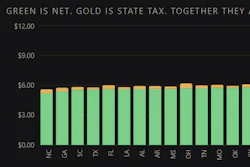












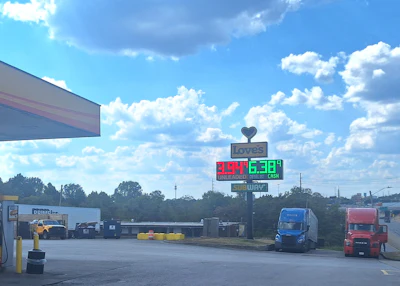
The U.S.’ national average price for a gallon of diesel fuel has for the first time ever crossed the $6 per gallon threshold.
The Energy Information Administration reported in its weekly update a national average of $6.29/gal. -- 31.8 cents higher than last week’s then-record high. Out West in California, the state’s average surpassed a whopping $8/gal.
Diesel's national average is now $2.55/gal. higher than the same week a year ago and $2.76/gal. higher than the same week two years ago.
[Related: How much will diesel go up tomorrow]
All regions across the country surpassed $6/gal, based on EIA’s numbers. The nation’s cheapest diesel is in the Gulf Coast region at $6.03/gal., and the most expensive is in California at $8.04. California is also the only state/region with an average above $7/gal.
Prices in other regions, according to EIA:
- New England -- $6.20
- Central Atlantic -- $6.31
- Lower Atlantic -- $6.10
- Midwest -- $6.25
- Rocky Mountain -- $6.07
- West Coast less California -- $6.57
[Related: 80 ways to maximize your truck's fuel efficiency]
How high will diesel go?
Matt Muenster, chief economist for Breakthrough, said the big surge in diesel pries this month has been “driven by a resurgence in disruption for the crude oil and diesel markets” -- largely a result of "the lack of progress toward more volume transiting the Strait of Hormuz," likewise additional crude oil production capacity impacted by attacks like those on "Saudi Arabia's East-West pipeline.”
Tom Kloza, chief oil analyst at Gulf Oil, said Tuesday there are still some states, primarily in the mid-continent and Gulf Coast, that remain below $6/gal. Yet by Wednesday or Thursday this week, it’s likely that “every state in the country will find prices averaging above $6/gal with some $7+ numbers in Washington and Hawaii with California probably assaulting $8.50/gal.”
“On February 27, the nationwide price of diesel was $3.77/gal., so we are looking at a 7-month increase on the order of $2.60/gal or about 70%,” Kloza noted.
WTI crude and Brent crude were both trading between $100 and $110 per barrel midday Eastern time Tuesday, but Kloza said he’s seeing “some international crudes fetch prices of around $130/barrel on global spot markets.”
Diesel, however, is outperforming crude “by a substantial margin” with retail prices putting diesel at around $219-$231/barrel, he added.
Kloza added that “U.S. refiners are running at close to capacity, and exports amount to more than 1.5 million barrels per day in the typical week.”
Diesel is “truly a world product and the rest of the world is struggling,” he said. Kloza estimated approximately 7 million barrels a day of processing is on the sidelines due to “drone damage in Russia, the Persian Gulf, and more recently the Red Sea.”
Breakthrough’s Muenster highlighted the U.S.’ strained inventories and record-high exports, “in part because Russian diesel exports have cratered because of damage to its energy infrastructure.” That demand, he said, “is likely to further draw inventories and continue price pressure.”
The problem diesel pricing runs into, though, is it’s unclear what price it would have to reach to “inspire demand destruction,” Kloza added.
“Diesel is used to fuel trucks and trains and boats and convey various goods across the continent,” he said. “It is used for agriculture and mining, and those enterprises will continue to run despite high prices. In a couple of months, we’ll see diesel molecules move into homes for heating, and that could inspire even greater advances” in pricing.
Kloza called the diesel market “untethered,” and said that the U.S., Europe and Asia “could see diesel prices of $8-$10/gallon before this is all over.”
Muenster expects prices to continue rising through at least mid-November.
In the near-term, a power outage Sunday, Sept. 13, at ExxonMobil’s Joliet, Illinois, refinery resulted in the 264,000-barrel-per-day refinery being taken offline for several hours, and normal service at the refinery is not expected to return until near the end of the week.
Muenster said this is likely to result in a spike in diesel prices around Chicago in the coming days, adding that “more regional volatility is likely given the intense stress the supply side of the market is under.”
[Related: Is a real diesel shortage brewing? FTR analysts assess risks]
Despite some rumblings suggesting the U.S. might halt diesel exports, Kloza said an outright export ban “isn’t likely.” In fact, just the mention of export restrictions “could frighten some of the speculative buyers out of the market” to soften export demand.
Kloza said U.S. inventories have never been lower for this time of year approaching heating fuel season. While diesel shortages aren’t guaranteed at this point, Kloza said “the regions to watch are New England, the Central Atlantic, and the Lower Atlantic,” further noting that “diesel stocks are fairly tight" all around the world.
Breakthrough’s Muenster said a shortage is not an immediate threat, but “unfortunately, nothing should be ruled out under current market conditions.”
Have spot rates responded to diesel’s surge?
Unfortunately for owner-operators working the load boards, not really. The dry van and reefer segments saw rates continue to trend upward seasonally during the week ending Sept. 11, but any gains were wiped out by diesel prices, FTR Transportation Intelligence and Truckstop.com reported.
Dry van rates increased 5.5 cents/mile during the week to a $2.77/mile average, which was 43% higher than in the same 2025 week.
Reefer rates saw their smallest gain in four weeks with a 2.7-cent increase to $3.63/mile.
Finally, flatbed spot rates fell 5.7 cents, which was still 29% higher than the same week a year ago -- the softest year-over-year comparison in 16 weeks, the firms reported.
DAT Freight & Analytics reported dry van rates down a penny from the prior week at $2.20/mile excluding fuel, while reefer rates fell about 2 cents to $2.71/mile during the week. Flatbed rates tumbled 5 cents to $2.62/mile in the DAT system.
DAT’s RateCast forecast projected rates holding flat at around $2.20/mile over the next 35 days into mid-October, with a 7-8-cent swing up or down possible, DAT’s Dean Croke noted. Similarly, reefer rates are projected at $2.65/mile within a range of about 6 cents either way. Finally, flatbed’s projected at $2.59/mile, also within about a 6-cent range, Croke said.
[Related: Owner-op revenues up, but where's income? Numbers are in]