











Gord Magill has been on fire lately. His book, “End of the Road: Inside the War on Truckers,” published by Creed and Culture, garnered the Canadian-born former steel hauler interviews with C-Span, Tucker Carlson and The Free Press.
He even recently lectured at Cornell University.
In "End of the Road," Magill describes a kind of technocratic takeover of the industry he grew up loving, pushing longtime truckers out.
In today's trucking, he writes, drivers fear surveillance while they sleep, poorly trained operators recently arrived to North America are dispatched over treacherous winter terrain with fatal consequences, and truckers are denied fundamental human needs by “spreadsheet brained” office staff.
Some of the story he tells will be readily familiar to Overdrive readers -- he cites Overdrive's work several times. (Editor's note: And since Long HauI Paul first wrote about Magill five years back, the pair have become friends; Magill actually calls LHP one in the book itself.)
Magill calls for a graduated licensing system similar to the Australian model, where driving privileges are issued in tiers beginning with cars, progressing to straight trucks, then semis, then multi-trailer road trains.
He cites the example of the Humboldt Tragedy in Canada, in which a driver named Jaskirat Singh Sidhu, with a mere one month’s trucking experience, ran a Super B train through a stop sign and plowed into a bus carrying the Humboldt Broncos hockey team, killing 16 and injuring 13 others. Magill cites published interviews with other poorly trained immigrant truck drivers who reported “feeling terrified [they] would lose control on an icy highway and kill someone.”
[Related: Will it take a disaster to truly fix driver training?]
Another troubling account in Magiil’s dystopian vision of our industry’s current state is that of a female driver, whose goes by the TikTok handle Original Trucking Barbie 2.0 and worries that the driver-facing camera in her truck never stops surveilling her.
I heard I am being targeted, that they’re watching me super close. That makes me feel violated. I know that the camera is on even when I’m in the sleeper. … They’re watching me while I’m undressing.
Having never been tethered to a driver-facing camera myself, I wondered whether this was even a thing. Doesn’t the filming cease once you’re off duty? I reached out to the folks at our own outward facing camera provider, Netradyne, for clarification.
Crickets.
The fear of in-cab surveillance certainly is a thing, according to Desiree Wood of Real Women in Trucking. “She basically needs to understand she's a free Only Fans model for office voyeurism” if off-duty observation is in fact occurring, Wood said. “That is unfortunately a thing people don't understand. You are in a fishbowl and you have to always remember to hide. That's no way to live. It makes you paranoid.”
Magill underscores the point in "End of the Road."
This follows a pattern of drivers feeling like they’re being watched no matter what they do, especially female truckers. A 2023 report [from the American Transportation Research Institute] notes: “Females rated the technology’s ability to protect their privacy 24% lower than male drivers. Some female drivers complained they have experienced ‘voyeurism, unwanted comments about their appearance, and even sexual harassment from employees tasked with reviewing DFC footage.’” [emphasis Magill’s]
I’m in full favor of outward-facing cameras -- in the vast majority of on-highway incidents, they will exonerate a good driver. Surely no one who creates policy around the use of surveillance-capable technology could be OK with this kind of voyeurism, right?
Doesn’t mean it can't happen.
For Magill, perhaps the most egregious development within our state of surveillance came from his own experience, and would ultimately drive him away from OTR hauling altogether.
[Related: 'Stop Netradyning me!' Can an app and a camera make you a better driver?]
'Road scholar' early years
How does a third-generation steel hauler with no formal education beyond a high school diploma wind up as a guest lecturer at an Ivy League university?
(I mean, a steel hauler! Back in the 1980s, in my early days with Builders Transport, I was warned to avoid a certain truck stop near Gary, Indiana, at all costs. It was patronized almost exclusively by steel haulers. “There’s two or three fights a day at that place,” an older hand told me. A trucker joke from that era: How can you tell if a steel hauler’s been eating chicken? Answer: The tips of his fingers are clean.) .
 The book's available in audiobook via Audible at this link.
He earned some early trucking chops as a shop hand for the Hamilton, Ontario, fleet Earl Paddock. After his parents' divorce, he would end up supporting his disabled mother through high school while working for the flatbed outfit.
The Paddocks became a second family for young Gord. They gave him a trade he came to love, providing a means of sustenance and decency during a difficult adolescence. Often working past midnight, he recalls in the book how making it to school on time was a struggle.
“I loved every minute" working for the Paddocks, he wrote in the book, "even the nights when I worked until midnight or later and then had to drag my tired ass into school the next day, usually tardily. The secretaries and vice principal of my high school often expressed concern about my late arrivals, Tim Horton’s coffee in hand. In a moment of frustration I once asked them, ‘My mom doesn’t work and we have no money, so what else do you want me to do?’ This would be the first of many instances when the tension between certain classes would be revealed to me, in spite of the pretense we live in a classless society.”
The recognition of class, and his own place on the continuum, informed the way he saw his position in the world for years to come.
 "End of the Road" is dedicated to the memory of Marty Paddock, whose family even loaned Magill a truck to take to his high-school graduation.
Later, Magill (CB handle: Gordo) got "post-secondary education" as a proverbial Road Scholar, leaving steel to pull road trains on the dirt roads of Australia, hauling logs out of the timber camps of New Zealand, and running the ice roads in the Northern Territories of his native homeland. He credits the Paddocks for always taking him back after his globetrotting junkets.
But make no mistake about it, Magill's ability to interrogate the wider issues in trucking is no fluke, and could be inspiration to any working stiff out there who was ever told by their 8th-grade teacher they could write. If you have something to say and can say it well, it makes no difference whether you attended a prestigious college or not.
In Magill’s case, being an outsider from a working class background, a veritable “anachronism” as he describes himself, only makes him more interesting.
[Related: Faces of the Road: Gord Magill, log hauler and student of the ice roads]
The Blandford incident: Toward Magill's last ride
The metamorphosis of Gord Magill trucker to Gord Magill author and commentator can be traced back to a single galvanizing incident.
Magill was working what was supposed to be a Monday-Friday gig for a tanker company out of Syracuse, New York, who had transitioned to electronic logging devices. It was the very first time he’d ever been tethered to an ELD. Trucking being trucking, they sent him out on a later load than normal one Friday. It was going to delay his return home to his wife, Jenna, until the wee hours.
As he recounts in "End of the Road": “I’d be getting home around one in the morning, long after my wife would have gone to bed, having spent a Friday night without me, and me without her.”
He woke up at 2 p.m. along the Mass Pike at the Blandford Service Plaza after sleeping around six hours. Magill was ready to go home: “I looked at my ELD. I had nearly four hours until I would be allowed to put the truck in gear and head to Syracuse.”
Anyone reading this who lived through the transition to e-logs knows what this feels like.
“Sitting in that parking lot choking down Starbucks sludge, I got to pondering,” he wrote. “I had nearly 20 years of trucking experience under my belt and had never been involved in a collision nor hurt anyone nor wrecked a truck, but due to the whims of safety bureaucrats ... I was being denied my agency.”
So longtime steel hauler, world traveler, incurable romantic Magill fired ‘er up and put ‘er in gear.
Texts from headquarters came quick. He ignored them; then the inevitable phone call.
“Mr. Magill, what do you think you are doing?”
“Going home. It’s Friday.”
There were a few more volleys, but it was over.
“Clean your truck out when you get back. We can’t take risks like this.”
Notwithstanding the recklessness of canning an OTR driver over the phone while he's negotiating traffic, the interaction with what he eventually would come to call the “spreadsheet brained management class” would effectively change the trajectory of his life.
He described the turning point this way to me via text message: “Yes, that incident in Blandford, and being the only job I’ve ever been fired from, certainly was an inflection point for me, and I’ve not been in a truck with an ELD ever since."
He has, furthermore, "no plans on getting behind the wheel of any such equipped unit. It’s not happening," he said.
[Related: ELD mandate and crashes: Cause or correlation? Owner-ops weigh safety, training, more]
Instead, he began taking what local work he could find, work that didn’t require electronic logs. He began hauling actual logs while Jenna continued a career as an elementary school teacher, a story told in part in this 2022 installment of my "Faces of the Road" series.
 Gord and Jenna at MATS earlier this year.
He ran propane for a couple winters, then something happened. Magill, who'd always been a voracious reader, began to write about what was happening to the industry from which he was now exiled -- an industry which had essentially saved him all those years ago. His work appeared in places like Newsweek, The Blaze, Compact, American Conservative.
Having been privy to a couple chapters of “End of the Road” prior to publication, and well knowing Gord Magill, I fully expected to excoriate the former steel hauler for his brawling ways. But the book turned out to be a measured piece of work in large part.
It won the endorsement of folks like Lewie Pugh of the Owner-Operator Independent Drivers Association, and I'd put it alongside somewhat recent books like Karen Levy’s “Data Driven” or Anne Balay’s “Semi Queer.”
Yet there are moments when Magill's passion can obscure his capacity for nuance.
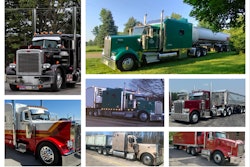
An example: His excoriation of the the aerodynamic trucks that "contribute to the ugliness that pollutes the collective aesthetics of our roadways."
For this gearjammer, all the emphasis on classic truck designs comes from someone who has never stared down the barrel of a five-figure fuel bill. That just isn’t a hill I would die on.
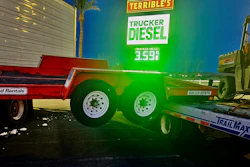
Having been the sole breadwinner of a family of six while making payments on a 5.2-mile-per-gallon Peterbilt 359, I'd invite Mr. Magill or any other diesel aesthete out there who finds fault with the visual polluters’ equipment to go out and purchase a pressed-out early-90’s-era extended hood 379 with an Eaton thirteen over, a 3406B Caterpillar, and 3:55 rears and go support a family on seven-dollar diesel.
There is a certain rage-chic among truckers -- a tacit mandate to loathe automatic transmissions and plastic trucks as a means of establishing old-school chops. After 4 million miles out here, I’m grateful for my own little automatic. I don’t feel particularly de-skilled using it.
I hope to never be assigned to a manual again.
That said, Magill is quick to point out it’s nothing personal. “I have no personal animus towards anyone who buys a plastic [truck] or anyone forced to drive one. My beef is with the government as always. This is not some quixotic disparagement of the equipment but about seeing foundational problems embodied in design mandates.”
[Related: EPA set to roll back key cog in greenhouse gas emissions regs machine]
I will say here that Gord Magill is a friend. Over the years, he's been to several of my shows, even brought a tent to attend one of them in upstate New York in the Fall, when it was forecast to be 40 degrees at night. We ultimately offered him the extra bed that was in our assigned cabin.
I feel like he’s a good guy -- highly ambitious and talented as a writer. To his credit, Gord is a very kind person to people from all political persuasions.
But I do see a fault line in the notion in "End of the Road" that those of us who drive the plastic trucks are de-skilled “lumpenproletariat,” Karl Marx's term for the dregs of the workforce.
[Related: Close look: How Trucker of the Year hits 10.5 mpg with '19 Freightliner mods, operations]
There’s been some vigorous discussion among us as to whether Magill’s refusal to sit those remaining four hours of his 10 that infamous Friday afternoon was simply an act of petulance, or if the act of defiance embodied that of a wider constituency of drivers.
My ultimate take on it? He was simply a man in love. As Bob Dylan once observed, “You can never be wise and in love at the same time.”
Still, his story should give regulators pause, over what it means when someone who once loved the OTR trade has no plans to ever get behind the wheel of an ELD-equipped truck again.
More about"End of the Road" via its publisher's website at this link.