










Trucking news and briefs for Wednesday, Nov. 4, 2026:
- Dates set for 2027 Roadcheck, Brake Safety Week, more.
- Hauling through Oregon? Nighttime detours ahead.
- More driverless trucks headed to the Texas oil patch.
- FMCSA advancing study into truck crash causes.
CVSA sets dates for 2027 inspection blitzes
The Commercial Vehicle Safety Alliance’s planned inspection and enforcement initiatives are complete for 2026, but inspectors are already looking ahead to 2027, setting dates for its major events.
Each year, CVSA conducts its 72-hour International Roadcheck inspection blitz, the week-long Brake Safety Week, Operation Safe Driver Week, and a Human Trafficking Awareness Initiative on scheduled dates. Other initiatives, like Brake Safety Day and a week-long hazardous materials-focused effort, aren’t publicly announced before they take place.
For 2027, dates for the scheduled initiatives are:
- Human Trafficking Awareness Initiative -- U.S., Jan. 11-15; Canada, Feb. 22-26; and Mexico, March 15-19
- Brake Safety Week -- April 18-24, a significant shift from its typical late-August timeframe
- International Roadcheck -- May 11-13
- Operation Safe Driver Week -- July 11-17
[Related: Brakes, tires, no medical card among top Roadcheck violations]
I-5 closures planned in Portland area this week and next
Truck drivers hauling through the Portland, Oregon, metro area over the next two weeks should plan ahead for nighttime detours as Oregon Department of Transportation crews replace three variable message signs.
ODOT said the work is to replace and upgrade equipment that’s “beyond its service life” in the area. The closure schedule is as follows:
- SB I-5 in Tigard, 1-4 a.m. Monday and Tuesday, Nov. 9-10
- NB I-5 in North Portland, 1-4 a.m. Wednesday and Thursday, Nov. 11-12
- NB I-5 in Wilsonville, 1-4 a.m. Thursday and Friday, Nov. 19-20
Signed detours will be in place during each closure.
Improvements during the work include replacing variable message signs, improving sign structures, and restriping.
For the SB I-5 closure in Tigard, all lanes will be closed between Southwest Carman Drive and Southwest Boones Ferry Road from 1-4 a.m. Nov. 9 and 10. The Southwest Carman Drive on-ramp to SB I-5 will also close during this time. A signed detour will direct drivers to take the Southwest Carman Drive, Exit 291, and follow Southwest 72nd Avenue south to Boones Ferry Road to re-connect with SB I-5.
The North Portland closure will impact all NB lanes of I-5 between North Lombard Street and North Marine Drive from 1-4 a.m. for Nov. 11 and 12. The North Whitaker Road/North Victory Boulevard on-ramp to NB I-5 will also close during this time. A signed detour will direct drivers to take the EB North Lombard Street, Exit 305A, and follow 99E north to re-connect with I-5 near North Marine Drive.
Finally, for the NB I-5 closure in Wilsonville, all lanes of NB I-5 between Southwest Wilsonville Road and Southwest Elligsen Road will fully close from 1-4 a.m. Thursday and Friday, Nov. 19 and 20. The Southwest Wilsonville Road on-ramp to NB I-5 will also close during this time. A signed detour will direct drivers to take the Southwest Wilsonville Road, Exit 283, and follow Southwest Parkway Avenue north to Southwest Elligsen Road to re-connect with I-5.
Kodiak delivers first autonomous Western Star 49X trucks to Texas oilfields
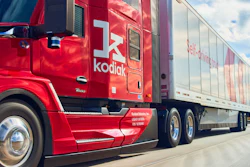
Kodiak AI this week announced it delivered the first two Western Star 49X trucks equipped with the Kodiak Driver autonomous system to Atlas Energy Solutions in September.
The two trucks build on the companies’ collaboration in the Permian Basin and are the first of 65 Western Star 49X trucks that Kodiak will deliver to fulfill Atlas’s initial order of 100 Kodiak-equipped driverless trucks. Kodiak is on track to complete that order in the first half of 2027.
The two new additions bring Atlas’s overall owned-and-operated fleet to 37 driverless trucks. The trucks operate with no human in the cab and, as of June 30, had surpassed 40,000 hours of cumulative driverless service.
Atlas’s Western Star trucks represent the first vehicles equipped with Kodiak’s seventh-generation (Gen7) hardware platform and are also the first day-cab autonomous trucks deployed into commercial service.
[Related: Driverless trucking in 'first innings,' but fears rise of a blowout game]
Kodiak’s Gen7 system has a more compact design that simplifies integration and supports a broader range of vehicle configurations. It provides nearly 50% more compute power than the Gen6 system. Kodiak said stress testing indicates that Gen7 SensorPods and compute enclosures are expected to have nearly 50% greater operational lifetimes than those of prior generations.
“Uptime is everything in our operation, so reliability and performance are what we look for in every truck,” said John Turner, CEO and President of Atlas Energy Solutions. “With driver shortages constraining the industry’s ability to deliver, our growing fleet of autonomous vehicles, powered by Kodiak’s seventh-generation hardware, gives Atlas a real advantage in serving Permian oil and gas producers. We expect the Western Stars to help us deliver proppant predictably as we add the remainder of the trucks in our initial 100 truck order through mid-2027.”
Kodiak added that its Gen6 platform already achieved notable results, including a driverless truck equipped with the Kodiak Driver operating a record 64 consecutive days of continuous uptime, never powering off or restarting, between June 30 and Sept. 1.
[Related: 'Driverless' trucking depends on lidar from 'Chinese Military Company' Hesai]
FMCSA moving forward with Crash Causal Factors study
The Federal Motor Carrier Safety Administration announced Tuesday it will award up to $7 million in total funding to support data collection for the Crash Causal Factors Program (CCFP) Heavy-Duty Truck Study.
The study will examine fatal crashes involving heavy-duty trucks to better understand the factors contributing to these crashes.
FMCSA’s announcement opens the application period to eligible state and local law enforcement agencies for the CCFP Cooperative Agreement Program. No single grant award will exceed $500,000. This will be the only funding opportunity that will be offered in support of the study, and awards are intended to support the duration of the data collection period.
Funding may be used for activities and equipment that directly support data collection on qualifying crashes within the study’s sampling locations, including:
- Post-crash commercial motor vehicle (CMV) inspections
- Crash reconstructions
- Post-crash investigations
- Crash data reporting
- Equipment needed for data collection
The CCFP is part of the U.S. Department of Transportation’s and FMCSA’s effort to reduce roadway fatalities involving CMVs and aims to strengthen the scientific understanding of CMV-involved crashes through a series of peer-reviewed studies, a national crash data repository, and ongoing analysis. The findings and anonymized data will help government agencies, state and local partners, researchers, safety advocacy groups and other stakeholders improve safety programs and develop effective crash countermeasures.
[Related: Large truck fatal crashes: FMCSA to study contributing factors]